
AR, Billing & Collections
Late Payments Are Becoming a Financing Problem for Suppliers, Not Just a Collections Problem
Atradius’s 2026 payment data shows trade credit expanding as bank finance tightens, while late payments affect nearly four in five Western European businesses. AR teams are increasingly managing a transfer of working-capital risk from buyers to suppliers.
For AR Leader · AR Specialist · Controller · Treasurer · CFO
Level All Levels

A late invoice is usually described as an accounts-receivable problem.
In 2026, it increasingly looks like a financing problem.
Atradius’s latest Payment Practices Barometer for Western Europe finds that around 52% of B2B sales now take place on credit. Nearly four in five companies report customers paying invoices late, and about one quarter of invoices are paid after their due date.
The mechanism matters.
As bank finance becomes harder or more expensive to obtain, buyers lean more heavily on suppliers for payment terms. Trade credit keeps commerce moving, but the financing risk does not disappear. It moves onto the supplier’s balance sheet.
The AR team then becomes the operational front line of a working-capital transfer.
That changes how finance should think about collections.
The objective is not simply to send more reminders. It is to decide which customers deserve credit, how much liquidity the company can afford to provide and when a commercial relationship is consuming too much balance-sheet capacity.
Trade credit is filling a financing gap
Trade credit is economically simple: the supplier delivers now and gets paid later.
When credit is abundant, those terms can support sales without attracting much attention from the CFO. When liquidity tightens, the same receivable becomes a financing asset funded by the seller.
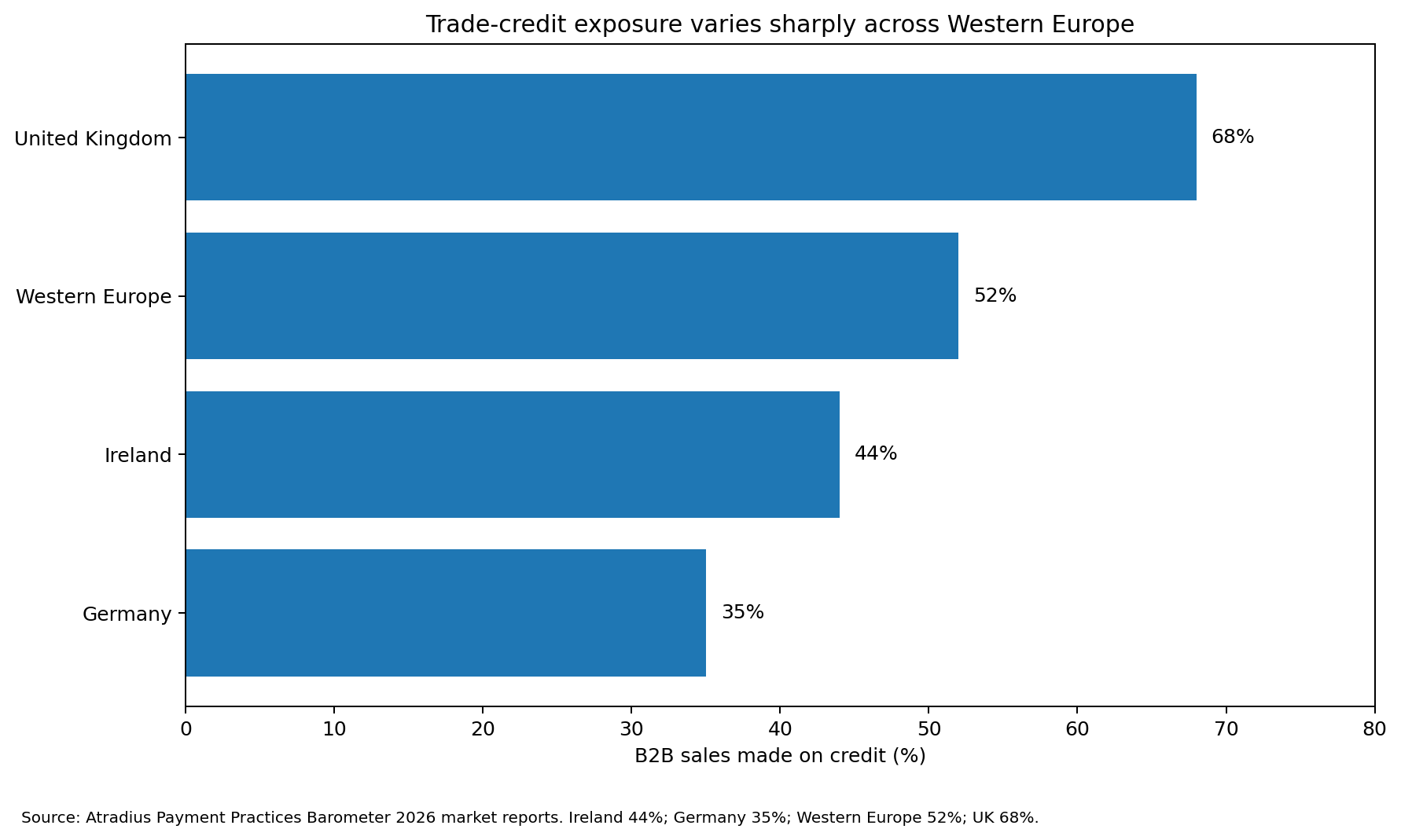
Atradius says restricted access to bank finance is contributing to greater reliance on trade credit across Western Europe. Around 52% of B2B transactions are now made on credit.
The Netherlands sits at the high end, with nearly three quarters of B2B sales on deferred terms. Germany is at the other extreme: only 35% of B2B sales are made on credit, reflecting a more cautious supplier stance.
The UK is notably more credit-intensive than the regional average. Atradius reports around 68% of UK B2B sales are made on credit—16 percentage points above the Western European benchmark.
Those differences are not merely payment-culture trivia.
They describe different levels of supplier balance-sheet exposure.
Late payment locks cash inside revenue
Revenue can look healthy while cash conversion deteriorates underneath it.
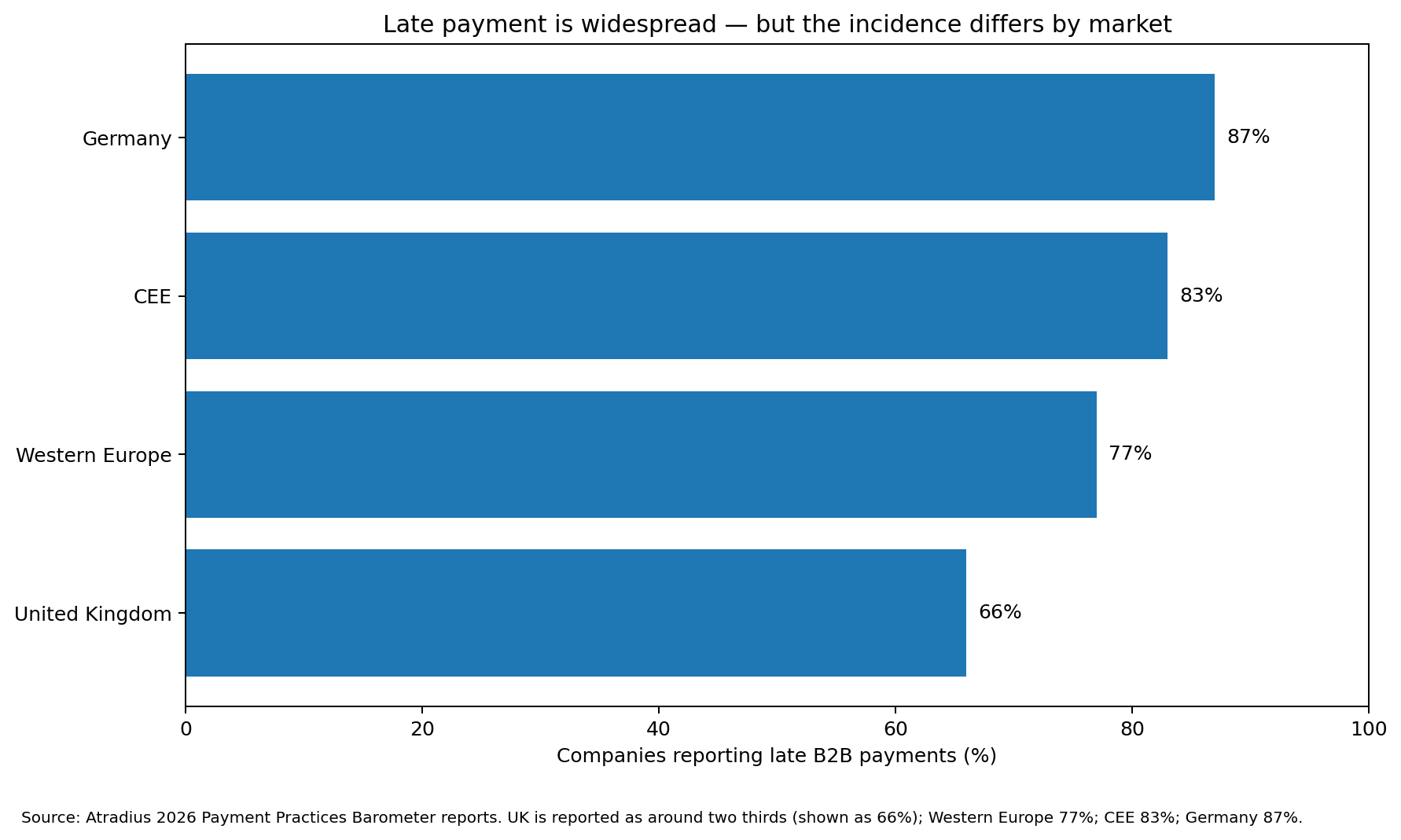
Across Western Europe, Atradius says nearly four in five businesses experience late B2B payments. Regionally, about a quarter of invoices are paid after the due date.
Germany looks particularly strained: 87% of companies report B2B payment delays, compared with 77% across Western Europe. In the UK, around two thirds of businesses report delayed payments, affecting about 25% of invoiced B2B turnover.
Central and Eastern Europe shows a similar pattern. Atradius reported in June that late payments affect 83% of suppliers and nearly one in three invoices is overdue.
The percentages differ by market, but the finance effect is the same.
A sale has been recognized. The cash has not arrived. The supplier still has payroll, inventory, tax and its own vendors to fund.
“The receivable is effectively financing the customer.”
Liquidity pressure is now the dominant explanation
Collections teams often segment late payers by behavior: administrative delay, disputed invoice, broken process, deliberate stretching or genuine inability to pay.
The 2026 data puts liquidity at the center.
Atradius says more than half of Western European businesses identify customer liquidity pressure as the main reason for late payment. In Central and Eastern Europe, around six in ten companies cite customer liquidity pressure.
That distinction should affect collections strategy.
A customer that forgot an invoice needs a reminder.
A customer that cannot fund the invoice needs a credit decision.
Repeatedly sending automated dunning messages to a structurally stressed buyer may create activity without changing the cash outcome.
AR therefore needs better connection to credit management, sales and treasury.
DSO is an outcome, not a diagnosis
Days sales outstanding remains one of the most useful AR measures because it translates receivables into time.
But a rising DSO does not explain why cash is late.
It can reflect looser payment terms, worse customer mix, invoice errors, disputes, weak collection execution, seasonality or deteriorating customer liquidity.
The distinction matters because each problem requires a different intervention.
If invoice disputes are driving delay, fix billing quality.
If customers are paying exactly to newly extended terms, the issue is commercial policy.
If financially stressed customers are repeatedly missing agreed dates, credit limits and exposure need attention.
If collectors are contacting low-risk customers while large balances age unnoticed, prioritization is broken.
The strongest AR teams use DSO as a trigger for investigation rather than a verdict on collections performance.
One Europe, very different receivables profiles
The regional averages conceal important differences.
Germany combines relatively low use of trade credit with very high incidence of reported payment delays. The UK extends much more B2B credit but reports late-payment incidence below the Western European average. Ireland is more benign: Atradius says overdue levels have been easing and overdue invoices are typically resolved within the first month after due date, keeping DSO broadly aligned with agreed terms.
That is a reminder that credit exposure and collection quality are not the same variable.
A company entering a new market should not simply copy its global payment terms.
Local financing conditions, insolvency risk, customer behavior and competitive practice matter.
AR policy should reflect them.
The collections queue should become a capital-allocation queue
Most collections systems prioritize invoices using combinations of amount, age and due date.
That is useful, but incomplete.
If trade credit is a form of customer financing, the collections queue should also consider exposure and risk.
A $100,000 invoice five days late from a highly liquid strategic customer is different from a $100,000 invoice five days late from a customer whose payment behavior has deteriorated for three months and whose total exposure is already above policy.
The second account may deserve earlier human attention even though the invoices look identical in an aging report.
This is where predictive collections and credit data can create value: not by generating a nicer reminder email, but by helping finance identify where the next dollar of collection effort protects the most cash.
Sales incentives can work against cash
Trade credit exists partly because it helps companies sell.
That creates an internal tension.
Sales may want longer terms to close a deal. Procurement at the customer may ask for 60 or 90 days. AR carries the resulting receivable. Treasury funds the gap.
If those functions are measured separately, the company can celebrate a revenue win while quietly increasing working-capital consumption.
Finance should make the cost visible.
A commercial approval for extended terms should show the incremental receivable balance, expected cash delay and customer credit exposure. Large deviations from standard terms should have an explicit owner.
The purpose is not to prevent sales from using terms strategically.
“It is to stop payment terms from becoming free money in the negotiation.”
Collections automation needs a risk model behind it
AI and automation are rapidly entering AR.
They can prioritize accounts, generate outreach, summarize disputes, predict payment timing and recommend next actions.
Those tools are most useful when the underlying objective is clear.
If the goal is simply “contact every overdue customer faster,” automation can create more messages without improving cash.
If the goal is “reduce economically risky receivables while protecting good customer relationships,” the system needs richer inputs: exposure, payment history, disputes, promises to pay, customer risk, strategic importance and available credit.
Automation should change the sequence of attention, not merely the volume of outreach.
The CFO should treat receivables as an investment portfolio
A receivables ledger is not usually described as a portfolio.
Economically, it behaves like one.
The company has extended different amounts of unsecured short-term credit to different counterparties, on different terms, with different probabilities of timely repayment.
That portfolio consumes capital.
In a period when buyers are using trade credit to compensate for tighter financing, the supplier should become more deliberate about the return it expects for taking that risk.
Sometimes the return is commercial: a larger order, a strategic customer, higher margin or better retention.
Sometimes the credit is simply inherited from industry convention.
Those should not be treated the same.
Collections is moving closer to treasury
The 2026 payment data points to a broader organizational change.
AR has traditionally been measured as an operating process: invoice, chase, collect.
But when late payment becomes a widespread liquidity phenomenon, collections starts to affect cash forecasting, financing needs and risk appetite directly.
Treasury needs realistic collection timing. Credit needs early evidence of deterioration. Sales needs to understand the cost of terms. AR sits where those signals meet.
That makes collections a working-capital discipline, not merely a back-office follow-up function.
The invoice may belong to AR.
The liquidity risk belongs to the CFO.
Key takeaways
- For AR and collections leaders
- Prioritize by exposure and risk, not only amount and age — identical invoices from different counterparties carry different cash consequences.
- For credit and finance business partners
- Treat liquidity-driven delay as a credit decision rather than a dunning problem, and show the working-capital cost of extended terms at commercial approval.
- For CFOs and treasury
- Manage the receivables ledger as a portfolio of unsecured short-term credit, with an expected return for the risk being carried.
Sources & further reading
- AtradiusB2B payment practices trends in Western Europe 2026May 20, 2026
- AtradiusB2B payment practices trends in Germany 2026May 27, 2026
- AtradiusB2B payment practices trends in the UK 2026June 3, 2026
- AtradiusB2B payment practices trends in Ireland 2026June 15, 2026
- Atradius83% of CEE suppliers are affected by late paymentsJune 11, 2026
All quantitative claims trace to 2026 Atradius Payment Practices Barometer publications; the UK late-payment figure is reported as “around two thirds” and shown as 66% in the chart. The interpretation that trade credit transfers working-capital risk to suppliers is editorial economic analysis, not a survey finding. No information published after September 6, 2026 is used and no quotes are invented.
- For
- AR Leader · AR Specialist · Controller · Treasurer · CFO
- Level
- All Levels

About the author
Alex MartinezFinance Operations Correspondent
Alex covers the operational side of finance, from supplier invoices and procurement to billing, collections and cash application, with a focus on automation and better financial workflows.
The Finance Observer content is for informational purposes only and is not professional financial, tax, legal or investment advice.
Related reading

Stripe Bought Metronome. The Bigger Bet Is That AI Will Break Traditional Billing.
When the bill depends on tokens, API calls, credits and commitments, invoice accuracy starts inside the product. Stripe’s Metronome deal turns billing into an architecture question for AR.

Usage-Based Pricing Is Turning Billing Into Finance Infrastructure.
Stripe’s 2025 usage-based billing work shows metering, pricing logic and invoicing converging into one finance-grade pipeline — with revenue operations and billing architecture landing on AR’s desk.

Credit Teams Are Digitizing Faster Than Their Approval Inputs.
Credit evaluation is going digital and AI-assisted, but the inputs that gate approvals — bank and trade references — still arrive at manual speed.
Related across formats
Curated video and audio that share this article's finance topics.
CFO Weekly
Editor's PickThe Rise of AI-Driven Finance Teams
A forward-looking discussion on AI agents transforming accounts receivable, the shift from finance operators to finance architects, “headless finance,” and what the CFO function could look like in the next three to five years.