
AR, Billing & Collections · AI & Automation
Stripe Bought Metronome. The Bigger Bet Is That AI Will Break Traditional Billing.
Stripe’s January acquisition of usage-billing specialist Metronome is less about adding another invoicing feature than rebuilding the monetization layer for software whose consumption can change by the second. For finance teams, that shifts billing closer to product telemetry—and raises the control bar.
For AR Leader · Controller · Finance Operations · Finance Systems · CFO
Level All Levels

For most of the software industry, billing used to start after the commercial decision was already made.
A customer bought a seat, a subscription tier or a fixed contract. Finance generated the invoice. Accounts receivable collected it.
AI products are making that sequence less stable.
When the bill depends on tokens, API calls, compute, credits, model choice, committed consumption, overages or several of those at once, the invoice is no longer simply a document produced at month-end. It is the output of a data system that has to observe product usage, interpret commercial terms and turn billions of events into defensible revenue.
That is the context for Stripe’s acquisition of Metronome, completed January 14.
Metronome specializes in usage-based billing. Stripe had already spent two years extending Stripe Billing for usage and hybrid models; in announcing the combination, the companies said the next phase would target product catalogs with thousands of SKUs, sales-led business models and richer revenue analytics.
The acquisition is a product story. It is also an AR architecture story.
“The more variable the price, the more billing correctness depends on what happened inside the product.”
Billing becomes a data pipeline
A fixed subscription can tolerate relatively simple billing logic.
Usage pricing cannot.
The system has to receive usage events, validate them, map them to the correct customer and contract, apply rate cards and credits, calculate commitments and overages, produce an invoice and preserve enough lineage to explain the charge later.
Metronome says its platform processes more than 35 billion usage events each month and can process more than 100,000 usage events per second per business. It also says $1.7 billion of usage revenue is invoiced monthly through the platform. These are current vendor-reported operating metrics, not independently audited market benchmarks.
The scale explains why engineering enters a process finance once largely owned.
If usage telemetry is late, duplicated or mapped to the wrong account, the billing system can calculate the wrong invoice perfectly.
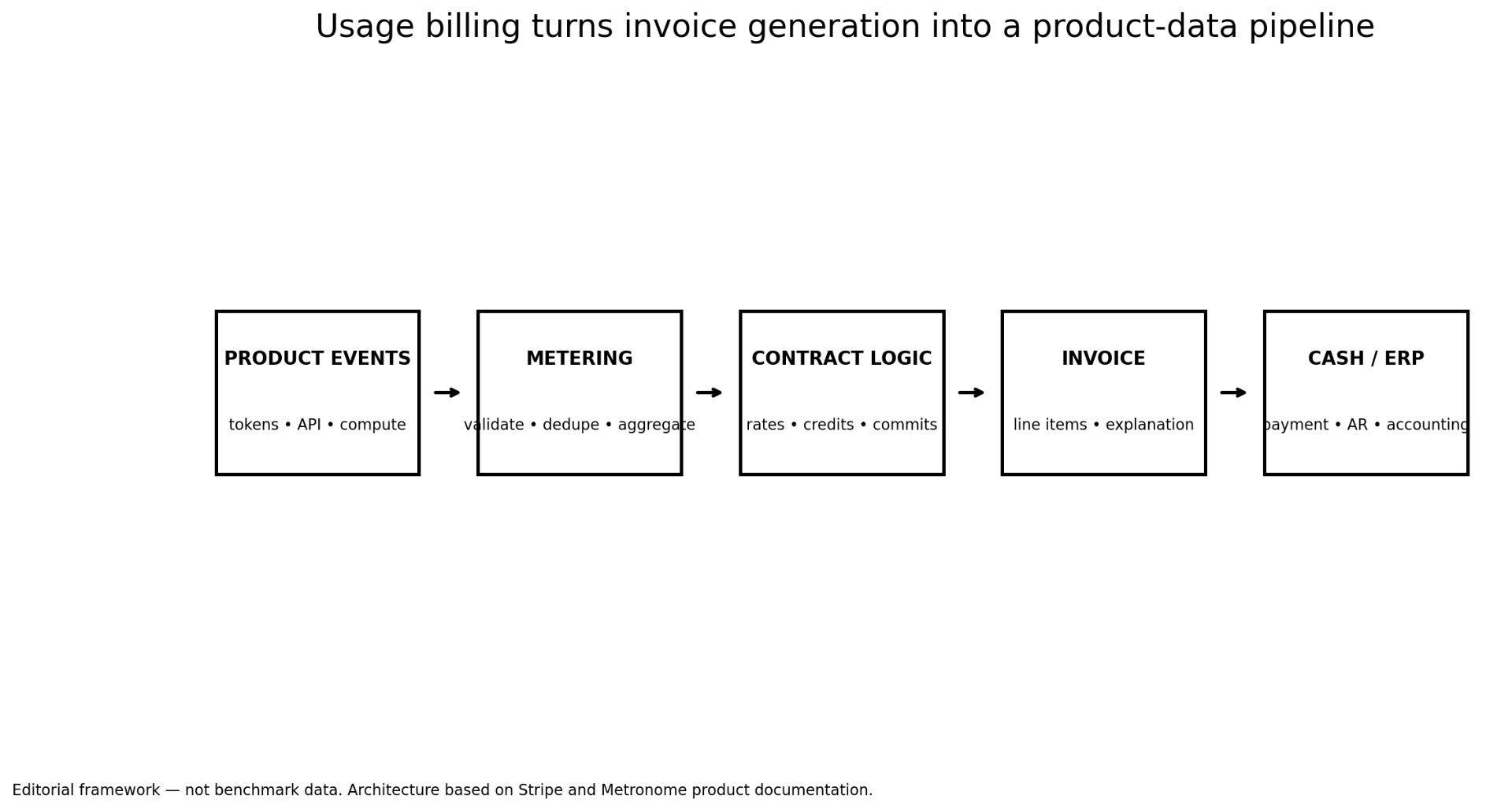
For controllers and billing leaders, this changes the control question. Invoice accuracy begins upstream with event completeness, contract configuration and metric definitions.
Why Stripe wanted Metronome
Stripe’s rationale is unusually explicit.
Patrick Collison, Stripe’s cofounder and CEO, said in January that the shift toward usage-based models would be “a defining feature of the next decade” and described metering and billing as the interface between product and business.
The company says Metronome already powers usage billing for AI companies including OpenAI, Anthropic and NVIDIA.
Stripe’s broader billing platform already supports recording usage, usage thresholds and billing credits. Metronome adds infrastructure designed around complex contracts and high-volume event streams.
The combination matters because the market is moving away from a clean split between self-service subscriptions and enterprise contracts.
An AI vendor may have a customer that starts with a credit card, negotiates a committed-spend contract, receives custom rates, buys through a cloud marketplace and later adds a second product with a different usage metric.
Finance still needs one answer to a basic question: what does the customer owe?
The contract is only half the truth
In traditional enterprise billing, the contract is often treated as the source of truth.
In usage billing, it is only half.
The contract says how to price. Product telemetry says what happened.
That creates a reconciliation problem between commercial configuration and operational consumption.
Finance should be able to trace an invoice line back through the pricing rule to the underlying usage. Customers increasingly need similar visibility because variable bills are inherently harder to predict.
Stripe/Metronome emphasizes embedded usage and spend dashboards, configurable alerts and anomaly detection as ways to give customers visibility before the invoice arrives.
That is not just a product-experience feature.
It can be a collections feature.
A customer that understands its consumption during the month is less likely to encounter a surprise bill, dispute the invoice or delay payment while finance reconstructs what happened.
Billing transparency can therefore affect DSO even before collections begins.
Usage creates new leakage paths
Variable billing also expands the places where revenue can leak.
Usage can fail to arrive. Events can be duplicated. A pricing configuration can be wrong. A contract amendment can be applied late. Credits can be mismanaged. An enterprise commitment can be consumed incorrectly. An invoice can be accurate but delivered too late.
The old AR control of checking whether invoices were generated is not enough.
Finance needs controls around the full chain.
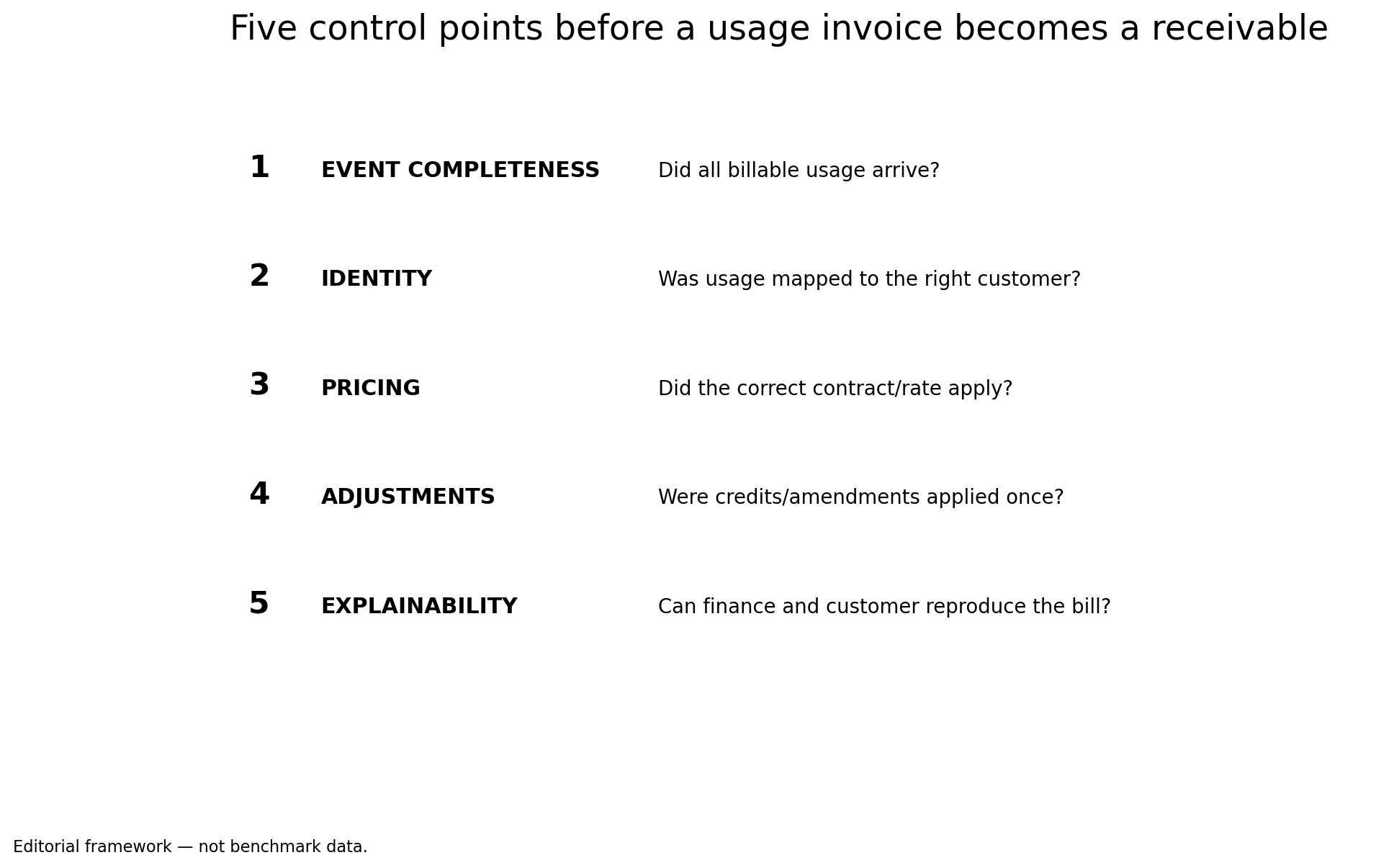
This is where billing platforms are converging with revenue operations and accounting infrastructure.
Metronome’s current Stripe product page describes CRM and ERP synchronization so finance and sales can operate from current data. Its Stripe app allows contracts and customers to be managed from the Stripe Dashboard while invoicing continues through Metronome’s Stripe integration.
The direction is clear: billing is becoming less of an isolated AR application and more of a monetization system spanning product, sales, finance and accounting.
Finance cannot outsource the metric definition
A powerful metering engine does not decide what a company should meter.
That remains a business decision.
AI companies are experimenting with token-based pricing, compute time, API requests, outcomes, credits and hybrid structures. The commercially attractive metric is the one customers perceive as connected to value. The financially safe metric is one the company can measure accurately, explain consistently and audit.
Those goals can conflict.
A sophisticated outcome-based price may align beautifully with customer value but depend on a definition that is difficult to measure without disputes.
A simpler consumption metric may be operationally cleaner but expose the customer to unpredictable spend.
Billing teams should therefore be in pricing discussions earlier than they often are.
Before a new metric launches, finance should ask: Can the event be captured completely? Can it be corrected? How are duplicates handled? What happens when data arrives late? Can a customer reproduce the calculation? How will credits and commitments interact? What happens at contract amendment?
If those answers are vague, the pricing model is not ready.
The invoice becomes a customer-facing data product
This may be the most important shift.
In usage businesses, the invoice is a compressed explanation of potentially millions of product events.
That makes billing quality part of customer trust.
A finance team that cannot explain why usage changed from $40,000 to $110,000 has a collections problem, a customer-success problem and potentially a retention problem.
The best architecture exposes the explanation before the invoice: current consumption, committed spend, rate tiers, remaining credits and forecasted overage.
That turns AR from reactive dispute resolution into proactive bill management.
Acquisition does not eliminate implementation risk
Stripe and Metronome have a strong strategic fit, but buyers should not mistake an integrated product direction for zero integration work.
Companies still have to connect product events, customer identity, CRM contracts, ERP records and payment rails. Enterprise pricing models often contain exceptions accumulated through negotiations. Historical contracts may not map neatly into a modern rate-card model.
Migration therefore deserves the same control discipline as a revenue-system implementation.
Run old and new calculations in parallel. Reconcile usage populations. Test amendments, credits and tier boundaries. Create deliberately late and duplicated events. Validate invoice totals. Ensure finance can reproduce the calculation without asking engineering to inspect production logs.
A billing platform can automate complexity.
“It cannot make contractual complexity disappear.”
The strategic boundary is moving
Stripe’s Metronome acquisition is notable because it shows where payments infrastructure is expanding.
Payment used to sit at the end of billing.
Billing is moving upstream into product data and commercial configuration. Revenue analytics sits beside it. Collections benefits from the same transparency. Accounting consumes the output.
For AR leaders, that means technology decisions about usage metering are no longer merely engineering decisions.
They determine whether revenue is billed completely, whether invoices can be defended, whether customers understand what they owe and how quickly cash can be collected.
AI may be changing what software sells.
It is also changing what an invoice has to prove.
Key takeaways
- For AR and billing leaders
- Move controls upstream: event completeness, customer identity mapping, rate-card configuration and credit handling decide invoice accuracy before AR sees it.
- For controllers
- Require that any usage invoice can be reproduced from stored lineage without engineering inspecting production logs.
- For finance leaders
- Join pricing decisions early — a metric that cannot be measured completely, corrected and explained is a collections risk, not just a product choice.
Sources & further reading
- StripeStripe completes Metronome acquisitionJanuary 14, 2026
- StripeMetronome + Stripe: Building the future of billingJanuary 23, 2026
- StripeUsage-based billing product pageVendor-reported operating metrics
- Stripe DocsBilling — usage-based subscriptionsUsage recording, credits and usage thresholds
- Metronome DocsManage contracts in StripeStripe Dashboard app and invoicing integration
All operating-scale figures are vendor-reported by Stripe and Metronome and are not independently audited benchmarks. Patrick Collison’s statement is quoted from Stripe’s published announcement. No information published after September 6, 2026 is used, and no quotes or metrics are invented.
- For
- AR Leader · Controller · Finance Operations · Finance Systems · CFO
- Level
- All Levels

About the author
Alex MartinezFinance Operations Correspondent
Alex covers the operational side of finance, from supplier invoices and procurement to billing, collections and cash application, with a focus on automation and better financial workflows.
The Finance Observer content is for informational purposes only and is not professional financial, tax, legal or investment advice.
Related reading

Usage-Based Pricing Is Turning Billing Into Finance Infrastructure.
Stripe’s 2025 usage-based billing work shows metering, pricing logic and invoicing converging into one finance-grade pipeline — with revenue operations and billing architecture landing on AR’s desk.

Credit Teams Are Digitizing Faster Than Their Approval Inputs.
Credit evaluation is going digital and AI-assisted, but the inputs that gate approvals — bank and trade references — still arrive at manual speed.

AI Agents Are Starting to Log Into Customer Portals
Tesorio's new agent tackles the manual work of submitting and tracking invoices across procurement portals — a narrow use case that says a lot about where finance AI is heading.
Related across formats
Curated video and audio that share this article's finance topics.
SAP’s Autonomous Finance Vision: What CFOs Should Look For Beyond the AI Demo
SAP
In this SAP Finance Connect keynote, SAP presents how AI assistants and agents could fit into core finance workflows, from accounting and consolidation to planning, billing and payments. As a vendor-hosted keynote, its product capabilities and reported benefits are SAP and participant claims rather than independently verified outcomes.
1Password’s CAO on Where AI Fits in a Well-Run Accounting Team
Senad Mustafic · Chief Accounting Officer, 1Password
Senad Mustafic, Chief Accounting Officer at 1Password, joins Kinter controller Armen Aklian, CPA, for an on-demand fireside chat (The CFO Track) about his path from financial analysis into controllership, how his thinking on AI has changed, and his approach to AI adoption at 1Password.

CFO Weekly
Why Accounting Judgment Still Matters When AI Does the Work
Host Megan Weis and Kerrie Jones, Financial Controller at Peak Living, on why following the correct process doesn’t guarantee a sensible outcome — and how controllers can teach accountants when to question the output, including AI’s. CFO Weekly is produced by Personiv.
CFO Weekly
Editor's PickThe Rise of AI-Driven Finance Teams
A forward-looking discussion on AI agents transforming accounts receivable, the shift from finance operators to finance architects, “headless finance,” and what the CFO function could look like in the next three to five years.