
AP, Procurement & Spend · AI & Automation
Procurement’s Cost Mandate Is Back. Resilience Is Making It Harder to Deliver.
A 2,648-executive global study says cost control has returned as procurement’s primary contribution, just as CIPS data shows companies diversifying suppliers, extending contracts and carrying more stock to survive disruption. The CFO problem is that resilience has a price.
For AP Leader · Finance Operations · Controller · VP Finance · CFO
Level All Levels

Procurement has been handed an awkward assignment for 2026: spend less on a supply chain that may need to cost more.
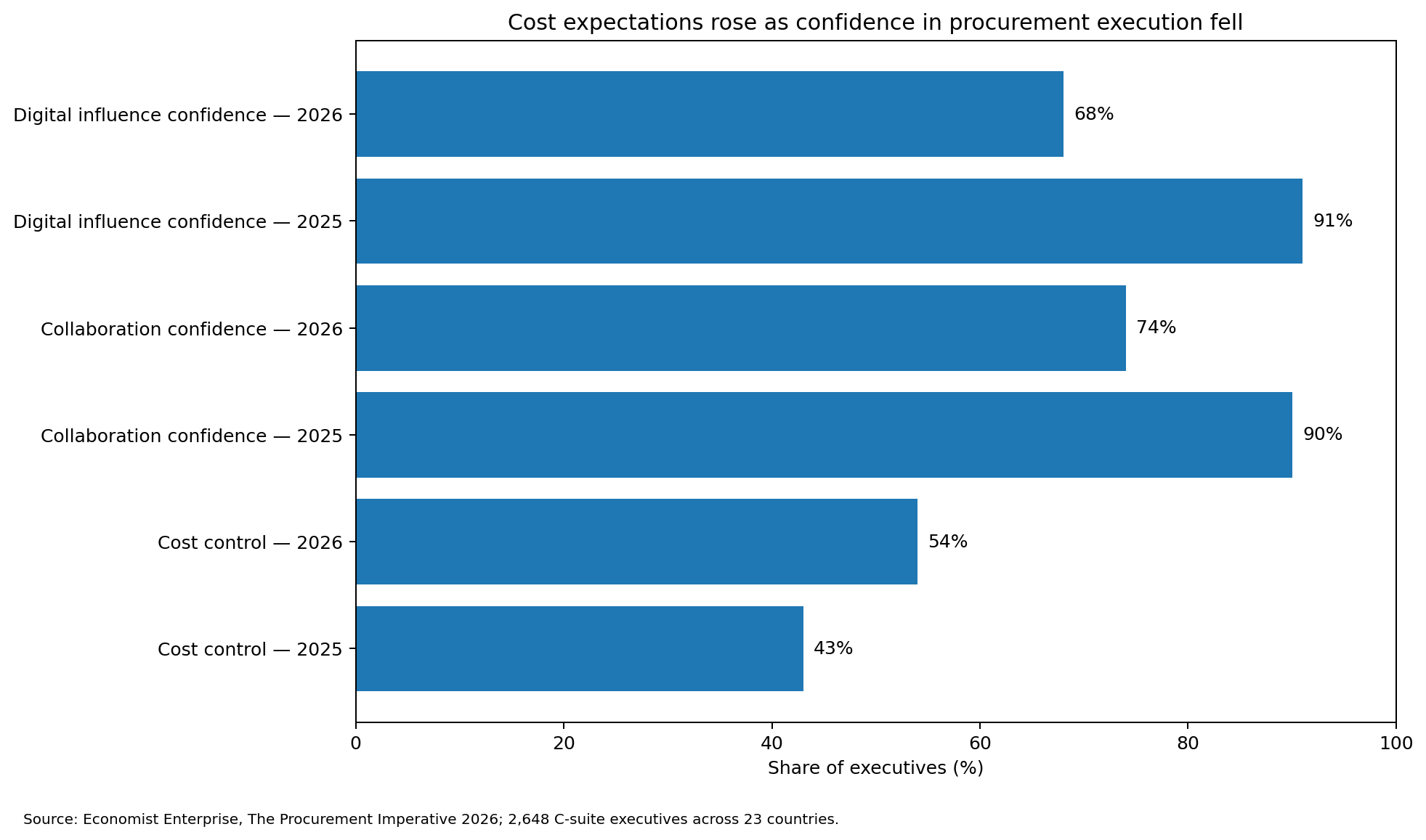
The contradiction shows up clearly in two sets of research published this year. Economist Enterprise’s fifth annual Procurement Imperative study, supported by SAP and based on 2,648 C-suite executives across 23 countries, finds that 54% of executives now identify cost control as procurement’s primary contribution, up from 43% in 2025. Among chief procurement officers the figure is 58%; among chief supply chain officers, 59%.
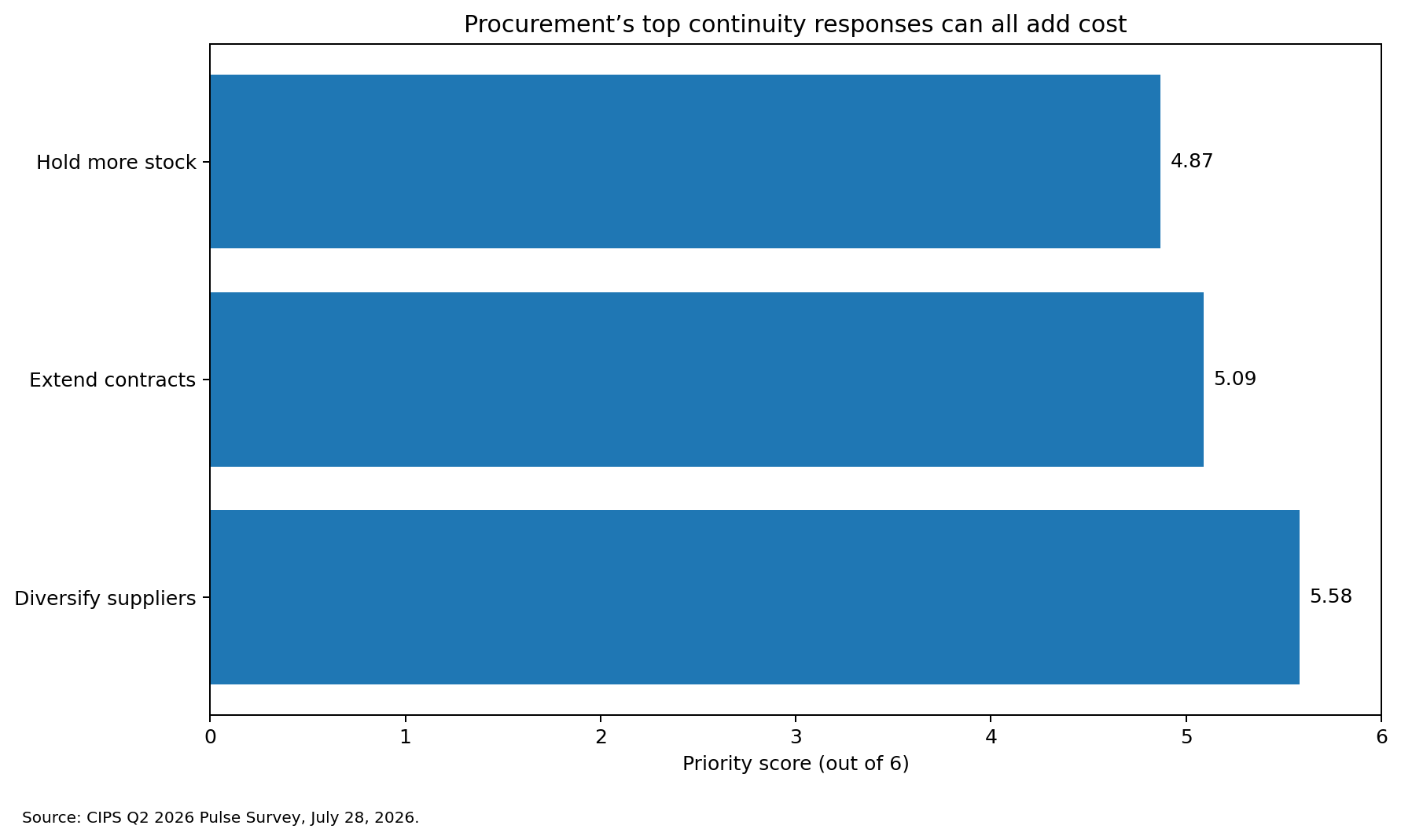
At the same time, the Chartered Institute of Procurement & Supply’s Q2 Pulse shows procurement teams actively paying for resilience. Their highest-ranked continuity response is diversifying suppliers, followed by extending contracts and holding more stock.
Those are sensible risk responses. They are not free.
The finance question is therefore changing. It is no longer enough to ask procurement how much it saved. CFOs need to know how much resilience the company bought, what risk that spending reduced and whether the trade-off is economically rational.
Cost control is back at the top
Procurement’s mandate widened dramatically after the pandemic. Supply shortages and geopolitical disruption made supplier risk, resilience and continuity board-level issues. Procurement teams gained influence because they knew where the company was exposed.
The 2026 Economist Enterprise research suggests the pendulum is moving back toward financial performance.
Fifty-four percent of executives identify cost control as procurement’s greatest contribution, more than ten percentage points above 2025. Digital transformation is simultaneously the most urgent short-term strategic priority, cited by 60% of executives.
That combination explains much of the current procurement technology market: leadership wants savings and productivity at the same time.
But the same research contains a warning. Executive confidence in procurement’s ability to collaborate effectively with the rest of the business fell to 74% from 90% a year earlier. Confidence in procurement’s influence over digital transformation dropped to 68% from 91%.
The function is being asked to do more while confidence in execution is falling.
That is a difficult operating environment for a CPO. Savings remain easy to count. Resilience, avoided disruption and supplier optionality are harder to put into a quarterly scorecard.
The supply-chain data says “do not optimize too far”
CIPS’s July Pulse captures why a narrow savings mandate is dangerous.
Short-term concern about shortages and disruption eased from a Q1 peak of 5.69 to 4.95 on a seven-point scale in Q2. But CIPS says the Q2 figure remained above every other reading in the previous two and a half years. Longer-term concern remained at 5.0.
Three-quarters of respondents cited conflict in the Middle East as a driver of disruption; 67% cited the broader geopolitical environment. Cyber exposure is also rising: 79% rated concern about cyber-attacks across supply chains at four out of seven or higher.
This is not an environment in which procurement can simply remove redundancy.
CIPS respondents ranked supplier diversification at 5.58 out of six as a continuity strategy for the next three to six months. Extending contracts scored 5.09. Holding more stock scored 4.87.
Each choice can improve resilience. Each can also increase cost.
A second supplier may have worse unit economics than the incumbent. Longer contracts can reduce flexibility. Safety stock consumes working capital and storage. Nearer or more reliable suppliers can carry higher prices.
Procurement’s job is increasingly to determine which premium is worth paying.
Input-cost pressure makes the trade-off sharper
CIPS respondents expected significant price pressure. Forty-one percent expected petroleum, metal ores and other mining and quarrying products to rise by more than 10%. Thirty-five percent expected shipping and logistics prices to rise by more than 10%; 30% expected the same for chemicals and chemical products.
Across 20 of 23 categories, at least 10% of respondents expected input prices to increase by more than 10% in Q3.
Tariff uncertainty remains part of the picture. Thirty-three percent said their organization was currently affected by evolving U.S. tariff policy and another 37% were monitoring it.
For finance teams, these numbers matter because “procurement savings” can become misleading when the market itself is moving.
A buyer who negotiates a 4% reduction against a supplier’s proposed 12% increase has created value even if the final price is higher than last year. A dashboard that measures only year-over-year purchase-price variance can make that performance look like failure.
The opposite problem also exists: calling every avoided increase a saving can inflate procurement’s contribution.
CFOs need a more disciplined value bridge.
Separate price, avoidance and resilience
A useful procurement scorecard should distinguish at least four types of value.
- Realized price savings — reduce actual purchase price or total cost against a valid baseline.
- Cost avoidance — prevents or reduces a credible future increase but may not reduce current spend.
- Demand reduction — removes consumption, specification or volume.
- Resilience investment — deliberately accepts cost in exchange for lower disruption exposure, shorter recovery time or greater supplier optionality.
Those categories should not be collapsed into one giant “savings” number. Finance should agree the baseline, timing and evidence standard for each before procurement reports the benefit.
This becomes particularly important when sourcing decisions include tariffs, freight, inventory and payment terms. A supplier with a lower unit price can still be economically worse after duties, logistics, working-capital requirements and risk are included.
“The procurement metric that matters is total enterprise value, not the negotiated line-item price.”
Resilience needs a finance case
The easiest resilience initiative to approve is one that sounds prudent. The hardest question is how much prudence is enough.
Supplier diversification is a good example. A company may want a second source for a critical component. The secondary supplier is more expensive and requires a minimum volume commitment.
That premium should be treated like insurance.
What revenue or margin is exposed if the primary supplier fails? How long would recovery take? What probability range does management assign to disruption? How much capacity does the second source actually guarantee? Does the contract reduce recovery time enough to justify the annual premium?
The answer does not need false precision. It does need an economic framework.
Finance can help procurement turn resilience from a qualitative virtue into a capital-allocation decision.
AI is arriving in the middle of the tension
The Economist Enterprise study finds agentic AI is the most sought-after procurement technology and digital transformation is the leading short-term strategic priority.
That makes sense. If procurement must manage more suppliers, more risk signals and more cost pressure without proportionally more people, automation becomes attractive.
But AI cannot resolve the fundamental trade-off.
An agent can identify alternative suppliers, monitor price movements, compare contract terms or surface risk. It cannot decide the company’s risk appetite unless management has expressed that appetite in usable policies and thresholds.
Technology therefore amplifies the need for a better procurement-finance operating model.
If procurement is rewarded only for price savings, an AI optimizer will be pushed toward price savings. If the company wants resilience, the objective function has to include resilience.
The CFO-CPO conversation should change
The 2026 research suggests three questions belong in every major sourcing review.
- 01What is the baseline? — Is procurement comparing against last year, the supplier’s opening bid, a market index or the credible no-action scenario?
- 02What risk are we buying down? — If the recommendation costs more, specify the exposure reduced — single-source dependency, geographic concentration, cyber risk, lead-time volatility or another measurable vulnerability.
- 03What is reversible? — Inventory can be consumed. A long contract may lock the company in. Dual sourcing can be scaled. The reversibility of a resilience decision changes its economic risk.
These questions give finance a better way to challenge procurement without forcing every decision back to lowest cost.
Savings and resilience are not opposites
There is a temptation to frame 2026 as procurement abandoning its strategic role and returning to cost cutting.
The data supports a more complicated interpretation.
Cost control has clearly returned as the dominant executive measure. But the operating environment has not returned to a world in which supply continuity can be taken for granted.
Procurement now has to fund resilience inside a tougher cost envelope.
A diversified supplier base may cost more. Holding additional stock may tie up cash. Longer contracts may reduce flexibility. Those choices can still create value if they prevent a much larger disruption.
“The CFO’s role is to make sure “resilience” does not become an excuse for unmanaged cost — and “savings” does not become an excuse for fragile supply.”
In 2026, procurement performance is the quality of that balance.
Key takeaways
- For procurement leaders
- Report realized savings, cost avoidance, demand reduction and resilience investment separately, with an agreed baseline and evidence standard for each.
- For finance business partners
- Judge sourcing on total enterprise value — duties, freight, working capital and risk included — rather than unit price against last year.
- For CFOs
- Treat resilience premiums like insurance: quantify the exposure reduced, the recovery time saved and whether the decision is reversible.
Sources & further reading
- Economist EnterpriseThe Procurement Imperative 20262,648 C-suite executives across 23 countries
- CIPSQ2 2026 Pulse Survey resultsJuly 28, 2026
- GEP / Ardent PartnersProcurement Metrics That Matter in 2026Survey of 311 CPOs and senior procurement executives
All chart values are taken directly from the cited surveys. The value-framework and scorecard recommendations are editorial analysis, not survey findings. No information published after September 6, 2026 is used, and no quotes are invented.
- For
- AP Leader · Finance Operations · Controller · VP Finance · CFO
- Level
- All Levels

About the author
Alex MartinezFinance Operations Correspondent
Alex covers the operational side of finance, from supplier invoices and procurement to billing, collections and cash application, with a focus on automation and better financial workflows.
The Finance Observer content is for informational purposes only and is not professional financial, tax, legal or investment advice.
Related reading
Zip’s Superagents Want to Run Procurement Work. The Hard Part Is Governing the Decisions.
Zip’s role-based Superagents can coordinate task agents, act across connected systems and escalate to humans. For finance and procurement, the governance layer — not the autonomy — is the story.

Procurement’s AI Divide Is Becoming a Performance Divide.
Deloitte’s 2025 Global CPO Survey found top procurement organizations putting up to 24% of budgets into technology and reporting three times greater GenAI returns than peers — a gap that now looks like an operating-model choice.
Finance Is Deploying AI Agents Faster Than It Can Govern Them
A vendor-sponsored survey of more than 1,500 finance leaders finds 92% under pressure to prove agentic-AI ROI, only 7% prioritizing governance over speed and 30% who have not updated controls in the past year.
Related across formats
Curated video and audio that share this article's finance topics.
SAP’s Autonomous Finance Vision: What CFOs Should Look For Beyond the AI Demo
SAP
In this SAP Finance Connect keynote, SAP presents how AI assistants and agents could fit into core finance workflows, from accounting and consolidation to planning, billing and payments. As a vendor-hosted keynote, its product capabilities and reported benefits are SAP and participant claims rather than independently verified outcomes.
1Password’s CAO on Where AI Fits in a Well-Run Accounting Team
Senad Mustafic · Chief Accounting Officer, 1Password
Senad Mustafic, Chief Accounting Officer at 1Password, joins Kinter controller Armen Aklian, CPA, for an on-demand fireside chat (The CFO Track) about his path from financial analysis into controllership, how his thinking on AI has changed, and his approach to AI adoption at 1Password.

CFO Weekly
Why Accounting Judgment Still Matters When AI Does the Work
Host Megan Weis and Kerrie Jones, Financial Controller at Peak Living, on why following the correct process doesn’t guarantee a sensible outcome — and how controllers can teach accountants when to question the output, including AI’s. CFO Weekly is produced by Personiv.
CFO Weekly
Editor's PickThe Rise of AI-Driven Finance Teams
A forward-looking discussion on AI agents transforming accounts receivable, the shift from finance operators to finance architects, “headless finance,” and what the CFO function could look like in the next three to five years.