
AP, Procurement & Spend · AI & Automation
Zip’s Superagents Want to Run Procurement Work. The Hard Part Is Governing the Decisions.
Zip’s 2026 Superagents move agentic AI beyond single procurement tasks into multi-step workflows spanning intake, contracts, AP and configuration. The product’s most important feature may be less glamorous than autonomy: policy-bound actions, human checkpoints and an audit trail.
For AP Specialist · AP Leader · Controller · Finance Operations · Finance Systems · CFO
Level All Levels
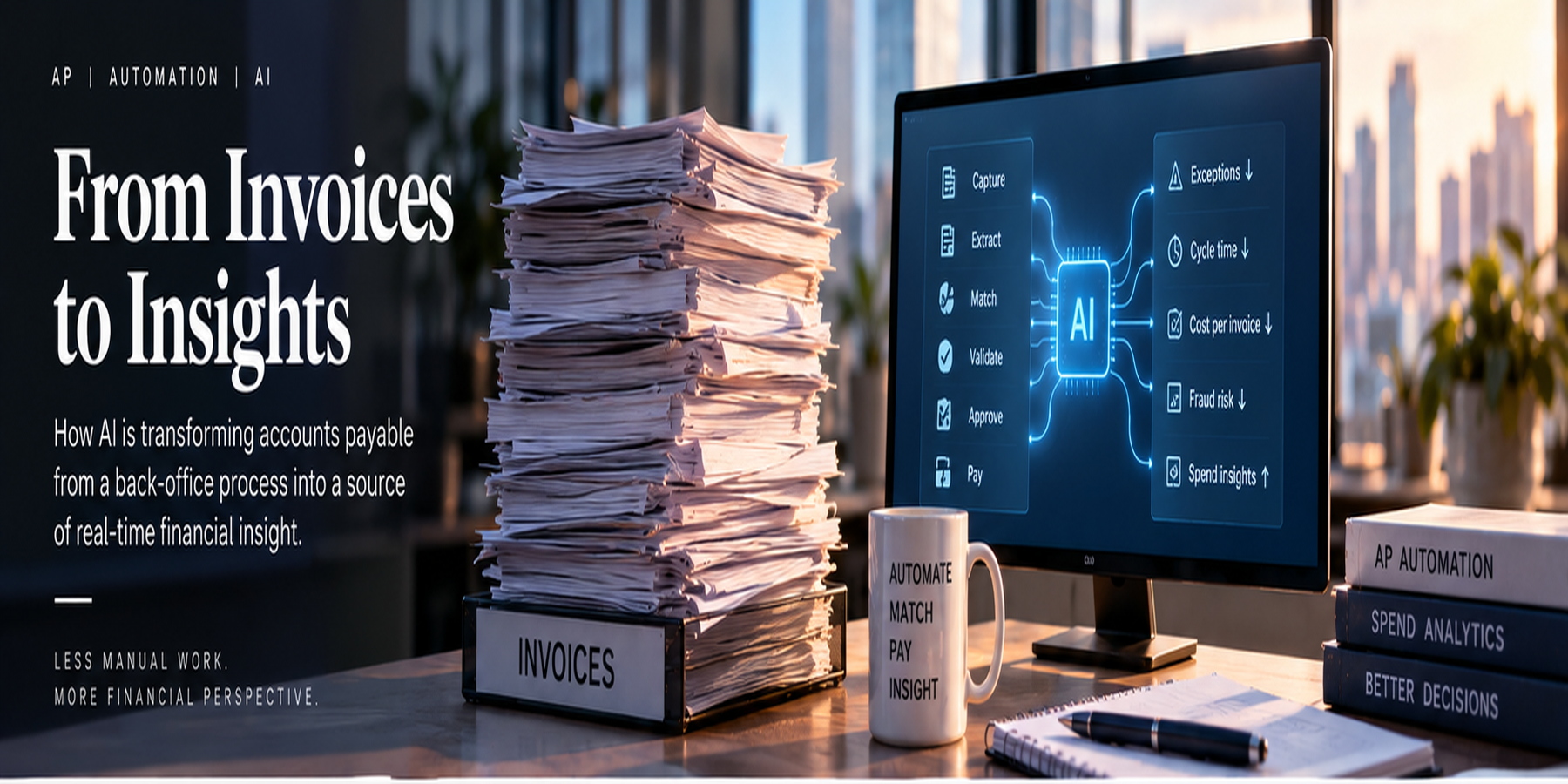
Procurement software has spent years making employees follow workflows. Zip now wants AI to work inside them.
In June, the procurement-orchestration company introduced five role-based “Superagents” for Intake, Procurement, Contracts, Accounts Payable and system configuration, alongside a procurement-native Model Context Protocol implementation that can connect Zip’s context and controls to AI assistants such as Claude and ChatGPT.
The product shift is significant because these agents are not positioned as another layer of procurement search or drafting. Zip says they can coordinate multiple task-level agents, reason across a multi-step process, act across connected systems, interact with employees and escalate to humans when policy requires it.
That puts the technology much closer to operational work.
An Intake Superagent can guide an employee through a request and steer the purchase toward the right channel. A Procurement Superagent can chase stalled approvals and handle tail-spend negotiation. A Contract Superagent can compare agreements with playbooks and recommend redlines. An AP Superagent can sort, code, match and route invoices. A Config Superagent can identify workflow bottlenecks and draft configuration changes for administrator review.
The obvious story is automation.
The more important one is governance.
From task agents to role agents
Zip’s launch is easier to understand in the context of what came before it.
In June 2025, the company introduced more than 50 purpose-built task agents. Those agents handled narrower activities such as invoice coding, data validation, adverse-media checks and renewal support.
Superagents are designed to orchestrate those smaller capabilities toward a larger outcome.
That distinction matters. A task agent that extracts a field from an invoice has a bounded failure mode. A role agent that decides which information to collect, calls other tools, communicates with stakeholders and advances a request through several stages creates a longer chain of decisions.
Every additional step can save human labor. It can also compound a bad assumption.
That is why procurement teams should resist evaluating agents solely by how many actions they can perform.
The better question is how the system behaves when something is ambiguous.
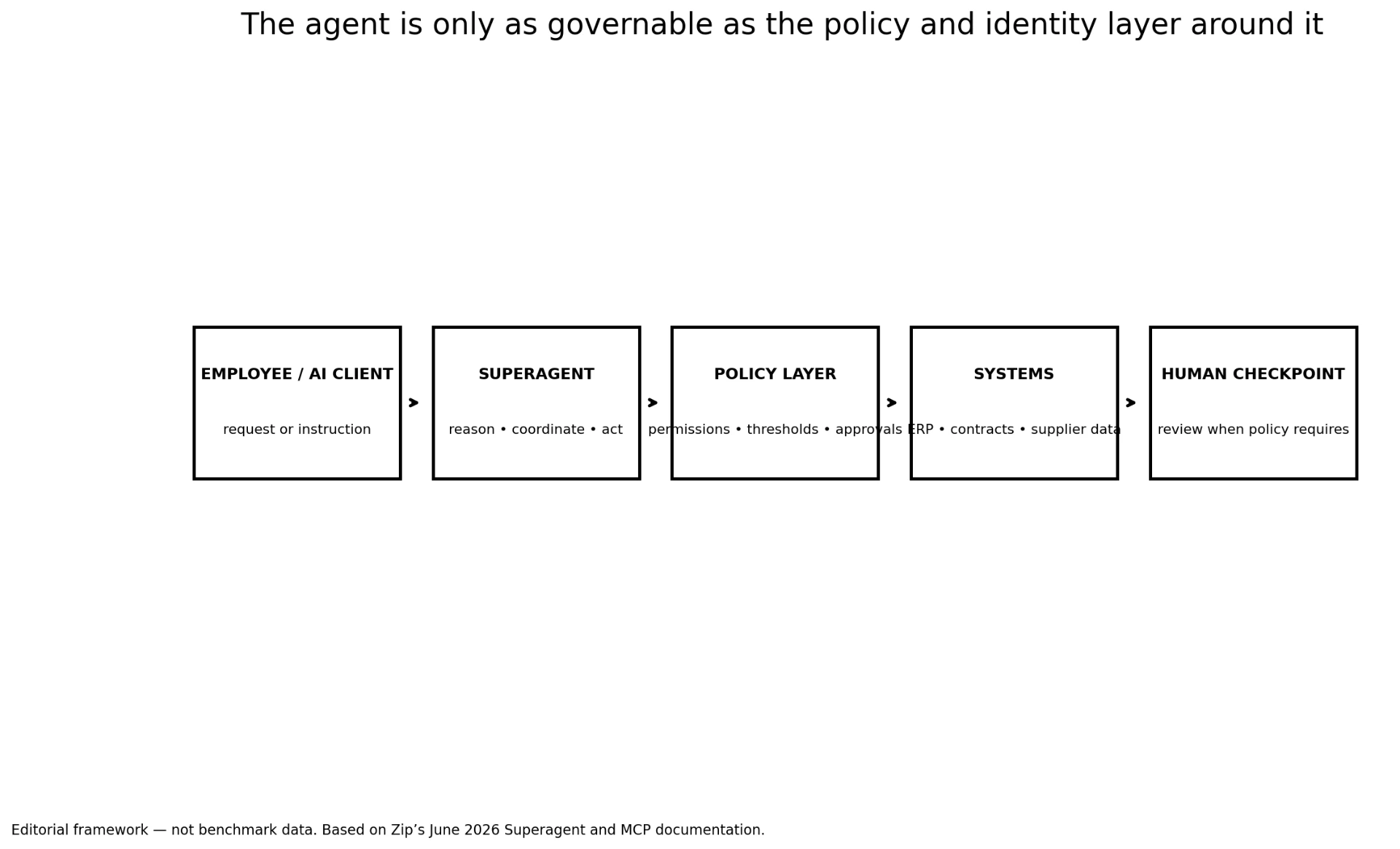
Zip says each action is governed by existing permissions, policies and controls, produces an audit trail, and can include configurable human-in-the-loop checkpoints. Through Zip MCP, actions initiated from an external AI assistant are authenticated through OAuth and remain inside Zip’s compliance controls.
Those are meaningful architectural claims. They do not remove the need for implementation decisions.
A company still has to decide where an agent may act automatically, where it may recommend but not execute, which thresholds trigger review, who can change the underlying policies and what evidence must be retained.
Procurement is unusually hostile to invisible automation
The attraction of agentic procurement is easy to see.
Buying processes contain enormous amounts of coordination work: asking requesters for missing information, checking policy, collecting security reviews, chasing legal approval, comparing supplier responses, creating records, matching invoices and resolving exceptions.
Much of that work is procedural rather than strategic.
But procurement is also a difficult environment for opaque automation because a single request can touch finance, legal, security, privacy, IT, tax and supplier risk.
The “right” outcome is rarely just the cheapest vendor.
A supplier may offer the best commercial terms but fail a security requirement. A contract clause may be acceptable below one spend threshold and require legal review above another. A preferred vendor may become inappropriate when data residency changes. An invoice may match the PO numerically but violate a contractual milestone.
An agent therefore needs more than language capability. It needs policy context and reliable escalation.
This is the strongest part of Zip’s product thesis: the company is arguing that the orchestration layer that previously routed humans can become the governance layer that constrains agents.
MCP moves procurement outside the procurement UI
Zip MCP makes the story broader.
Model Context Protocol gives compatible AI clients a standardized way to connect to external systems and tools. Zip’s implementation is intended to let procurement context travel into the AI environment where an employee is already working.
The company gives the example of an employee researching suppliers in an AI assistant and being prompted to submit a governed purchase request. A power user could also retrieve aggregated information across suppliers, requests, invoices and payments from an AI chat.
For procurement adoption, that could solve a persistent problem: employees often avoid procurement systems until they are forced into them.
If the control can meet the employee inside the conversational interface, intake may become less dependent on training people to remember where procurement begins.
But the architecture also raises an identity question. When an employee asks an external assistant to perform procurement work, finance needs confidence that the system still knows who the employee is, what that person is permitted to see and which actions require another approver.
Zip says MCP actions respect user permissions through OAuth and remain auditable. Buyers should test those boundaries deliberately.
The AP Superagent deserves separate scrutiny
Accounts payable sits at the downstream end of the Superagent model and carries a different risk profile from intake.
Zip says its AP Superagent can sort, code, match and route invoices using approval rules, supplier records and ERP data while maintaining payment controls.
Those are precisely the tasks where automation can remove large volumes of repetitive work. They are also tasks where errors can become cash movements.
The control design should therefore separate invoice understanding from payment authority.
An agent may be excellent at determining a likely GL code or matching an invoice to an existing PO. That does not mean it should be allowed to override a duplicate-payment flag, change supplier bank details or bypass an approval because the invoice looks routine.
“For AP leaders, “agentic” should not become shorthand for “fewer controls.”
It should mean more work happens automatically inside explicit controls.
Vendor metrics need a buyer’s discount rate
Zip publishes impressive performance figures for its AI platform: $10 billion in customer savings, 10 million AI insights, three-times faster intake and five-times faster invoice processing. In July, the company said it had more than 700 customers, five million platform users, more than $1 trillion in spend orchestrated, 40 million approvals processed and 10 million vendors managed.
Those numbers are useful evidence of scale, but they are vendor-reported.
They do not tell a CFO what a Superagent will save in a specific environment, how the benchmark was calculated or how much of the reported benefit comes from orchestration versus AI.
One customer example is more concrete. In Zip’s June announcement, UCI Health Chief Procurement and Supply Chain Officer Susanna Rustad said the company’s AI Spend Automation contributed to more than $20 million in cost avoidance and value recapture on a major IT infrastructure initiative.
That is a real attributed customer statement. It is still one implementation.
Procurement teams building a business case should measure their own baseline: request cycle time, approval touches, percentage of spend under management, sourcing throughput, invoice exception rate, contract-review time and procurement labor per request.
Then isolate what changes.
The right KPI is not “autonomy”
The procurement software market is starting to compete on agent counts and autonomous actions.
That can become a distraction.
A high percentage of autonomous approvals is not inherently better if the automated decisions are low-value, poorly governed or create downstream cleanup. Conversely, an agent that automatically resolves only half of requests may be highly valuable if it removes the most repetitive work and gives buyers more time for negotiations.
The useful metrics are operational.
How much cycle time disappeared? How many manual handoffs were removed? Did more spend enter procurement before commitment? Did contract leakage fall? Did invoice exceptions fall? Did supplier risk reviews happen earlier? Did the company capture measurable savings without increasing control exceptions?
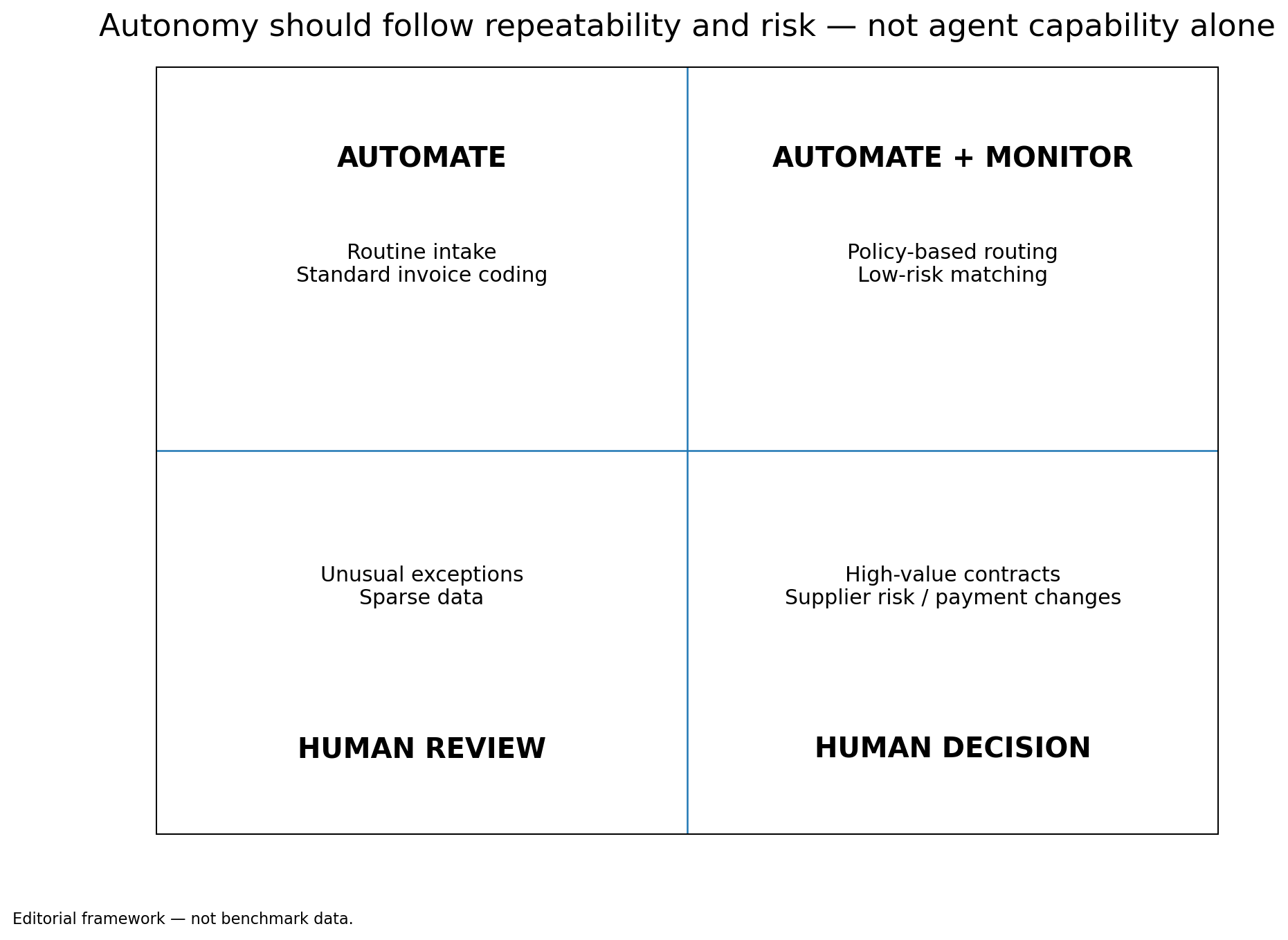
That last question matters because procurement automation is not a laboratory exercise. The output eventually becomes a supplier commitment, contract, invoice or payment.
What buyers should test before expanding
A serious Superagent pilot should include failure tests, not only happy-path demos.
Create an invoice with a mismatched supplier. Submit a contract with a nonstandard indemnity clause. Ask the agent to expose information the user should not see. Change the purchase amount after approval. Create a request that crosses a threshold mid-workflow. Give the agent conflicting supplier data. Try to push an action past a required human checkpoint.
Then inspect the audit trail.
The purpose is not to prove the AI can be tricked. Any complex system can encounter edge cases. The purpose is to learn whether the control environment fails safely.
Finance and procurement should also govern configuration changes separately from transaction execution. Zip’s Config Superagent can identify bottlenecks and draft workflow changes for admin review. Keeping that review boundary is important: the agent executing a policy should not silently rewrite the policy that constrains it.
The orchestration layer is becoming the control layer
Zip’s Superagents are a useful marker for where procurement technology is heading.
The software category used to compete on digitizing intake, routing approvals and integrating source-to-pay systems. Agentic AI makes that workflow history valuable for another reason: it contains the policies, identities, approvals and exceptions an autonomous system needs in order to act safely.
That may prove more defensible than the AI model itself.
Foundation models will improve. Procurement-specific controls remain company-specific.
“The winning procurement agent may therefore be the one that looks least autonomous in a demo and most accountable six months later in an audit.”
That is the standard finance should apply.
The future of procurement is unlikely to be humans clicking through every workflow step. But it should not be agents making invisible purchasing decisions either.
The more work the agent does, the more important it becomes to know exactly which rules it followed, which evidence it used and where a human still owns the decision.
Key takeaways
- For AP and procurement teams
- Separate invoice understanding from payment authority. Agents may code and match; duplicate-payment flags, bank-detail changes and approval bypasses stay with people.
- For finance systems owners
- Test identity and permission boundaries when actions start in an external AI assistant, and govern configuration changes separately from transaction execution.
- For CFOs
- Treat platform-scale figures as vendor-reported. Build the business case on your own baseline: cycle time, approval touches, spend under management and control exceptions.
Sources & further reading
- ZipIntroducing Zip Superagents, MCP, and AI Spend AutomationJune 2, 2026
- ZipWhat are Zip Superagents? AI in procurement, explainedJune 4, 2026
- ZipSix years of Zip: momentum on every frontJuly 9, 2026
- VentureBeatIndependent product and market contextJune 2, 2026
Product scale and performance metrics in this article are vendor-reported. UCI Health’s figure is one attributed customer example, not a benchmark. No information published after September 6, 2026 is used, and no quotes are paraphrased beyond the cited sources.
- For
- AP Specialist · AP Leader · Controller · Finance Operations · Finance Systems · CFO
- Level
- All Levels

About the author
Alex MartinezFinance Operations Correspondent
Alex covers the operational side of finance, from supplier invoices and procurement to billing, collections and cash application, with a focus on automation and better financial workflows.
The Finance Observer content is for informational purposes only and is not professional financial, tax, legal or investment advice.
Related reading
AP Is Moving From Automation to Agency
Accounts payable digitized the paperwork years ago. The remaining work is the decision layer — and that is exactly what agentic AP software is now aiming at.

Procurement’s AI Divide Is Becoming a Performance Divide.
Deloitte’s 2025 Global CPO Survey found top procurement organizations putting up to 24% of budgets into technology and reporting three times greater GenAI returns than peers — a gap that now looks like an operating-model choice.

Procurement’s Cost Mandate Is Back. Resilience Is Making It Harder to Deliver.
Cost control is back as the dominant executive measure of procurement — but supplier diversification, longer contracts and safety stock all cost money. The 2026 question is which premium is worth paying.
Related across formats
Curated video and audio that share this article's finance topics.
SAP’s Autonomous Finance Vision: What CFOs Should Look For Beyond the AI Demo
SAP
In this SAP Finance Connect keynote, SAP presents how AI assistants and agents could fit into core finance workflows, from accounting and consolidation to planning, billing and payments. As a vendor-hosted keynote, its product capabilities and reported benefits are SAP and participant claims rather than independently verified outcomes.
1Password’s CAO on Where AI Fits in a Well-Run Accounting Team
Senad Mustafic · Chief Accounting Officer, 1Password
Senad Mustafic, Chief Accounting Officer at 1Password, joins Kinter controller Armen Aklian, CPA, for an on-demand fireside chat (The CFO Track) about his path from financial analysis into controllership, how his thinking on AI has changed, and his approach to AI adoption at 1Password.
CFO Weekly
Why Accounting Judgment Still Matters When AI Does the Work
Host Megan Weis and Kerrie Jones, Financial Controller at Peak Living, on why following the correct process doesn’t guarantee a sensible outcome — and how controllers can teach accountants when to question the output, including AI’s. CFO Weekly is produced by Personiv.
CFO Weekly
Editor's PickThe Rise of AI-Driven Finance Teams
A forward-looking discussion on AI agents transforming accounts receivable, the shift from finance operators to finance architects, “headless finance,” and what the CFO function could look like in the next three to five years.