
AR, Billing & Collections · AI & Automation
AI Agents Are Starting to Log Into Customer Portals
Tesorio's new Supplier Portals Agent targets one of the strangest remaining manual jobs in accounts receivable.
For AR Specialist · AR Leader · Controller · Finance Operations · Finance Systems
Level All Levels

The Bottleneck Hiding After the Invoice Is Created
For years, finance automation has concentrated on creating invoices, sending reminders, applying cash and reporting on receivables. Yet for many B2B companies, an oddly manual step remains between “invoice ready” and “invoice accepted by the customer”: somebody has to log into the customer's procurement portal.
The AR employee may need to find the correct purchase order, enter invoice details, upload supporting documents, satisfy buyer-specific fields, submit the invoice and then return later to find out whether it was accepted, rejected, disputed or paid.
Multiply that workflow across customers using Coupa, SAP Ariba and other portals and a supposedly digital process starts to resemble manual data entry spread across dozens of websites.
On March 27, 2025, Tesorio launched its Supplier Portals Agent, an AI agent designed specifically to attack that workflow.
It is a useful product launch to watch not because supplier portals are glamorous, but because they illustrate where agentic AI may first create value in finance: repetitive work that requires software to navigate systems, gather context and take a bounded action.
What Tesorio Actually Launched
According to Tesorio's launch materials and product documentation available at the time, the Supplier Portals Agent is designed to automate portal-based invoice management.
For supported workflows, it can match invoices to purchase orders in Coupa and Ariba, perform pre-submission checks, verify items such as payment terms and available PO balance, submit invoices and centralize issue handling.
Its monitoring capability is intended to bring portal status information back into Tesorio so AR teams can follow what happens after submission rather than repeatedly checking separate portals.
Max Dame, Tesorio's vice president of finance and operations, described the idea to CFO Dive as an agent that goes into portals for customers, submits invoices and then monitors the submission and approval process.
The agent is not simply answering a question about receivables. It is being asked to perform part of the receivables workflow.
Why Portals Became an AR Problem
Supplier portals solve a real problem for buyers. They standardize purchasing and invoice intake, enforce required information and connect invoices with procurement approvals. But the efficiency can be asymmetric.
Tesorio said at launch that portal-based invoices can account for as much as 70% of invoice volume for some businesses. That figure is a vendor-reported observation, not an industry-wide benchmark.
A rejected invoice can delay the payment process. A missing PO, incorrect field or unnoticed dispute can sit outside the AR team's normal workflow until somebody checks the portal. That makes portal visibility a working-capital issue, not merely an administrative inconvenience.
The First Customer Signals
Tesorio's launch announcement included early customer reports from Plaid, Fastly, Pendo and Workiva.
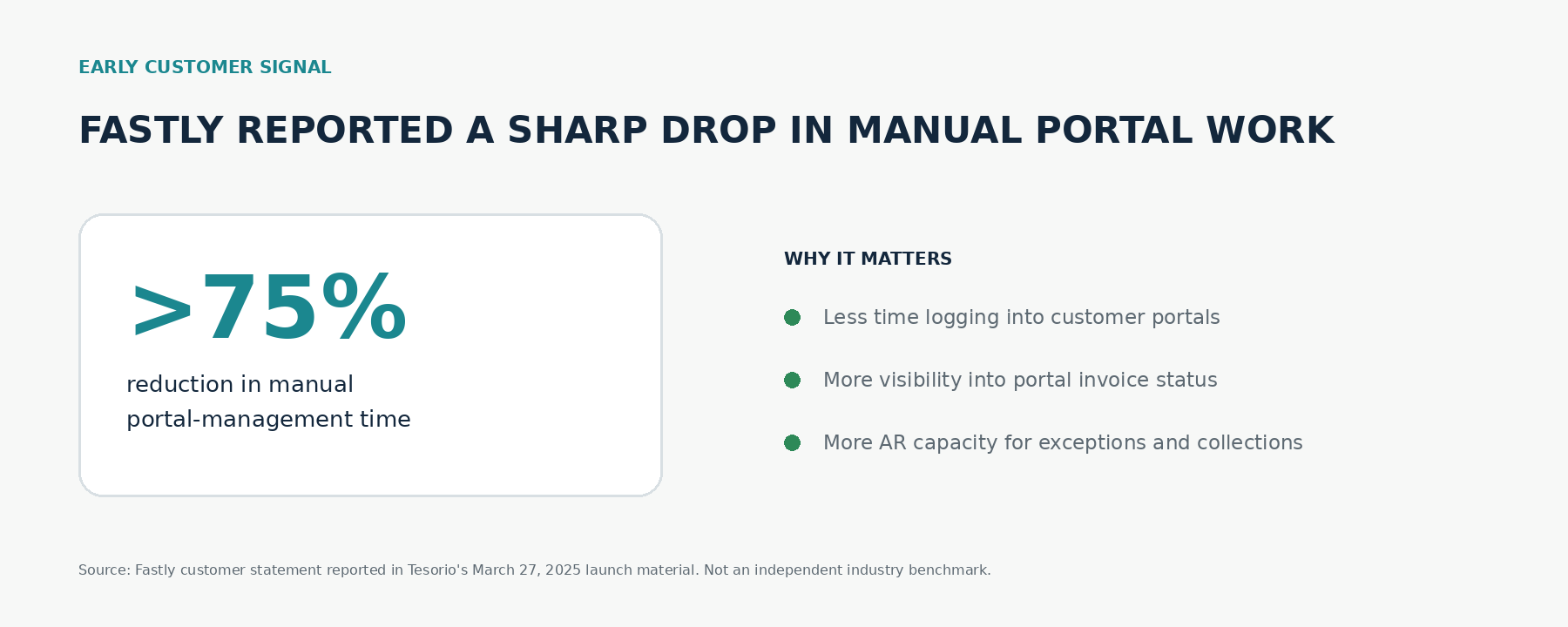
Fastly Payments Operations Analyst Carla Buggs said the company gained visibility into thousands of portal invoices and reported that manual portal-management time fell by more than 75%.
Plaid Accounts Receivable Lead Jack Spencer described having a unified dashboard for portal invoice statuses as a significant improvement to collections.
Pendo Senior Credit & Collections Manager Melissa Zmuda said the product turned a previously manual portal process into an automated workflow that saves hours each week.
These are customer statements supplied in connection with a vendor launch, so they should not be treated as independent benchmark research. But they provide useful evidence of the operational problem the product is targeting.
From Software That Recommends to Software That Acts
Traditional AR software may identify which account deserves attention or recommend the next collection action. An agentic workflow goes one step further: software performs a sequence of actions toward a defined objective.
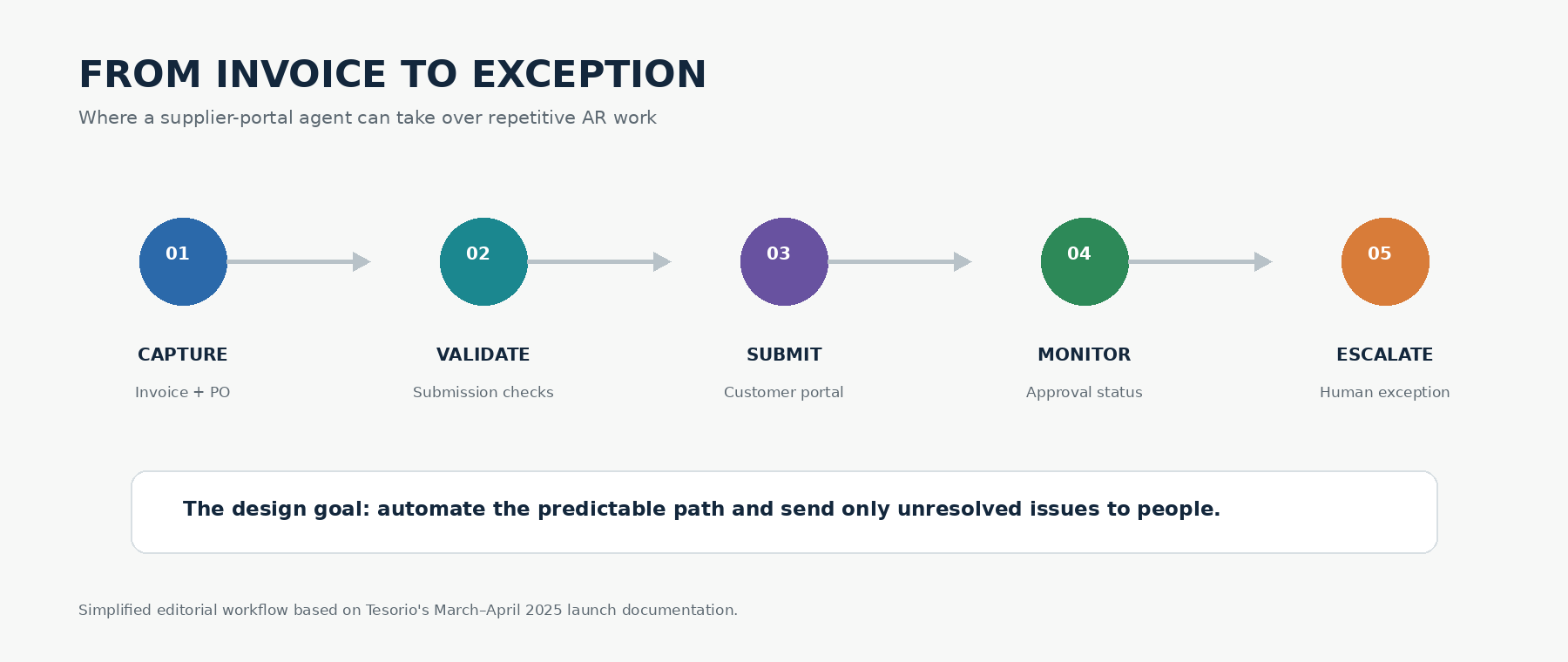
In the supplier-portal example, that sequence can include identifying the invoice, locating the relevant PO, validating submission requirements, entering information into the external portal, submitting, capturing the result, monitoring status and surfacing an exception when human intervention is needed.
The realistic near-term model for finance is not unlimited autonomy. It is bounded autonomy: software acts within a defined process, while humans remain responsible for exceptions, controls and decisions outside the expected path.
What an AR Team Should Check Before Automating Portals
- 01Portal volume — How many invoices actually require portal submission, and which customers create most of the workload?
- 02Rejection reasons — Identify why invoices are rejected today. Automation should not accelerate bad inputs.
- 03PO quality — If PO numbers, balances or terms are frequently incorrect upstream, the portal agent will encounter those problems downstream.
- 04Credential security — An agent that logs into external procurement systems needs controlled credentials, appropriate authentication and clear access ownership.
- 05Action logging — The team should be able to determine what the agent submitted, when it acted and what happened afterward.
- 06Exception ownership — When the portal rejects an invoice or a PO is insufficient, somebody needs a clear task, context and escalation path.
- 07Customer-specific rules — Large buyers often configure procurement systems differently. Supporting a platform does not mean every customer's workflow is identical.
The Product Is Smaller Than the Big AI Story — And That May Be the Point
Much of the 2025 conversation about AI in finance is focused on ambitious concepts: autonomous finance, AI copilots and digital workers.
Supplier-portal automation is much narrower. That is precisely why it is interesting.
Finance teams do not need every AI project to reinvent the function. A product can create value by removing a stubborn operational task that sits between existing systems.
The best test is not whether an agent looks intelligent. It is whether the process becomes measurably better: fewer manual portal logins, faster successful invoice submission, fewer preventable rejections, shorter time to identify disputes, less AR employee time spent checking status and better visibility into invoices awaiting buyer approval.
What This Means for AR Professionals
For an AR analyst, this kind of automation shifts attention away from portal administration and toward exceptions.
Instead of asking “Did we upload the invoice?”, the analyst can spend more time asking: Why was it rejected? Why has approval stalled? Is the PO exhausted? Who at the customer needs to resolve the issue? Which delayed invoice has the largest cash impact?
Automation does not eliminate the work around exceptions. It makes the quality of exception management more important.
Product Watch — What We Would Watch Next
Tesorio's Supplier Portals Agent is new. The relevant questions over the next year are practical:
- How many portal configurations can it handle reliably?
- How does it respond when a buyer changes its portal workflow?
- How frequently does a human need to intervene?
- How are credentials and MFA handled?
- How complete is the audit trail?
- Can automated submission measurably reduce invoice-to-cash delays?
- How does performance differ between standardized and unusual portal configurations?
Those answers will determine whether portal agents become a niche convenience or a standard layer in enterprise AR automation.
The Larger Signal
Finance software is moving from systems that store transactions, to systems that analyze transactions, and increasingly toward systems that can perform bounded operational work.
Supplier portals are an unusually clear example because the task is visible: somebody used to log in and do it manually.
If agents can reliably absorb that work, the AR team does not disappear. The queue changes.
Humans spend less time operating portals and more time resolving the financial exceptions that prevent revenue from becoming cash.
Key takeaways
- For AR analysts
- Expect portal administration to become increasingly automatable. Exception investigation and customer-resolution skills become more valuable.
- For AR managers
- Measure the existing portal workload before buying automation. Time spent, rejection rates and delayed approvals create the baseline for ROI.
- For controllers
- Require credential controls, audit trails and clear human escalation before allowing software to act in external financial workflows.
- For finance systems
- Portal automation is an integration problem as much as an AI problem. Authentication, changing portal interfaces and exception handling matter.
Sources & further reading
- TesorioMeet the Supplier Portals AgentMarch 27, 2025
- CFO DiveTesorio launches AI agent to ease invoice bottlenecksMarch 27, 2025
- PYMNTSTesorio Adds AI Agent for Supplier Portals to AR Automation PlatformMarch 28, 2025
- Tesorio Help CenterOverview of Tesorio's Supplier Portals AgentApril 1, 2025
- For
- AR Specialist · AR Leader · Controller · Finance Operations · Finance Systems
- Level
- All Levels

About the author
Alex MartinezFinance Operations Correspondent
Alex covers the operational side of finance, from supplier invoices and procurement to billing, collections and cash application, with a focus on automation and better financial workflows.
The Finance Observer content is for informational purposes only and is not professional financial, tax, legal or investment advice.
Related reading
Stripe Bought Metronome. The Bigger Bet Is That AI Will Break Traditional Billing.
When the bill depends on tokens, API calls, credits and commitments, invoice accuracy starts inside the product. Stripe’s Metronome deal turns billing into an architecture question for AR.

Zip’s Superagents Want to Run Procurement Work. The Hard Part Is Governing the Decisions.
Zip’s role-based Superagents can coordinate task agents, act across connected systems and escalate to humans. For finance and procurement, the governance layer — not the autonomy — is the story.

Late Payments Are Becoming a Financing Problem for Suppliers, Not Just a Collections Problem
Around 52% of Western European B2B sales are now made on credit, and nearly four in five companies report late payment. The receivable is financing the customer — which makes collections a working-capital discipline.
Related across formats
Curated video and audio that share this article's finance topics.
SAP’s Autonomous Finance Vision: What CFOs Should Look For Beyond the AI Demo
SAP
In this SAP Finance Connect keynote, SAP presents how AI assistants and agents could fit into core finance workflows, from accounting and consolidation to planning, billing and payments. As a vendor-hosted keynote, its product capabilities and reported benefits are SAP and participant claims rather than independently verified outcomes.
1Password’s CAO on Where AI Fits in a Well-Run Accounting Team
Senad Mustafic · Chief Accounting Officer, 1Password
Senad Mustafic, Chief Accounting Officer at 1Password, joins Kinter controller Armen Aklian, CPA, for an on-demand fireside chat (The CFO Track) about his path from financial analysis into controllership, how his thinking on AI has changed, and his approach to AI adoption at 1Password.

CFO Weekly
Why Accounting Judgment Still Matters When AI Does the Work
Host Megan Weis and Kerrie Jones, Financial Controller at Peak Living, on why following the correct process doesn’t guarantee a sensible outcome — and how controllers can teach accountants when to question the output, including AI’s. CFO Weekly is produced by Personiv.
CFO Weekly
Editor's PickThe Rise of AI-Driven Finance Teams
A forward-looking discussion on AI agents transforming accounts receivable, the shift from finance operators to finance architects, “headless finance,” and what the CFO function could look like in the next three to five years.