
AI & Automation
BILL Cut 30% of Its Workforce. What Should Another CFO Actually Steal?
The useful lesson is a decision every finance team can make: where will the capacity released by automation go—and what evidence will justify changing the plan?
For CFO · VP Finance · Controller · Finance Operations · FP&A Leader
Level Leadership

Your team has automated a task. The pilot looks good. People say it saves time. Then budget season arrives, and somebody asks a harder question: What can we now do differently?
At BILL, that question came with an unusually sharp constraint. The financial-operations company cut roughly 30% of its workforce. In September, CFO Rohini Jain told The Wall Street Journal that the reduction was intended to accelerate AI adoption and push teams toward more efficient work. [1]
That is a forceful management bet. It is also a useful case for anyone who has approved an automation project and struggled to connect its benefits to a staffing plan, service commitment or budget.
The idea to steal: give recovered capacity a destination before counting it as a business benefit. The practical method below is our interpretation of the case, not a documented BILL internal process.
THE CFO — A finance leader facing an operating decision
Jain joined BILL as CFO on July 7, 2025, after senior finance roles at companies including PayPal, eBay, Walmart and GE. Her remit was finance strategy at a business providing financial-operations software to small and midsize companies. [2]
The relevant part of her story is the decision she confronted: how to change the economics of an established business while preserving its ability to deliver and grow.
For another finance leader, the case raises a familiar tension. A cost reduction can be entered into a plan immediately. A new way of working has to be made to function. The space between those two events is where execution risk sits.
THE PROBLEM — Saving time does not tell you what to budget
Suppose a team uses AI to prepare a reconciliation, classify an invoice or draft a variance explanation. A task becomes faster. That is useful, but it leaves several questions unanswered.
Does the task occur often enough to release meaningful capacity? Is the saved time concentrated in a role that can take on different work? Does someone else now spend longer reviewing the output? Does the improvement hold during a difficult close or a spike in transaction volume?
Until those questions are answered, an estimate of hours saved is an input to planning. It does not establish a cash saving or justify a staffing change.
This is the gap a finance team should examine: the distance between a faster task and a changed operating commitment. A process owner might promise shorter turnaround times. An FP&A partner might revise a future hiring request. A controller might dedicate more attention to unresolved exceptions. Each is a different use of capacity, with a different test of success.
THE MOVE — Use a hard constraint to accelerate change
BILL’s approach put pressure on that gap. According to the September WSJ report, its workforce reduction combined layoffs and voluntary buyouts. Jain described taking action first as a way to force changes in how work was done. [1]
The management logic is understandable: when resources become scarcer, teams must make sharper choices about activities, tools and priorities. But the same constraint can produce very different responses. A team might eliminate unnecessary work, simplify a workflow or automate a repetitive task. It might also keep every obligation and compensate through longer hours.
Finance needs to distinguish those responses. Lower payroll is observable. A stronger operating model requires evidence about what the remaining organization can deliver.
That makes the workforce action a starting condition for analysis, rather than a measure of productivity by itself.
THE RESULT — Read the profit story in two columns
BILL’s fiscal 2026 results show why an adjusted-profit headline deserves a closer look. Non-GAAP operating income rose from $239.5 million to $323.7 million. The GAAP operating loss narrowed from $80.6 million to $73.4 million. [3]
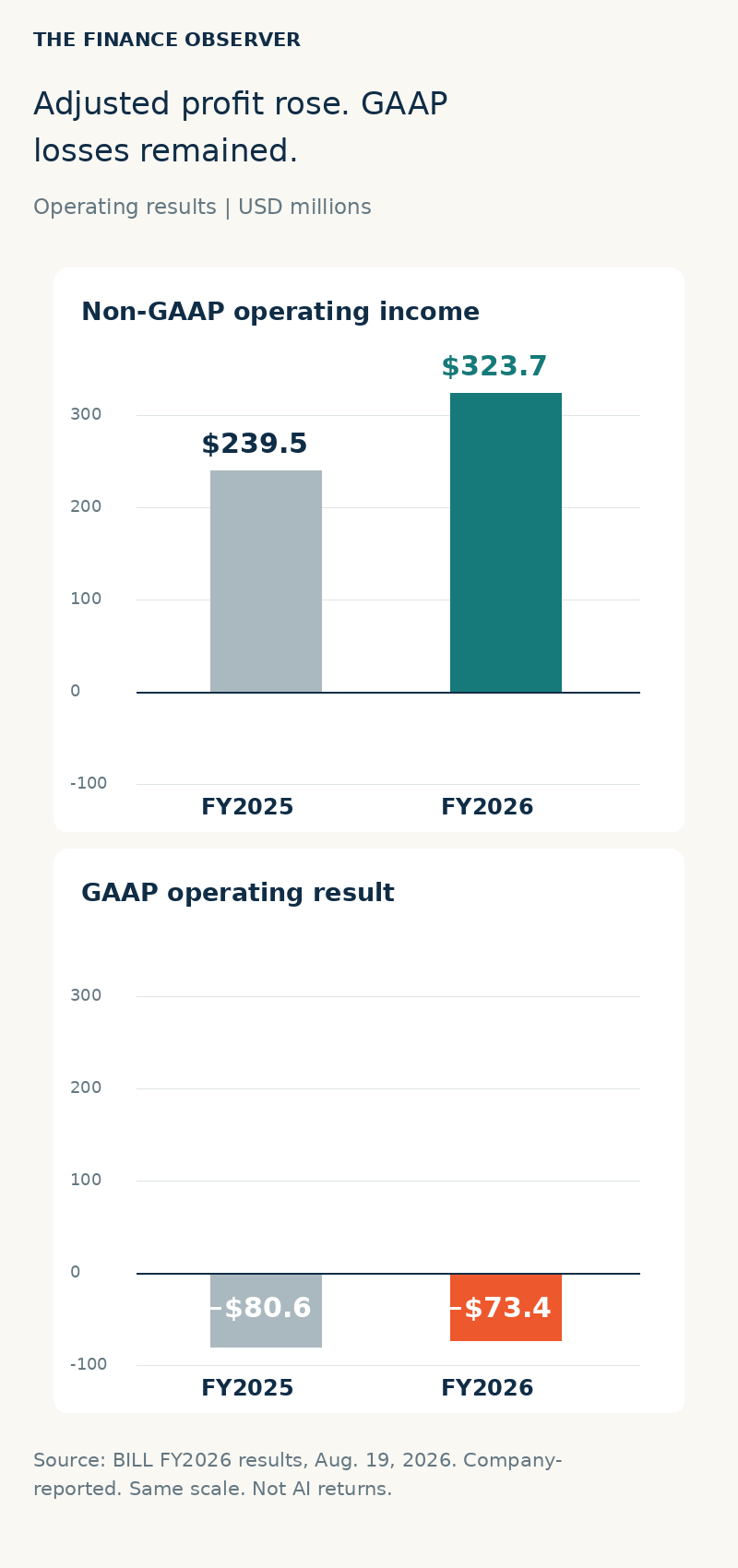
BILL excludes expenses including stock-based compensation, depreciation and amortization, and restructuring from its non-GAAP operating results. [3] Both measures matter when assessing the financial profile; neither supplies a standalone return calculation for the AI program.
The case therefore supports a narrower conclusion than “AI made the company more productive.” BILL reported higher adjusted operating profit while reshaping its organization. Establishing how much improvement came from particular automation initiatives would require evidence linking those initiatives to changes in work and cost.
For an internal finance review, request that link explicitly. Track the underlying workflow alongside its financial consequences. A favorable company-level result cannot explain every initiative inside it.
THE CLEVER PART — Make a decision about the capacity
The useful insight is that productivity needs an owner and a destination. If an automation project releases capacity, somebody must decide what the organization will receive in exchange.
There are several legitimate answers. The team can absorb growth, avoid a future hire, improve service or redirect attention toward more valuable work. Those choices should be visible in the operating plan.
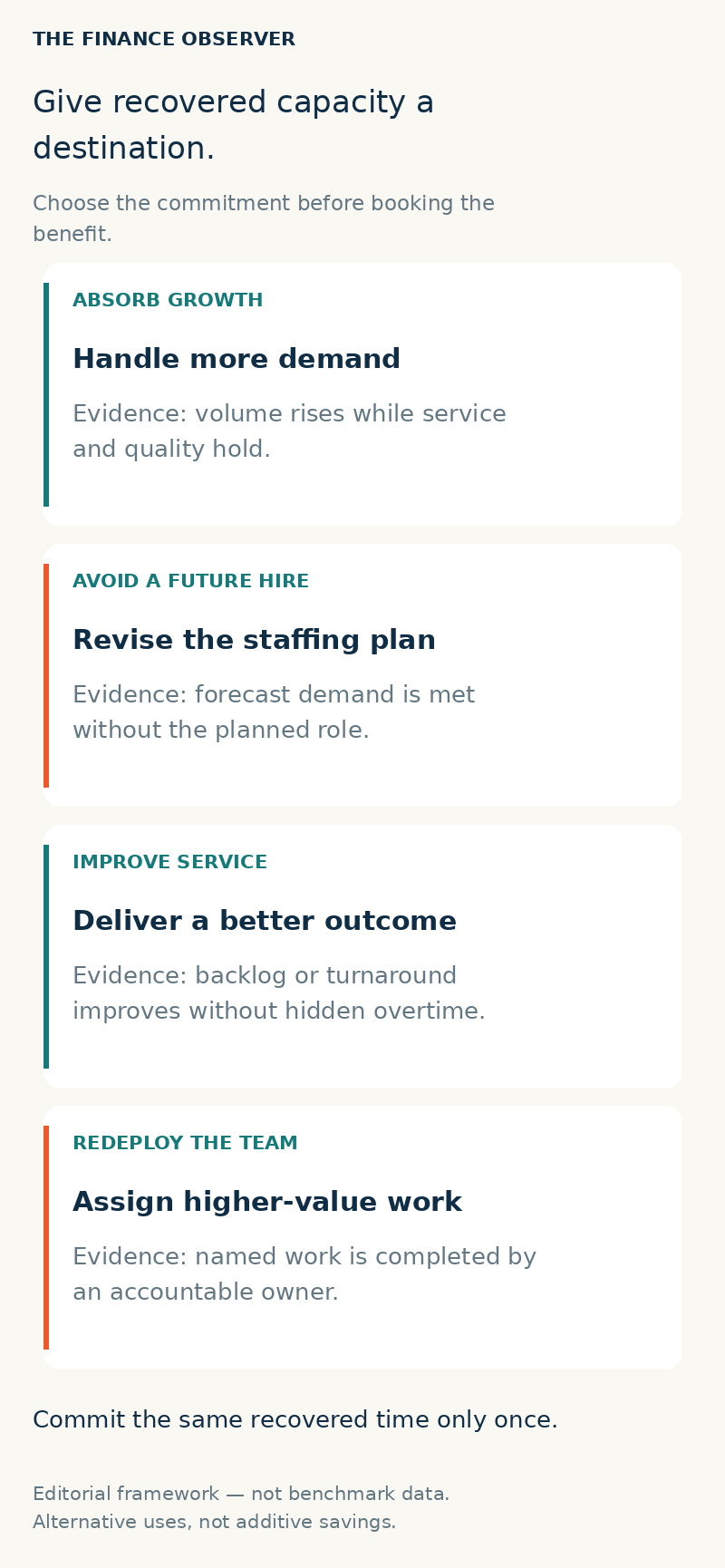
This distinction prevents a common planning error: making several commitments against the same pool of recovered time. A team cannot assume that all of its released capacity will absorb growth while also promising the full amount as a cost reduction.
Different claims also require different evidence. An avoided hire needs a credible demand forecast and a comparison with the staffing plan. Better service needs an observable change in delivery. Redeployment needs named work and an accountable owner. These are decisions a finance partner can help make before a benefit gets embedded in the budget.
STEAL THIS IDEA — Build a capacity plan for one workflow
Start with a process whose output you can observe, such as invoice handling, cash application or account reconciliation. Use the following review to translate a promising pilot into an operating decision.
- 01Establish the workload — Record demand, complexity, backlog, turnaround time and quality. Include a representative busy period. An average week may hide the conditions that determine staffing needs.
- 02Identify work removed and work added — Describe the task the tool performs and the checks people still undertake. Include exception handling, corrections, monitoring and maintenance. Measure the workflow across teams so that work transferred to another department is not mistaken for work eliminated.
- 03Choose the destination — State the specific commitment the released capacity will support. “Improve efficiency” is too vague to plan around. “Support the forecast increase in invoice volume before approving the next planned hire” identifies a decision that can be tested.
- 04Set the evidence required — Agree on throughput, service and control measures with the process owner. Define the conditions that would make you reconsider. A growing backlog or rising correction rate should trigger investigation even if the cost line looks favorable.
- 05Change the plan when the evidence supports it — Software, implementation and continuing review costs belong in the calculation. Distinguish cash savings from avoided future spending and from capacity used to improve delivery. Report each in its own terms.
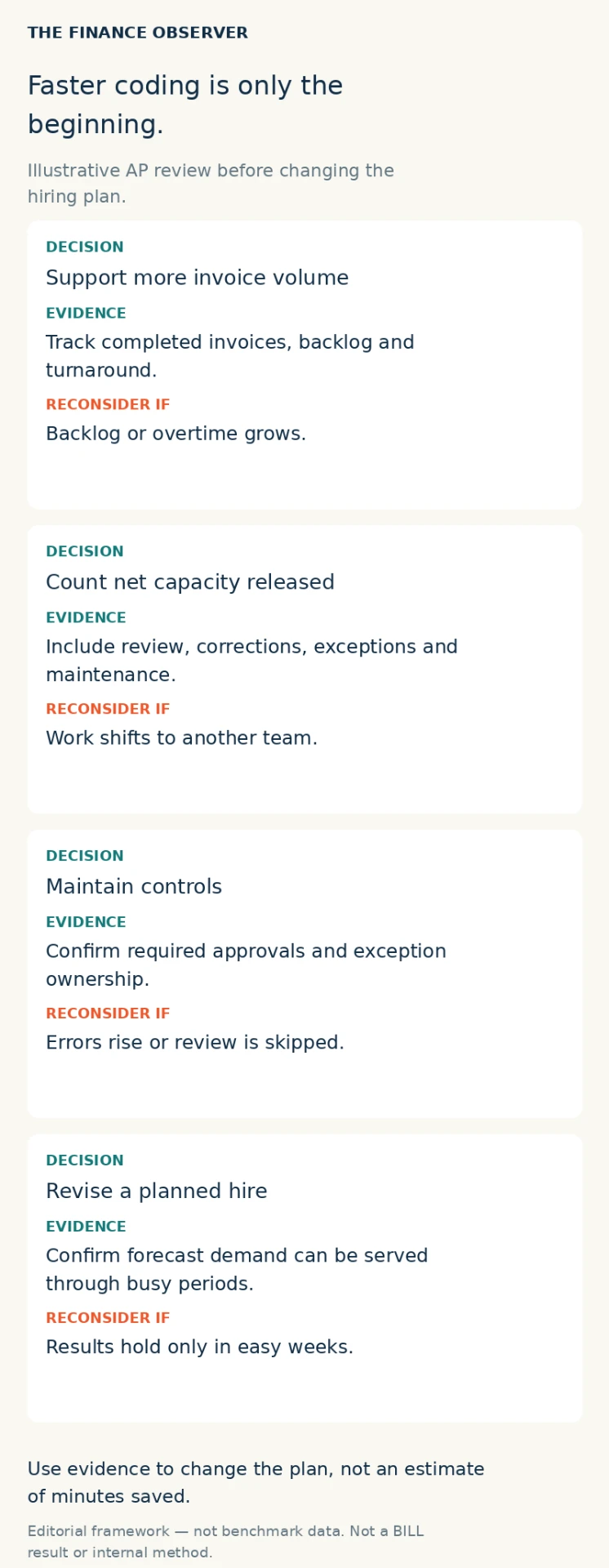
Consider that AP example. Faster invoice coding may leave the team with extra time, but supplier questions and exceptions still need attention. If the chosen destination is growth absorption, the pilot must show that the team can handle the expected workload without deteriorating service, errors or rising overtime.
The staffing decision then follows that evidence. A claim about faster coding alone is insufficient because coding is only one part of the job.
This gives the finance team a useful role beyond checking the business case. It helps the process owner turn a technology change into a realistic delivery commitment.
DON’T COPY THIS — The percentage or the sequence
BILL’s workforce reduction belongs to its own circumstances. It should not become a target for another organization’s AI initiative.
Cutting capacity before a replacement process is dependable puts pressure on the people and controls that remain. A workflow can appear efficient during routine processing while relying on experienced employees to resolve unfamiliar cases. Remove that expertise, and the difficult work may accumulate out of view.
Before changing a staffing assumption, examine exceptions, absences and peak demand. Check whether automation has concentrated review responsibilities in one person or weakened the separation between preparation and approval.
The practical lesson is to make resource decisions explicit and support them with evidence. The case does not establish that a reduction of this size is necessary for transformation, or that equivalent cuts would work elsewhere.
THE MONDAY-MORNING VERSION
Bring the largest automation initiative in your budget to its process owner and ask:
“If this works, which commitment in our operating plan changes?”
Write the answer in one sentence:
We will use the capacity released from [specific work] to deliver [specific outcome], and change [budget, staffing or service commitment] once [evidence] confirms that quality and controls hold.
That sentence exposes what a generic productivity claim leaves unresolved: who receives the benefit, what changes and when the decision becomes defensible.
BILL supplies the consequential management case. The useful idea for your team is to give every material productivity improvement a destination—and make the operating plan show it.
Sources & further reading
- Wall Street Journal / CFO JournalBill’s CFO on Going AI-First—and Cutting Jobs—in Her Rookie YearSeptember 10, 2026
- BILLCFO appointment announcementJune 2, 2025
- BILLFourth Quarter and Fiscal Year 2026 Financial ResultsAugust 19, 2026
- Topics
- AI & Automation
- For
- CFO · VP Finance · Controller · Finance Operations · FP&A Leader
- Level
- Leadership

About the author
Sophie GrantFinance Technology Correspondent
Sophie covers finance technology and the systems behind accounting and reporting.
The Finance Observer content is for informational purposes only and is not professional financial, tax, legal or investment advice.
Related reading

Finance Is Deploying AI Agents Faster Than It Can Govern Them
A vendor-sponsored survey of more than 1,500 finance leaders finds 92% under pressure to prove agentic-AI ROI, only 7% prioritizing governance over speed and 30% who have not updated controls in the past year.

Finance Has Deployed AI. It Has Barely Redesigned the Jobs.
Adoption has outrun organization design: most finance functions have deployed AI without redesigning roles, controls, service models or performance measures — and that is where transformation value is being lost.

Finance AI Is Moving Up the Value Chain. The Best Returns Are No Longer in Automation.
KPMG’s 2026 study of 1,013 finance leaders finds the strongest reported AI gains in decision speed, decision quality and forecast accuracy — not task elimination. Adoption is now broad; exceptional performance is not.
Related across formats
Curated video and audio that share this article's finance topics.
SAP’s Autonomous Finance Vision: What CFOs Should Look For Beyond the AI Demo
SAP
In this SAP Finance Connect keynote, SAP presents how AI assistants and agents could fit into core finance workflows, from accounting and consolidation to planning, billing and payments. As a vendor-hosted keynote, its product capabilities and reported benefits are SAP and participant claims rather than independently verified outcomes.
1Password’s CAO on Where AI Fits in a Well-Run Accounting Team
Senad Mustafic · Chief Accounting Officer, 1Password
Senad Mustafic, Chief Accounting Officer at 1Password, joins Kinter controller Armen Aklian, CPA, for an on-demand fireside chat (The CFO Track) about his path from financial analysis into controllership, how his thinking on AI has changed, and his approach to AI adoption at 1Password.

CFO Weekly
Why Accounting Judgment Still Matters When AI Does the Work
Host Megan Weis and Kerrie Jones, Financial Controller at Peak Living, on why following the correct process doesn’t guarantee a sensible outcome — and how controllers can teach accountants when to question the output, including AI’s. CFO Weekly is produced by Personiv.
CFO Weekly
Editor's PickThe Rise of AI-Driven Finance Teams
A forward-looking discussion on AI agents transforming accounts receivable, the shift from finance operators to finance architects, “headless finance,” and what the CFO function could look like in the next three to five years.