
AI & Automation
Finance Has Deployed AI. It Has Barely Redesigned the Jobs.
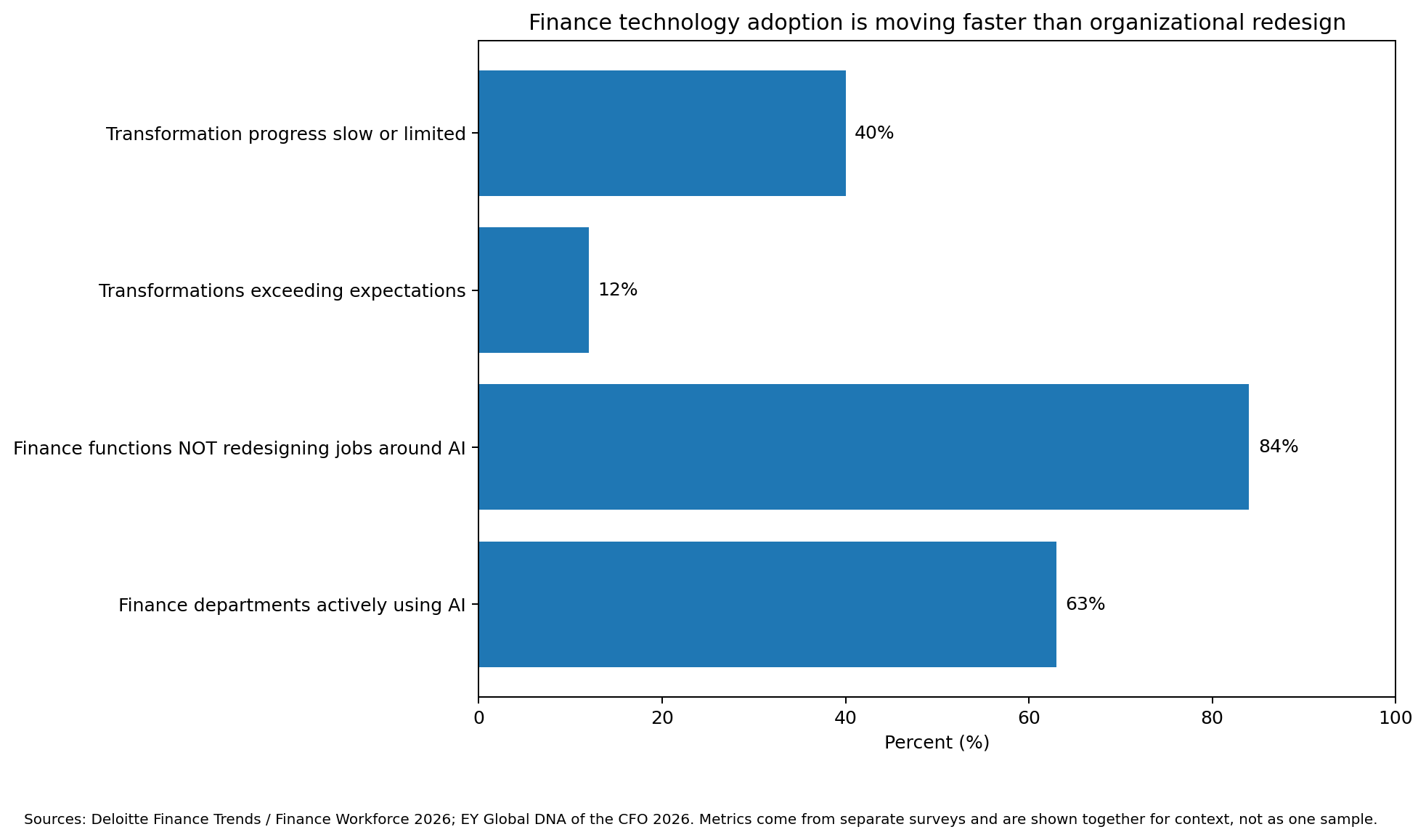
Deloitte says 63% of finance departments are actively using AI, yet 84% have not redesigned jobs or the nature of work around it. EY finds only 12% of CFOs say recent finance transformations exceeded expectations. The next transformation bottleneck is not software—it is the operating model.
For CFO · VP Finance · Controller · FP&A Leader
Level All Levels
Finance transformation has a new version of an old problem.
The technology changes. The organization does not.
Deloitte’s 2026 finance-workforce research says 63% of finance departments have fully deployed and are actively using AI solutions, yet 84% have not redesigned jobs or the nature of the work itself around AI.
That is a remarkable mismatch.
Companies are putting new capabilities into processes designed for older tools, then asking why the economics of transformation are disappointing.
EY’s 2026 Global DNA of the CFO survey offers the other half of the picture. Only 12% of CFOs say their finance transformation outcomes exceeded expectations during the previous two years, while 40% say progress has been slow or limited.
The issue is not that finance has failed to buy enough technology.
It is that transformation is still too often treated as a systems program with training attached at the end.
AI makes that model untenable.
If software can draft commentary, investigate variances, reconcile transactions, prepare journal support and coordinate workflow steps, finance cannot simply automate those activities and leave every role, review layer, service model and performance measure intact.
The work itself has to be redesigned.
Adoption has outrun organization design
The first phase of finance AI was easy to fit into the existing organization.
A controller got a reconciliation assistant. An FP&A analyst got a copilot. An AP team automated invoice extraction. Nobody had to redraw the org chart.
Agentic AI changes the pressure.
When a system can move across several steps rather than assist with one task, the boundary between roles begins to shift. A workflow that once required a preparer, analyst, reviewer and coordinator may need fewer handoffs but stronger exception ownership.
Deloitte’s finding—that 84% have not redesigned jobs around AI—suggests most finance functions are still in the overlay phase.
AI sits on top of the work.
It has not yet changed the work.
Why transformations underperform even when the tools work
A finance transformation can deliver technically and still fail economically.
The ERP goes live. The data warehouse is populated. The automation runs. The close dashboard works.
Yet the organization keeps the old spreadsheet because managers trust it more. Reviewers continue checking every transaction because the control policy never changed. Analysts use the hours saved by automation to produce more reports rather than better decisions. Business partners still spend their time assembling data.
That is why technology ROI can be difficult to see.
The process has changed locally while the operating model remains constant.
EY’s survey of 1,610 CFOs, finance directors and heads of finance across 28 countries found only 21% describe their finance function’s AI preparedness as leading or advanced. The same study argues that the constraint is often less the technology than the mindset, confidence and capabilities of finance teams.
That does not mean transformation is a “people problem.”
It means people, process, controls and technology are one system.
Changing only one component produces friction elsewhere.
Stop redesigning tasks. Redesign accountabilities.
The most useful question in an AI transformation is not “Which tasks can the agent do?”
It is “Who is accountable for the outcome after the agent does them?”
Consider variance analysis.
An AI system can identify deviations, retrieve supporting data, generate hypotheses and draft commentary. If the analyst’s role remains “produce the variance report,” the organization may simply get the same report faster.
A redesigned role looks different.
The analyst owns whether management understands the economic driver, whether the forecast changes and whether action is required.
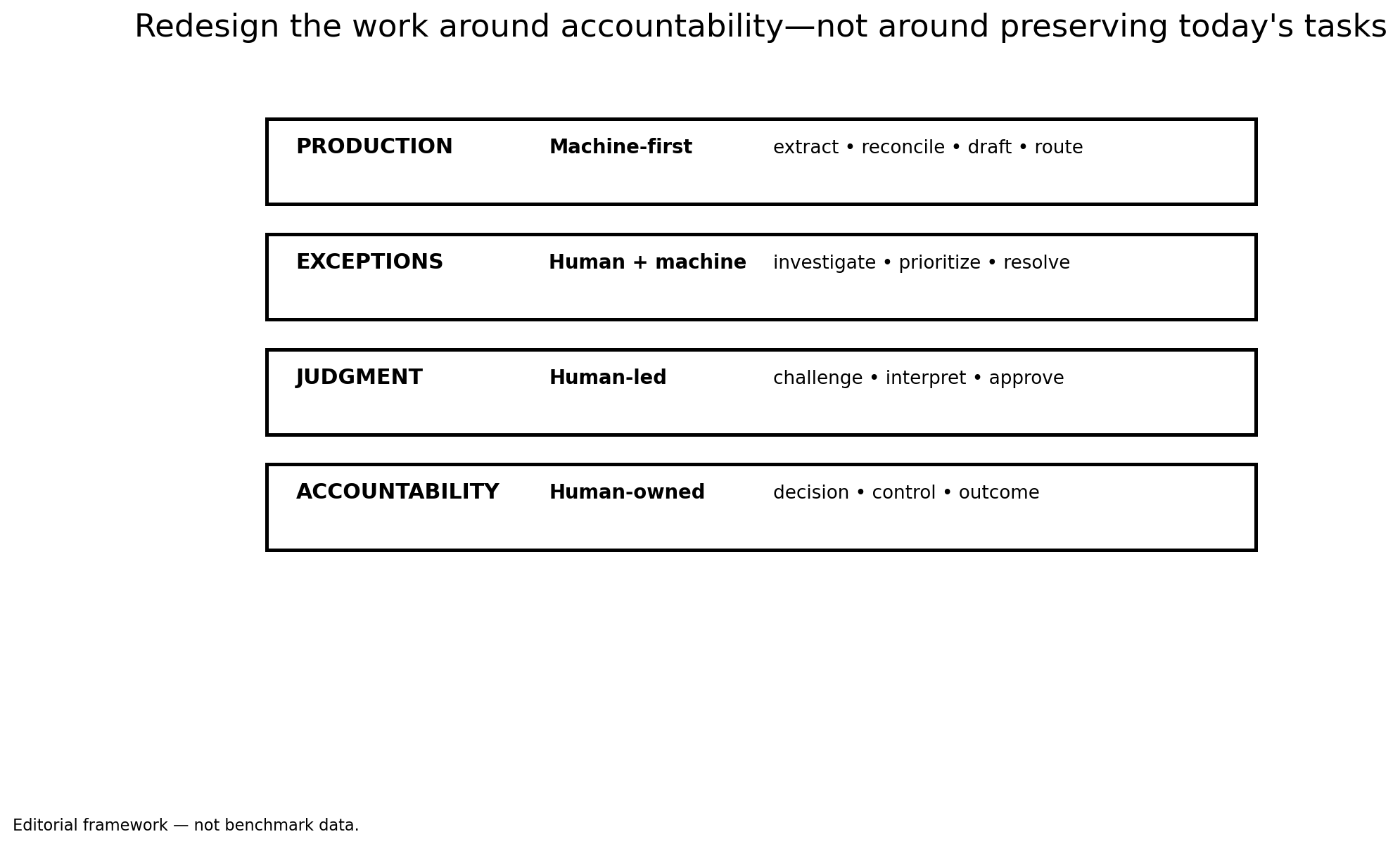
The machine handles more production. The human owns more judgment.
That shift should appear in job descriptions, goals and performance reviews.
Otherwise finance tells people to become strategic while continuing to measure them on output volume.
The middle layer is where transformation gets difficult
Senior finance leaders often describe a future organization with fewer manual tasks and more business partnership.
The transition is hardest in the middle.
Managers and controllers frequently exist partly because complex processes require coordination, review and escalation. Automation can reduce some of that coordination while increasing the importance of judgment and control design.
The role does not disappear.
It changes from supervising production to supervising a human-machine system.
That requires different skills: interpreting exceptions, designing thresholds, challenging model output, understanding data lineage and deciding when automation should stop.
Finance transformation programs rarely budget enough time for this managerial redesign.
They train users on the new tool but do not redefine what good management looks like after the tool arrives.
Shared services need a new economic model
The classic finance transformation playbook moved standardized work into shared services or global business services, then reduced unit cost through scale, labor arbitrage and process standardization.
AI changes the economics.
If transactional work becomes increasingly automated, the advantage of a service center may shift away from labor cost and toward process ownership, data quality, automation governance and exception expertise.
A center that once measured invoices per FTE may need to measure straight-through processing, exception resolution, control effectiveness and time to root cause.
That is a very different operating model.
It also changes location strategy.
If fewer roles are pure transaction processing, access to analytical, technical and process-engineering skills can matter more than wage differential alone.
Finance needs to design the human-machine boundary explicitly
“Human in the loop” is not an operating model.
Finance should define where human judgment is economically and legally valuable.
A useful transformation design starts with four questions:
- 01What can the system observe?
- 02What can it recommend?
- 03What can it prepare?
- 04What can it execute?
Then add the finance questions: what is material, what requires segregation of duties, what requires accounting judgment and what evidence must remain?
The answer will differ by process.
An agent may automatically resolve low-value bank reconciliation exceptions but only recommend treatment for unusual intercompany differences. It may draft a forecast narrative but never change the approved plan. It may prepare a journal but require human approval above a threshold.
The operating model is the map of those boundaries.
The skills gap is not primarily prompting
Finance AI training has often focused on how to use the tool.
That is necessary and insufficient.
Deloitte’s workforce research argues that strategic judgment, curiosity and agility become more important as AI changes finance work. The study is based on 1,800 responses and describes a workforce whose expectations and work patterns have shifted materially since Deloitte’s 2022 research.
The high-value skill is not writing a clever prompt.
It is knowing when the output is wrong.
An FP&A professional needs enough commercial understanding to challenge an AI-generated explanation. An accountant needs enough technical accounting knowledge to reject a plausible but incorrect classification. A treasury analyst needs to understand liquidity risk rather than simply accept a recommended transfer.
Automation increases the premium on domain judgment because routine production no longer provides the same apprenticeship.
That creates a new talent problem.
If junior staff do less manual preparation, where do they learn the mechanics that senior judgment depends on?
Transformation plans need an answer.
Apprenticeship has to be redesigned too
Finance careers have historically been built through repetition.
Analysts learn the P&L by building it. Accountants learn the close by preparing reconciliations. Treasury staff learn cash behavior by moving through daily positioning.
If AI performs more of that work, organizations can lose the learning embedded in production.
The solution is not to preserve inefficient tasks for educational purposes.
It is to make learning deliberate.
Junior staff can review machine-prepared work, investigate exceptions, rotate through process ownership and receive structured exposure to the underlying accounting and business logic.
The role of the manager becomes partly educational: explaining why the automated answer is accepted or rejected.
That is more demanding than the old apprenticeship.
It can also be better.
Transformation metrics need to move beyond capacity
Many finance business cases begin with FTE capacity.
That is understandable because it is measurable.
But a transformation that frees 20% of analyst time and then leaves the organization unsure what to do with it has not created 20% value.
Finance should track where the capacity goes.
Did forecast cycle time fall? Did managers receive analysis earlier? Did exception backlogs shrink? Did finance support more commercial decisions? Did controls improve? Did the team stop producing low-value reports?
The metric is not capacity released.
It is capacity redeployed.
That distinction forces leadership to make an explicit choice about the future work of finance.
CFOs need to transform the management system
EY’s research frames successful transformation as a combination of mindset, skill set and toolset.
For CFOs, the practical implication is broader.
The management system has to change.
Roles, spans, service centers, controls, career paths, objectives and performance measures should all reflect the new division of work between people and technology.
That is why transformation cannot be delegated entirely to the ERP program, automation CoE or data team.
Those groups can build capabilities.
Only finance leadership can decide what the function becomes.
The next phase is organizational, not technological
2026 may be remembered as the year finance AI moved from experimentation toward normal infrastructure.
That makes the organizational lag more visible.
Sixty-three percent active AI use alongside 84% without job redesign is not a contradiction. It is a description of the current stage of transformation.
The tools arrived first.
Now the harder work begins.
Finance has to decide which activities disappear, which judgments become more important, which controls change, how managers supervise software actors and how people build expertise when machines perform more of the practice.
The CFO who treats AI as another productivity tool may get incremental efficiency.
The CFO who redesigns the operating model around it has a chance to build a different finance function.
That is the transformation.
Key takeaways
- CFO
- Treat the operating model — roles, spans, controls, service centers, career paths and performance measures — as part of the AI program, not a change-management afterthought.
- Finance Leaders
- Measure capacity redeployed rather than capacity released: cycle times, exception backlogs, earlier analysis and control effectiveness.
- Controller
- Define explicitly what an agent may observe, recommend, prepare and execute, and where materiality, segregation of duties and accounting judgment require a human owner.
- FP&A
- Invest in domain judgment over prompting: the durable skill is recognizing when an AI-generated explanation or classification is wrong.
Sources & further reading
- DeloitteThe finance workforce of 2026Primary research — 1,800 responses; 63% report AI fully deployed and actively used, 84% have yet to redesign jobs or the nature of work around AI
- DeloitteFinance Trends 2026More than 1,300 global finance leaders; 63% active AI use; 21% report clear measurable ROI
- EY2026 Global DNA of the CFO SurveyJune 3, 2026 — 1,610 CFOs and heads of finance across 28 countries, fielded Feb. 16–Mar. 30, 2026; 21% describe AI preparedness as leading/advanced, 12% exceeded transformation expectations, 40% slow or limited progress
- DeloitteQ4 2025 CFO SignalsJanuary 13, 2026 — 50% of North American CFOs name digital transformation of finance a top 2026 priority; 49% cite automation to free employees for higher-value work; 87% expect AI to be extremely/very important to finance operations
Deloitte and EY metrics come from separate surveys with different samples and methodologies and are never presented as a single combined sample. Survey associations are not treated as causal proof. The operating-model redesign framework is a The Finance Observer editorial framework, not benchmark data. No information published after September 6, 2026 is included and no quotes are invented.
- Topics
- AI & Automation
- For
- CFO · VP Finance · Controller · FP&A Leader
- Level
- All Levels

About the author
Sophie GrantFinance Technology Correspondent
Sophie covers finance technology and the systems behind accounting and reporting.
The Finance Observer content is for informational purposes only and is not professional financial, tax, legal or investment advice.
Related reading

BILL Cut 30% of Its Workforce. What Should Another CFO Actually Steal?
The useful lesson is a decision every finance team can make: where will the capacity released by automation go—and what evidence will justify changing the plan?
Finance Is Deploying AI Agents Faster Than It Can Govern Them
A vendor-sponsored survey of more than 1,500 finance leaders finds 92% under pressure to prove agentic-AI ROI, only 7% prioritizing governance over speed and 30% who have not updated controls in the past year.
Finance AI Is Moving Up the Value Chain. The Best Returns Are No Longer in Automation.
KPMG’s 2026 study of 1,013 finance leaders finds the strongest reported AI gains in decision speed, decision quality and forecast accuracy — not task elimination. Adoption is now broad; exceptional performance is not.
Related across formats
Curated video and audio that share this article's finance topics.
SAP’s Autonomous Finance Vision: What CFOs Should Look For Beyond the AI Demo
SAP
In this SAP Finance Connect keynote, SAP presents how AI assistants and agents could fit into core finance workflows, from accounting and consolidation to planning, billing and payments. As a vendor-hosted keynote, its product capabilities and reported benefits are SAP and participant claims rather than independently verified outcomes.
1Password’s CAO on Where AI Fits in a Well-Run Accounting Team
Senad Mustafic · Chief Accounting Officer, 1Password
Senad Mustafic, Chief Accounting Officer at 1Password, joins Kinter controller Armen Aklian, CPA, for an on-demand fireside chat (The CFO Track) about his path from financial analysis into controllership, how his thinking on AI has changed, and his approach to AI adoption at 1Password.

CFO Weekly
Why Accounting Judgment Still Matters When AI Does the Work
Host Megan Weis and Kerrie Jones, Financial Controller at Peak Living, on why following the correct process doesn’t guarantee a sensible outcome — and how controllers can teach accountants when to question the output, including AI’s. CFO Weekly is produced by Personiv.
CFO Weekly
Editor's PickThe Rise of AI-Driven Finance Teams
A forward-looking discussion on AI agents transforming accounts receivable, the shift from finance operators to finance architects, “headless finance,” and what the CFO function could look like in the next three to five years.