
FP&A, Planning & Analytics
FP&A Bought More Tools. The Data Problem Got Worse.
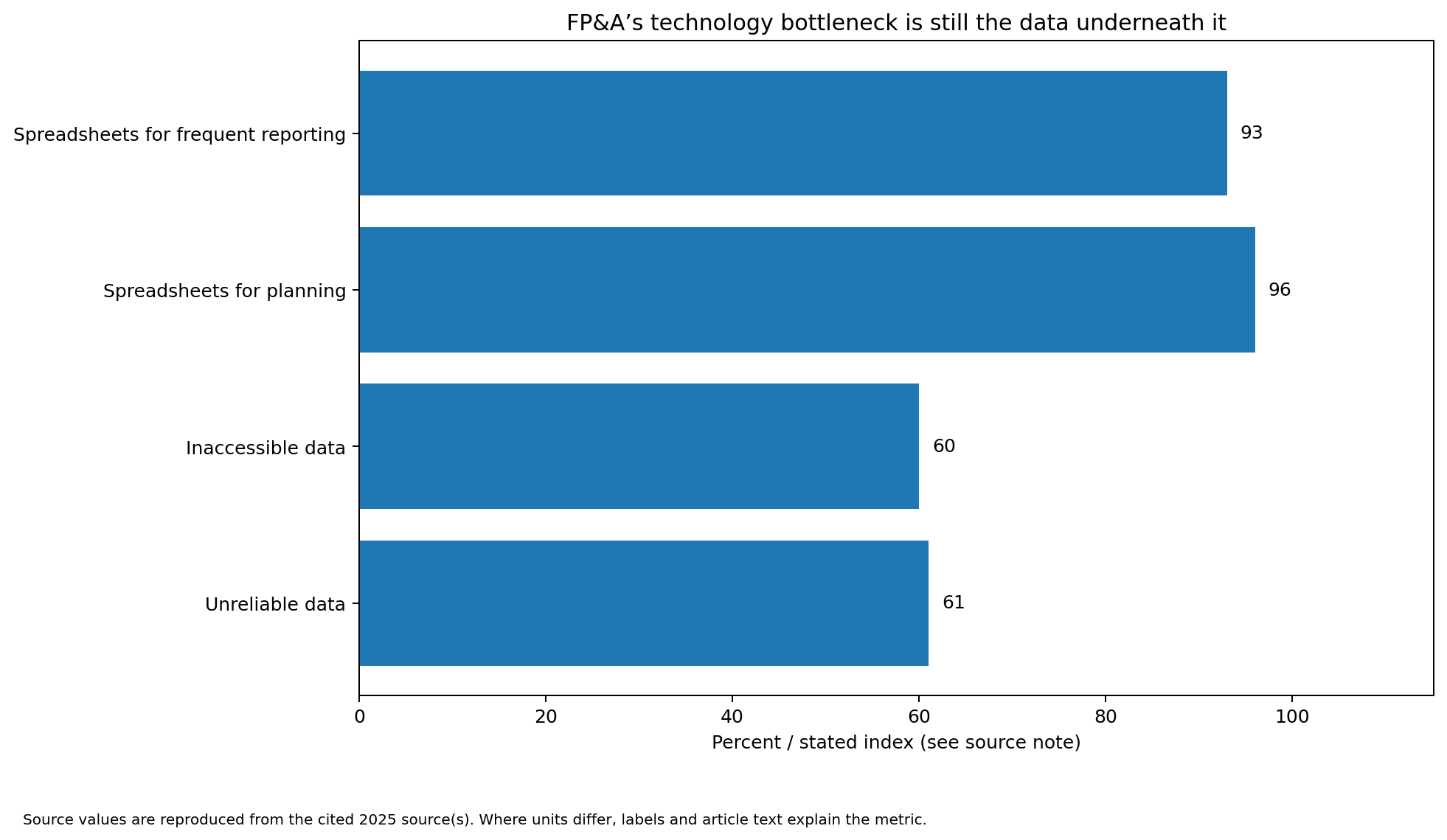
AFP’s 2025 benchmark found 61% of FP&A professionals challenged by unreliable data and 60% by inaccessible data, while spreadsheets remained nearly universal. The next planning upgrade is less about another application than about fixing the information supply chain.
For FP&A Leader · FP&A Analyst · Financial Analyst · Controller · CFO
Level All Levels

AFP’s 2025 benchmark found 61% of FP&A professionals challenged by unreliable data and 60% by inaccessible data, while spreadsheets remained nearly universal. The next planning upgrade is less about another application than about fixing the information supply chain.
The useful way to read this story at the end of 2025 is not as another technology headline or survey statistic. It is evidence that the Office of the CFO is changing where work happens, who owns the decision and what has to be controlled. The specific numbers matter, but the managerial implication matters more: finance teams are being asked to move faster without lowering the standard for accuracy, auditability or economic judgment.
What the 2025 evidence actually says
Verified finding 1. 61% cited lack of data reliability as a technology challenge.
Verified finding 2. 60% cited lack of accessible data.
Verified finding 3. 96% used spreadsheets for planning and 93% used them for reporting daily or weekly.
Verified finding 4. More than half used at least eight categories of planning tools and 10 reporting-tool types quarterly.
These findings should be read within the scope of their underlying surveys, product announcements or case evidence. Vendor claims are not treated as independent benchmarks, and survey associations are not treated as proof that one practice caused another outcome.
Why this deserves attention now
The finance function has spent much of the last decade digitizing individual activities. In 2025 the pressure moved toward the connections between them. Planning depends on trusted data. Accounting automation depends on clean process design. Procurement risk reaches treasury through payments. Billing architecture affects revenue recognition and collections. AI depends on governed business definitions.
That interdependence changes the economics of transformation. A local improvement can be real and still fail to improve the end-to-end process if the next handoff remains manual, ambiguous or poorly controlled. CFO organizations therefore need to evaluate change at the workflow level rather than by counting features deployed.
For practitioners, the practical question is simple: what decision becomes better, faster or safer because of this change? If that question cannot be answered, the initiative may be technically impressive without being financially important.
The control question is becoming inseparable from the productivity question
Finance cannot adopt the same definition of speed as a consumer application. A forecast, journal, supplier change, credit decision or cash movement becomes valuable only when users can understand where the information came from and who remains accountable.
That makes control design part of product design. The right workflow does not merely automate a step. It defines evidence, thresholds, exceptions, approvals and escalation. As AI and automation move closer to execution, those boundaries become more important.
A useful test is to divide the process into four layers: observation, recommendation, preparation and execution. Finance can often automate observation aggressively. Recommendation requires validation. Preparation can be automated when evidence is retained. Execution should depend on materiality, authority and risk.
What managers should change
Managers should start with the process rather than the software. Map the current handoffs, identify the slowest decision and separate genuine judgment from administrative work. Then decide which data definitions must be common across the process.
Next, create a small set of outcome measures. Cycle time is useful, but it is not enough. Add exception rates, rework, control failures, decision latency and the amount of senior-finance capacity consumed by routine production.
Finally, define ownership after automation. If a system drafts the answer, someone still owns whether the answer is economically and technically correct. That accountability should appear in the operating model, not remain an informal expectation.
What controllers and CFOs should be skeptical about
The 2025 market produced a large amount of confident language about autonomous finance, continuous planning, intelligent procurement and agentic workflows. Buyers should distinguish availability from adoption and adoption from proven value.
A feature in preview is not the same as a production control environment. A vendor-reported customer outcome is not a market benchmark. A survey showing that higher-performing organizations use a practice more often does not establish causation.
Finance leaders should ask for evidence that matches their environment: transaction volume, entity complexity, regulatory requirements, ERP architecture, data quality and staffing model.
The architecture underneath the headline
The most durable change is often less visible than the application interface.
Finance increasingly needs a common layer of definitions, permissions and process state that can be used by people, analytics and AI. Without it, every new tool creates another interpretation of customer, revenue, supplier, cash or margin.
This is why data governance and workflow governance keep reappearing across seemingly unrelated finance stories. The issue is not centralization for its own sake. It is creating enough consistency that automation can scale without multiplying reconciliation work.
A practical 90-day response
Finance teams do not need a multi-year program to act on this trend. Pick one high-friction workflow and establish a baseline. Document the current cycle time, manual touches, data sources, exceptions and control points.
Then redesign only the part that creates the largest delay or risk. Use existing technology where possible. Test with real users. Require evidence for every automated decision. Measure whether the process improved.
If it works, standardize the pattern before expanding it.
That sequence—prove, control, standardize, scale—is less dramatic than a transformation announcement. It is also more likely to survive the next budget cycle.
What 2025 changed
The year did not eliminate the old finance constraints. Spreadsheets remained pervasive. Experienced talent remained uneven. Data quality remained a problem. Fraud remained high. Economic and trade uncertainty complicated planning.
What changed was the cost of leaving those constraints disconnected.
The strongest finance organizations are beginning to treat data, process, technology, controls and talent as one operating system. That is the operating-model lesson behind this story.
For FP&A, Planning & Analytics leaders, the implication is not to chase every 2025 trend. It is to identify which trend changes the economics or risk of a process they already own—and redesign that process deliberately.
That is where the headline becomes finance value.
Key takeaways
- FP&A leaders
- Unreliable and inaccessible data — not missing applications — remain the top reported technology obstacles; fix the information supply chain before buying another tool.
- Controllers
- Design evidence, thresholds, exceptions and approvals into automated workflows; ownership of the answer must survive automation.
- CFOs
- Evaluate change at the workflow level with outcome measures beyond cycle time, and treat vendor-reported outcomes as claims rather than benchmarks.
Sources & further reading
- AFP2025 FP&A Benchmarking Survey61% cited unreliable data; 60% cited inaccessible data; 96% used spreadsheets for planning; 93% for frequent reporting
- AFPSurvey: Lack of Reliable and Accessible Data Holds FP&A Back From Success With TechnologyPress release, January 14, 2025
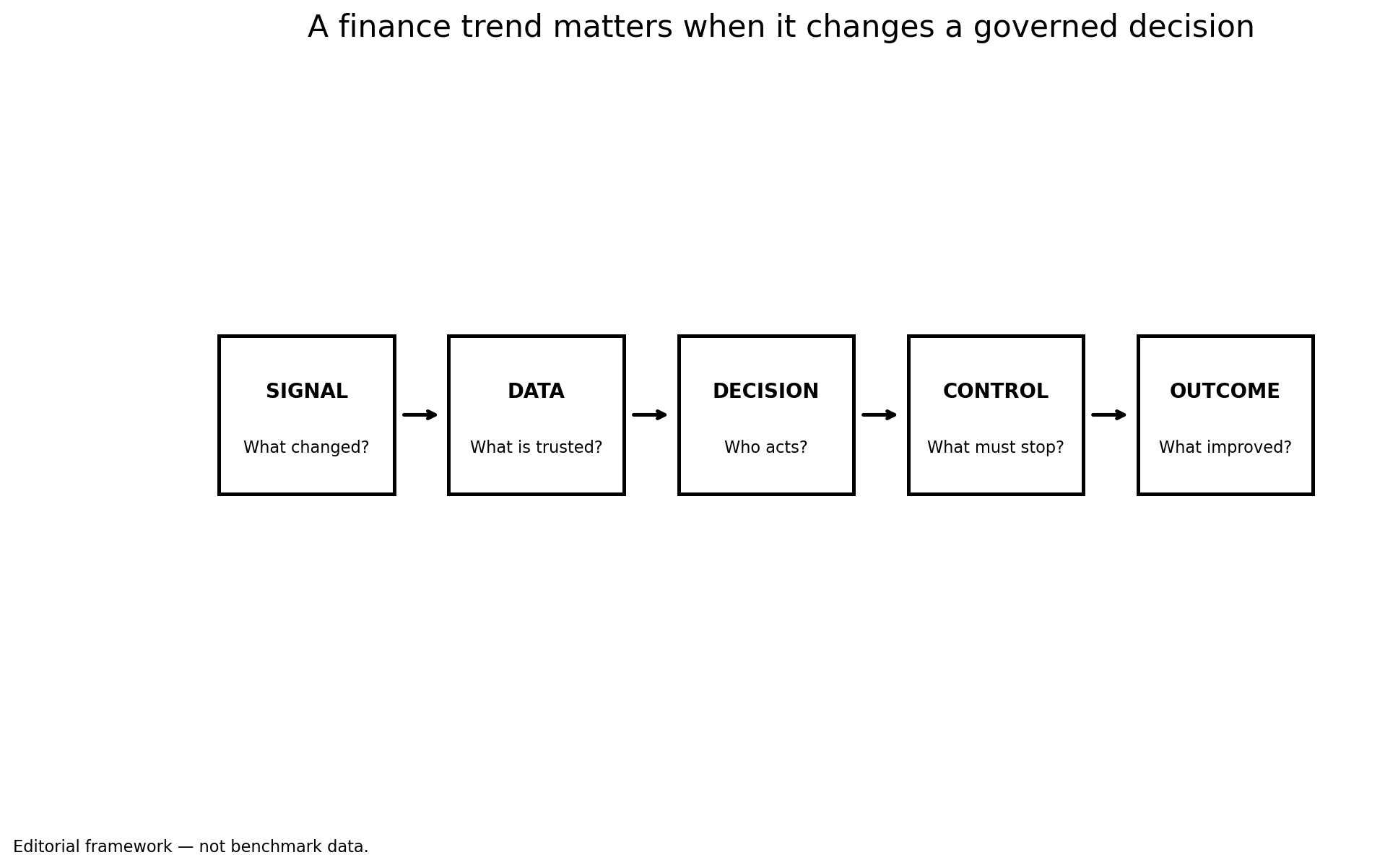
Survey findings are reported within the scope of their underlying samples and methodologies, and associations are not treated as causal proof. Vendor statements are identified as vendor-reported. The signal-to-outcome diagram is a The Finance Observer editorial framework, not benchmark data. Only information publicly available on or before December 31, 2025 is used, and no quotes are invented.
- For
- FP&A Leader · FP&A Analyst · Financial Analyst · Controller · CFO
- Level
- All Levels

About the author
Daniel BrooksFP&A & Analytics Editor
Daniel covers planning, forecasting and financial analytics, focusing on how finance teams are using better data, technology and new planning methods to improve business decisions.
The Finance Observer content is for informational purposes only and is not professional financial, tax, legal or investment advice.
Related reading

Financial Planning Software Is Converging Around Continuous Planning—and AI Is Raising the Bar.
Gartner’s December 2025 market view put integrated, intelligent and continuous planning at the center of the category — while spreadsheets stayed nearly universal. The buying question is shifting to governed planning across connected data and AI.
The Forecast Is Becoming a Living System
FP&A is moving from periodic forecasting toward a continuously updated view of the business — but spreadsheets, fragmented data and process design still stand in the way.
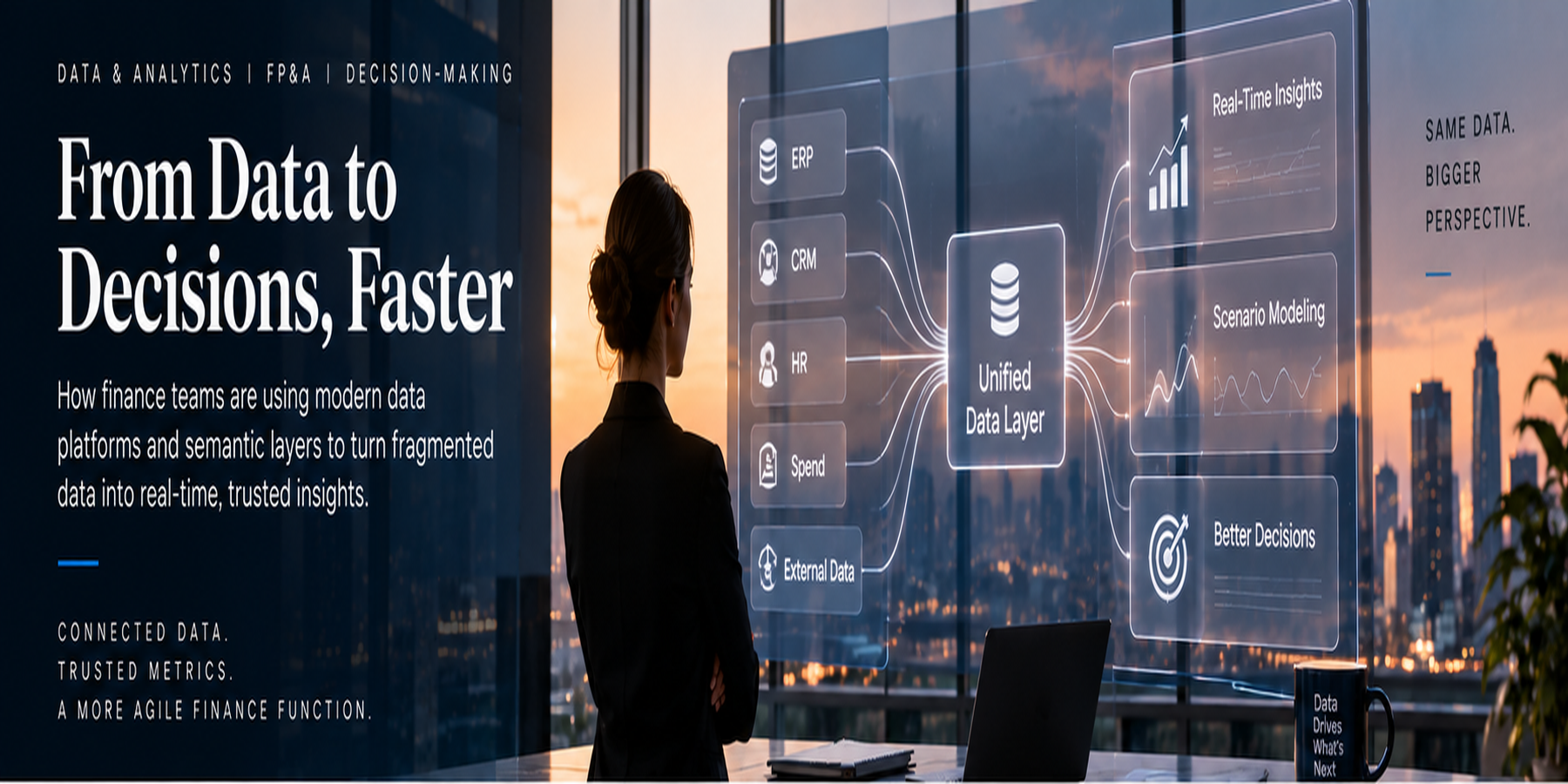
The Semantic Layer Is Back. This Time, Finance AI Depends on It.
Snowflake and Databricks are pushing governed business definitions into the data platform itself — turning the semantic layer into the contract that decides whether finance AI answers with the company's real definition of revenue and margin.
Related across formats
Curated video and audio that share this article's finance topics.
The CFO Playbook
Editor's PickThe Operator CFO: Turning Growth Ambition Into Margin, Cash and Accountability
Benzinga CFO Robert Checchia, with host David McClelland, explains why finance leaders need to get closer to operations, give P&L owners clearer numbers and connect growth decisions to margin and cash generation — plus prioritization under private-equity ownership and AI experimentation with guardrails.
CFO Thought Leader / Planning Aces
Editor's PickFinance Leaders Decode AI's Promise
Finance leaders explore AI agents for analytics, experimentation and order-to-cash checks, along with reconciliations, data readiness and opportunities to dramatically shorten finance cycle times.