
FP&A, Planning & Analytics · AI & Automation
The Forecast Is Becoming a Living System
Why FP&A is moving beyond static planning toward rolling forecasts, scenarios and AI-assisted decision making
For FP&A Analyst · FP&A Leader · Financial Analyst · CFO
Level All Levels
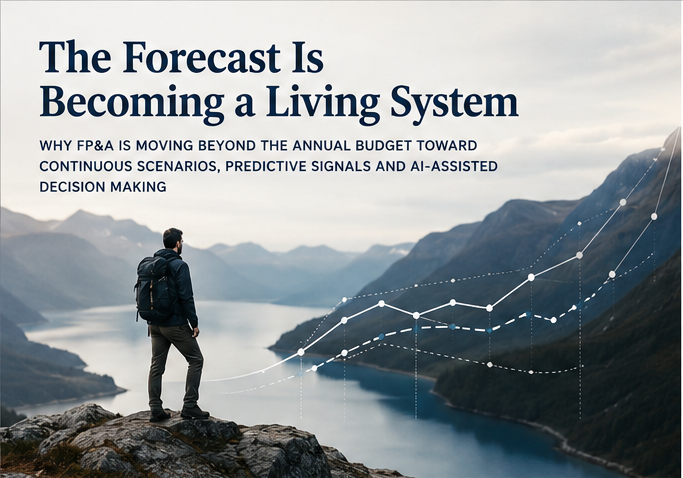
The Forecast Was Never Supposed to Be a History Lesson
For many FP&A teams, forecasting still begins with a familiar ritual: pull actuals, update a spreadsheet, chase business owners for assumptions, reconcile versions, explain variances, and publish a new view of the year.
The problem is not that this process produces no value. It is that the business can move faster than the forecast.
A pricing change, delayed product launch, hiring freeze, demand shock or cost increase can make a forecast stale almost as soon as it is approved. When the next formal reforecast arrives weeks later, FP&A may be explaining a reality that operating teams have already started responding to.
That is why one of the most important shifts in planning is not simply toward a more accurate forecast. It is toward a forecast that behaves more like a living system: refreshed as material drivers change, connected to operating assumptions, able to model alternatives, and designed to support decisions rather than merely document expectations.
The technology to support that model is advancing. The operating model is not always keeping up.
The Spreadsheet Paradox
The 2025 AFP FP&A Benchmarking Survey captures the contradiction clearly.
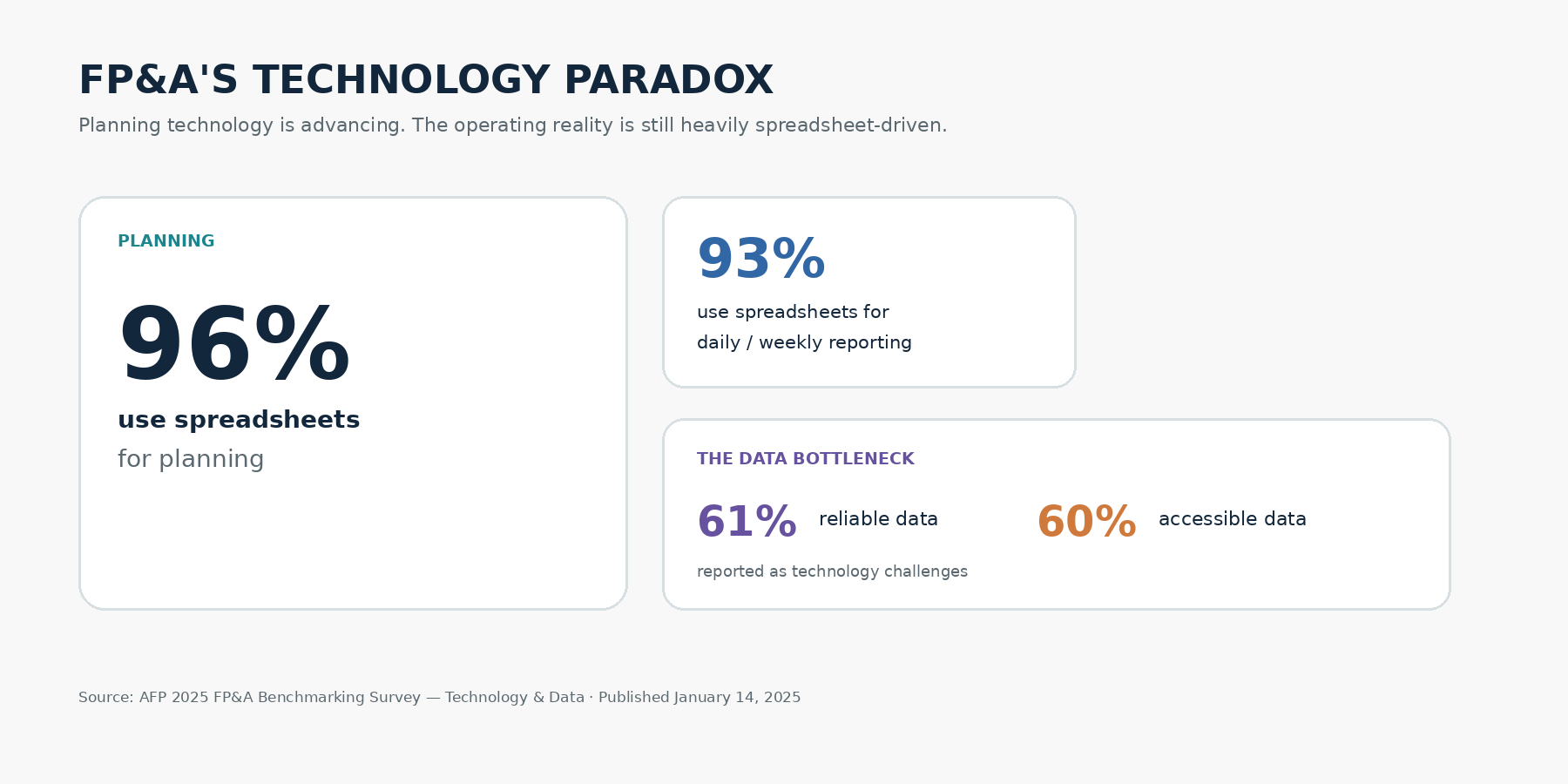
Among 362 FP&A and finance practitioners, 96% reported using spreadsheets for planning. Ninety-three percent used spreadsheets for reporting daily or weekly. At the same time, 71% used enterprise performance management tools for planning at least quarterly.
In other words, modern planning platforms have not displaced the spreadsheet. In many organizations they coexist with it.
AFP reported that 82% of respondents used spreadsheets to prepare data for EPM systems, 57% used spreadsheets to bypass EPM systems, and 85% used spreadsheets alongside EPM.
This matters because the ambition of continuous planning depends less on how sophisticated the forecasting model looks and more on whether assumptions, actuals and operational drivers can move through the planning process without constant manual reconstruction.
The biggest technology problem identified by respondents was not a lack of AI. It was data: 61% cited lack of reliable data as a challenge and 60% cited lack of accessible data.
That is a useful warning for any FP&A team rushing to add intelligence on top of a fragmented planning process.
AI Is Arriving — But It Is Not Yet the Operating Model
By early 2025, AI had clearly entered the FP&A conversation. It had not yet become standard practice.
AFP found that just 23% of respondents were using AI in FP&A on a daily, weekly or monthly basis, while 40% were testing it and planned to implement it within the following year.
A separate FP&A Trends Group poll conducted across eight FP&A Board meetings between January and March 2025, involving 322 senior finance leaders, painted a similarly early-stage picture: 53% reported no current AI use in FP&A, 27% used AI for reporting or workflow automation, 10% for forecasting and 10% for pattern and trend analysis.
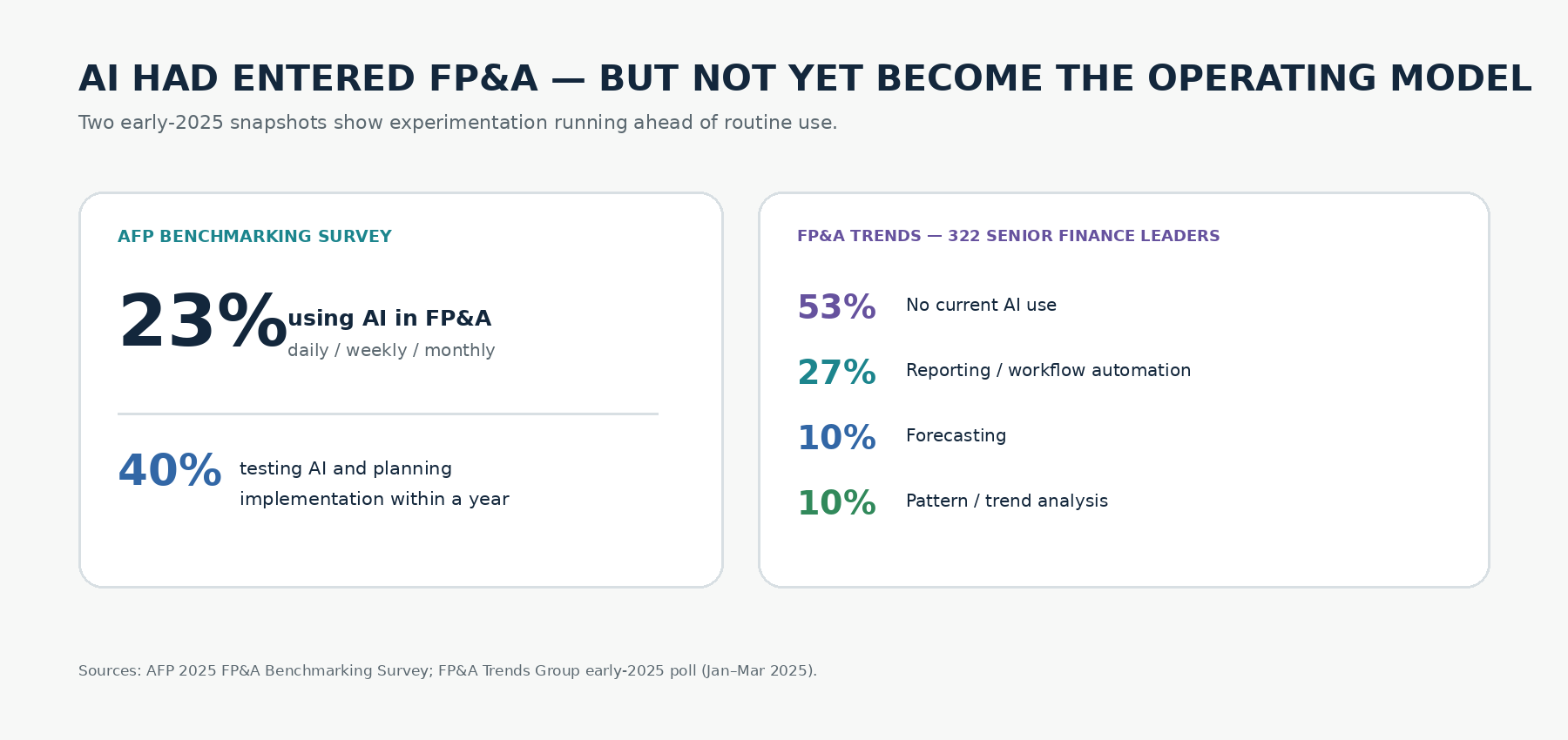
These numbers are important because they put the 2025 AI narrative in context.
The question is not whether AI can generate a forecast. The harder question is whether finance has the data, process discipline and trust required to make AI-generated signals part of real decisions.
As AFP President and CEO Jim Kaitz put it in January 2025:
“Technology, when implemented and upgraded properly and paired with skilled FP&A professionals, can have a significant impact on the success of an organization.”
The pairing matters. Technology without an operating model produces another tool. Technology embedded in a decision process can change how FP&A works.
From Calendar-Driven to Event-Driven Planning
Traditional planning is calendar-driven.
The budget starts because budget season starts. The forecast updates because the monthly or quarterly calendar says it is time. Business units submit assumptions because finance requests them.
A living forecast is more event-driven.
A meaningful driver changes. The model updates. A threshold is crossed. FP&A investigates. A scenario becomes materially more likely. Management sees the implication before the next scheduled planning cycle.
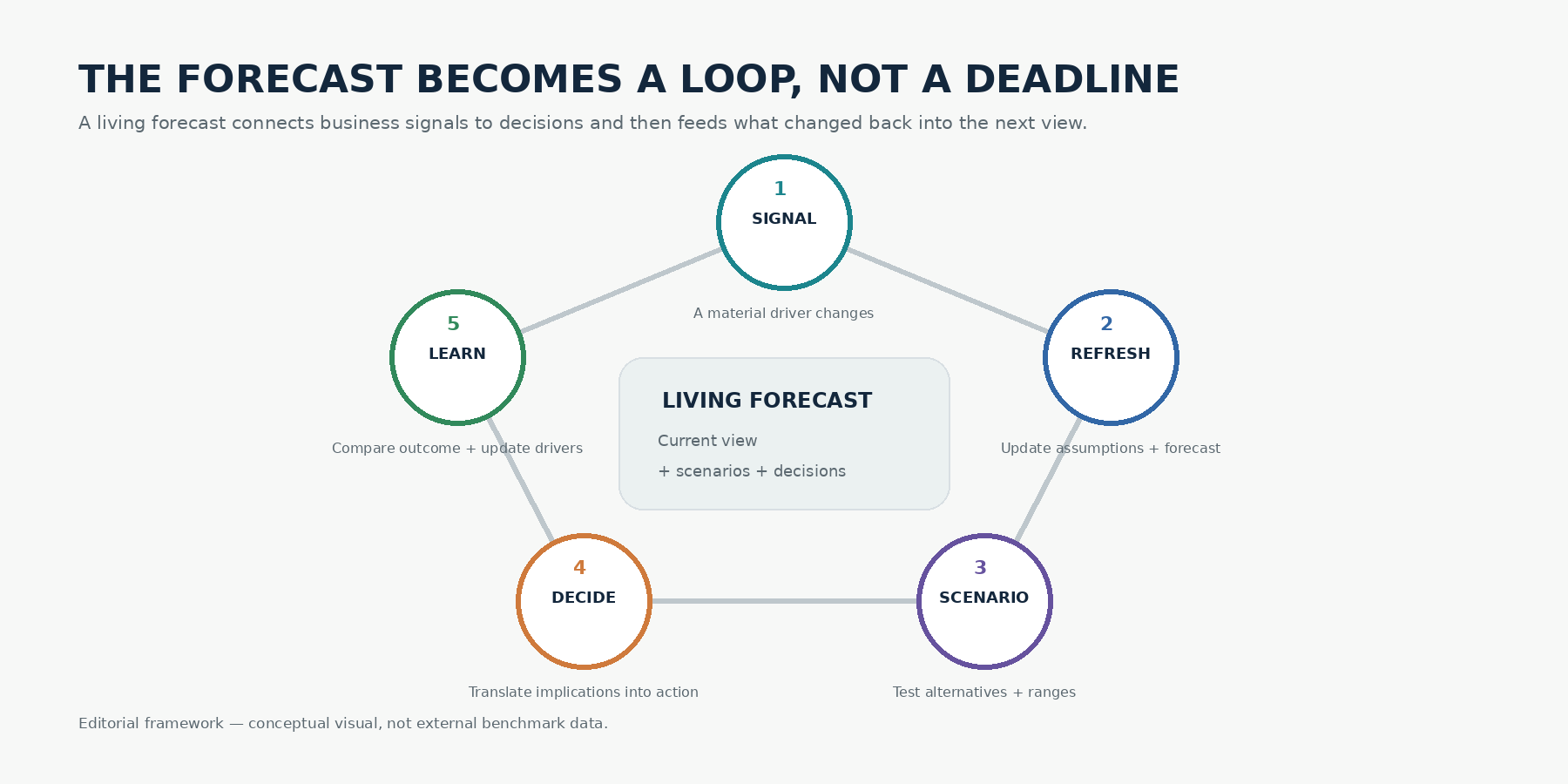
This does not mean a company should continuously change its official targets. Targets, forecasts and scenarios serve different purposes.
- A target — expresses ambition.
- A forecast — expresses the best current view of what is likely.
- A scenario — explores what could happen under different assumptions.
Confusing those three is one reason organizations resist frequent forecasting. If every forecast revision is interpreted as changing the target, teams learn to defend the old number rather than improve the view of reality.
What AI Can Actually Do for FP&A in 2025
The most credible near-term uses of AI are narrower than the idea of an autonomous finance department.
First, AI can reduce preparation work. It can help summarize large bodies of information, draft variance commentary, organize inputs and accelerate repetitive analytical steps.
Second, machine-learning approaches can detect patterns that may be difficult to identify manually, especially where forecasts depend on many historical and operational variables.
Third, generative interfaces can make analysis easier to interrogate. Instead of building a new report for every follow-up question, analysts can increasingly explore data using natural-language questions — provided the underlying data and semantic definitions are trustworthy.
Fourth, AI can assist scenario work. FP&A can spend less time mechanically rebuilding versions and more time testing which assumptions matter.
But the analyst remains responsible for a critical question: does the model understand the business event, or has it merely found a statistical pattern?
A forecast can be mathematically sophisticated and commercially wrong.
The Real Bottleneck Is Connected Planning
Gartner's March 2025 finance technology survey found that 50% of finance leaders planned significant increases in generative-AI spending. Planning, budgeting and forecasting were also among finance's top priorities.
Yet investment alone does not create continuous planning.
A forecast becomes useful when financial and operational drivers connect.
- Revenue — may depend on pipeline, conversion, price, capacity and churn.
- Payroll — depends on hiring plans, attrition, compensation and start dates.
- Inventory — depends on demand, lead times and purchasing decisions.
- Cash — depends on collections, payment behavior and working-capital assumptions.
If those drivers live in disconnected systems and arrive through email and spreadsheets, FP&A spends its time assembling the picture.
The future value of planning technology is therefore not simply a better forecasting algorithm. It is a shorter path from a change in the business to a decision-ready financial implication.
What Changes for the FP&A Analyst?
The analyst's job does not disappear when forecasting becomes more automated. The center of gravity moves.
Less valuable
- copying actuals between files
- reformatting recurring reports
- manually consolidating versions
- rebuilding standard variance commentary
- chasing numbers that already exist elsewhere
More valuable
- understanding business drivers
- challenging assumptions
- designing scenarios
- identifying material signals
- testing model outputs
- explaining uncertainty
- connecting financial outcomes to operational decisions
This is why technology skills and finance skills are converging. In AFP's 2025 survey, 83% of respondents said technology and data skills were as desirable as finance skills.
The strongest FP&A professional increasingly needs both.
A Practical Framework: Build the Living Forecast in Layers
- 01Define the decision — Do not begin with “we need AI.” Begin with the decision the forecast needs to improve.
- 02Identify the drivers — Separate inputs that genuinely change the outcome from detail that only makes the model larger.
- 03Fix the data path — Document where each driver originates, who owns it, how often it changes and how it reaches the model.
- 04Separate target, forecast and scenario — Give each a clear purpose so forecast updates do not become political renegotiations of targets.
- 05Automate the repetitive layer — Prioritize ingestion, consolidation, recurring calculations, standard reporting and first-pass analysis.
- 06Add predictive signals where they help — Use statistical or AI-based predictions where historical and operational data can genuinely improve the view.
- 07Keep human judgment visible — Record overrides, assumptions and reasons. A human adjustment can be valuable information rather than evidence that the model failed.
- 08Measure decision latency — Ask how long it takes from a meaningful business change to a finance view that management can act on.
What Should FP&A Measure?
Forecast accuracy still matters, but it is not enough.
A living planning system should also be judged by:
- time required to refresh the forecast
- percentage of inputs received automatically
- number of manual data transformations
- age of operational data when a forecast is published
- time spent preparing versus analyzing
- number of scenarios that can be evaluated in a decision window
- frequency of manual overrides
- time from material business signal to management action
The objective is not to forecast constantly for the sake of forecasting.
It is to make the planning process responsive enough that finance can help the organization act while the information still matters.
The Forecast Becomes a Conversation
The annual budget is not disappearing in 2025.
Neither are spreadsheets.
And AI is nowhere close to running FP&A by itself.
But the direction is becoming clearer.
Planning is moving away from the idea that finance periodically produces a number and toward a model in which assumptions, actuals, scenarios and decisions remain connected throughout the year.
The best forecast may therefore become less like a document and more like a conversation:
- What changed?
- Why did it change?
- What does it mean?
- What happens if the assumption is wrong?
- What can we do about it?
That is what makes the forecast a living system.
Key takeaways
- For FP&A analysts
- Build skills in drivers, data, scenario modeling and model validation — not only spreadsheet execution.
- For FP&A managers
- Reduce the manual path between operational data and the forecast before layering AI on top.
- For finance business partners
- Treat forecasts as decision tools. Bring commercial assumptions and uncertainty into the discussion early.
- For finance leaders
- Measure planning speed and decision latency alongside forecast accuracy. A precise forecast that arrives too late has limited value.
Sources & further reading
- AFP2025 AFP FP&A Benchmarking Survey: Technology & DataJanuary 14, 2025
- AFPWhy Aren't FP&A Teams Using the EPM Tools They Bought?May 5, 2025
- GartnerTop 10 Technologies for Future Investment in FinanceMarch 19, 2025
- FP&A Trends GroupEarly-2025 poll of 322 senior finance leadersJanuary–March 2025
- For
- FP&A Analyst · FP&A Leader · Financial Analyst · CFO
- Level
- All Levels

About the author
Daniel BrooksFP&A & Analytics Editor
Daniel covers planning, forecasting and financial analytics, focusing on how finance teams are using better data, technology and new planning methods to improve business decisions.
The Finance Observer content is for informational purposes only and is not professional financial, tax, legal or investment advice.
Related reading

FP&A Bought More Tools. The Data Problem Got Worse.
AFP’s 2025 benchmark found unreliable and inaccessible data are still FP&A’s biggest technology obstacles, with spreadsheets nearly universal — the next upgrade is the information supply chain, not another application.

Financial Planning Software Is Converging Around Continuous Planning—and AI Is Raising the Bar.
Gartner’s December 2025 market view put integrated, intelligent and continuous planning at the center of the category — while spreadsheets stayed nearly universal. The buying question is shifting to governed planning across connected data and AI.
FP&A Has a New Software Class — and Investors Are Paying Attention
A new generation of AI-native FP&A vendors is targeting the middle layer between source systems and spreadsheets. Aleph's Series B is a signal about what investors think is still unresolved in finance.
Related across formats
Curated video and audio that share this article's finance topics.
SAP’s Autonomous Finance Vision: What CFOs Should Look For Beyond the AI Demo
SAP
In this SAP Finance Connect keynote, SAP presents how AI assistants and agents could fit into core finance workflows, from accounting and consolidation to planning, billing and payments. As a vendor-hosted keynote, its product capabilities and reported benefits are SAP and participant claims rather than independently verified outcomes.
1Password’s CAO on Where AI Fits in a Well-Run Accounting Team
Senad Mustafic · Chief Accounting Officer, 1Password
Senad Mustafic, Chief Accounting Officer at 1Password, joins Kinter controller Armen Aklian, CPA, for an on-demand fireside chat (The CFO Track) about his path from financial analysis into controllership, how his thinking on AI has changed, and his approach to AI adoption at 1Password.

CFO Weekly
Why Accounting Judgment Still Matters When AI Does the Work
Host Megan Weis and Kerrie Jones, Financial Controller at Peak Living, on why following the correct process doesn’t guarantee a sensible outcome — and how controllers can teach accountants when to question the output, including AI’s. CFO Weekly is produced by Personiv.
The CFO Playbook
Editor's PickThe Operator CFO: Turning Growth Ambition Into Margin, Cash and Accountability
Benzinga CFO Robert Checchia, with host David McClelland, explains why finance leaders need to get closer to operations, give P&L owners clearer numbers and connect growth decisions to margin and cash generation — plus prioritization under private-equity ownership and AI experimentation with guardrails.