
The Finance Talent Market Flipped in One Year. Controllers Should Treat It as a Capacity Risk.
In 2025, most finance employers in a Controllers Council study reported no talent shortage. In 2026, 61% reported minor or significant shortages, hiring rebounded and onsite work overtook hybrid for the first time since the pandemic. The constraint is increasingly experienced capability—not simply headcount.
For CFO · Controller · Accounting Manager · VP Finance · Finance Operations
Level All Levels
The finance talent shortage has been predicted for years.
In 2026, one benchmark suggests it is becoming operational.
Controllers Council’s annual Corporate Finance & Accounting Talent Study, based on more than 350 controllers, CFOs, chief accounting officers, VPs of finance and related executives across North America, found 61% reporting either minor or significant shortages of accounting, finance and CPA talent.
That is a sharp change from 2025.
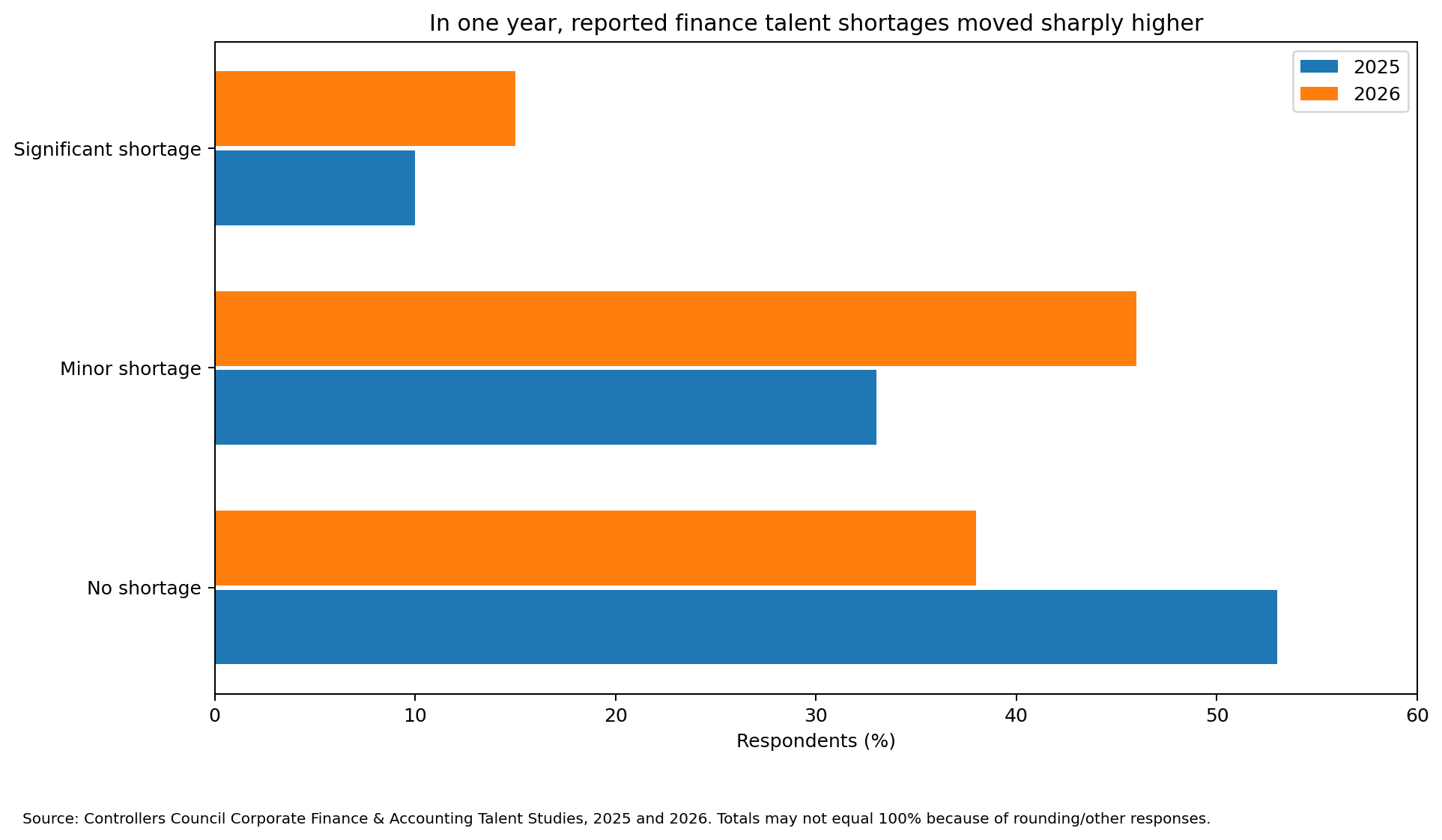
Last year, 53% of respondents reported no shortage, 33% a minor shortage and 10% a significant shortage.
This year, Controllers Council reports 46% with minor shortages and 15% with significant shortages, leaving only 38% reporting none.
The association’s Talent Shortage Index moved to 77% from what it described as a 108% Talent Surplus Index in 2025.
At the same time, hiring rebounded to a 134% Hiring Index and compensation increases nearly doubled year over year.
Finance leaders should resist treating this as a conventional recruiting story.
A shortage of experienced finance capability can become a close risk, a control risk and a transformation-capacity risk.
The reversal matters more than the headline
Talent markets move.
A single annual survey cannot establish that a structural shortage is permanent.
But the year-over-year reversal is difficult to ignore.
In 2025, Controllers Council described the market as increasingly employer-friendly. Hiring was muted, compensation growth had slowed and a majority reported no shortage.
By mid-2026, the language changed: aggressive hiring, shortages and rising compensation.
That means workforce assumptions made even twelve months ago may already be stale.
Finance organizations planning lean staffing models should revisit the resilience built into them.
The scarce resource is experience
Headcount is an incomplete measure of finance capacity.
A team can have the approved number of people and still lack the capability to close reliably, implement a new ERP, manage technical accounting, support an acquisition or redesign controls.
Controllers Council’s July analysis of the survey argues that the shortage increasingly reflects capability as much as headcount: organizations may find applicants, but fewer combine technical expertise, business judgment, communication and leadership.
That is particularly important for controllership.
The controller role has expanded.
Financial reporting and controls remain central, but many controllers now also participate in systems programs, data governance, process redesign, M&A integration and AI oversight.
The more the role expands, the smaller the pool of candidates who match the full specification.
A vacancy can create hidden operating leverage
Finance labor shortages rarely stop the business immediately.
They create load elsewhere.
A vacant accounting-manager role pushes review work upward. A missing senior accountant increases the controller’s preparation burden. A thin FP&A team produces fewer scenarios. A tax vacancy increases dependence on advisers.
The work still gets done—until something changes.
A close becomes more complex. An acquisition arrives. An audit issue emerges. A system implementation reaches testing.
Then the lack of spare capability becomes visible.
This is why finance should treat talent as capacity planning rather than HR administration.
Hiring is rebounding into the shortage
Controllers Council reports a 2026 Hiring Index of 134%, which it describes as a return to pandemic-era levels after a two-year lull.
Robert Half’s separate U.S. hiring research points in the same direction, though it uses a different methodology and should not be combined numerically with the Controllers Council study.
Robert Half says 74% of finance and accounting leaders plan to increase full-time headcount in the second half of 2026, while 61% say finding skilled professionals is more challenging than a year ago.
That combination matters.
More organizations are trying to hire at the same time that many say skilled talent is harder to find.
Compensation pressure is a predictable result.
Return-to-office is colliding with a tighter labor market
The Controllers Council survey found another reversal.
Fully onsite work became the most common finance-and-accounting model for the first time since the pandemic: 46% expected fully onsite teams, compared with 43% hybrid and 11% fully remote.
In 2025, hybrid led at 53%, with 33% fully onsite.
Employers are therefore tightening location requirements at the same time the talent market is tightening.
That may be strategically sensible for some roles.
Close teams, early-career development and cross-functional work can benefit from proximity.
But the trade-off should be explicit.
A company that requires five days onsite is choosing from a smaller geographic and preference pool than a company that supports hybrid work.
In a shortage, that choice has an economic cost.
AI is not resolving the experienced-talent constraint
The obvious counterargument is automation.
If AI can perform more finance work, perhaps the shortage matters less.
The same 2026 Controllers Council research says 53% of respondents are evaluating, piloting or implementing AI with internal staff.
That suggests technology adoption is moving quickly.
But automation changes the composition of work before it eliminates the need for experienced judgment.
Reconciliations can be accelerated. Documents can be processed. Reports can be drafted. Exceptions can be prioritized.
Someone still has to decide whether the accounting is correct, whether the control is sufficient and whether the exception is material.
In fact, automation can increase the premium on experienced reviewers because fewer people spend their careers learning through repetitive preparation.
The apprenticeship problem is becoming measurable
Accounting has traditionally developed expertise through layers of work.
Prepare. Review. Correct. Repeat.
Automation removes some of the preparation.
That is good for productivity. It creates a learning-design problem.
If junior professionals no longer build hundreds of reconciliations manually, how do they develop the pattern recognition required to review automated reconciliations later?
The answer cannot be to preserve low-value work indefinitely.
Finance needs structured apprenticeship: exception review, rotations, technical case work, shadowing, and explicit explanation of why machine-prepared output is accepted or rejected.
Talent development becomes part of the automation architecture.
Retention is now a control strategy
When experienced people are scarce, retention has a direct operational value.
Replacing a controller or accounting manager is not simply a recruiting cost.
The departing employee carries institutional knowledge: entity history, auditor expectations, recurring close issues, system workarounds, materiality judgments and business relationships.
Some of that knowledge should be documented. Much of it is tacit.
Finance leaders should therefore map key-person dependency with the same seriousness they map system dependency.
Which processes depend on one reviewer? Which technical areas have no backup? Which transformation workstreams rely on one person? Which people could leave without a trained successor?
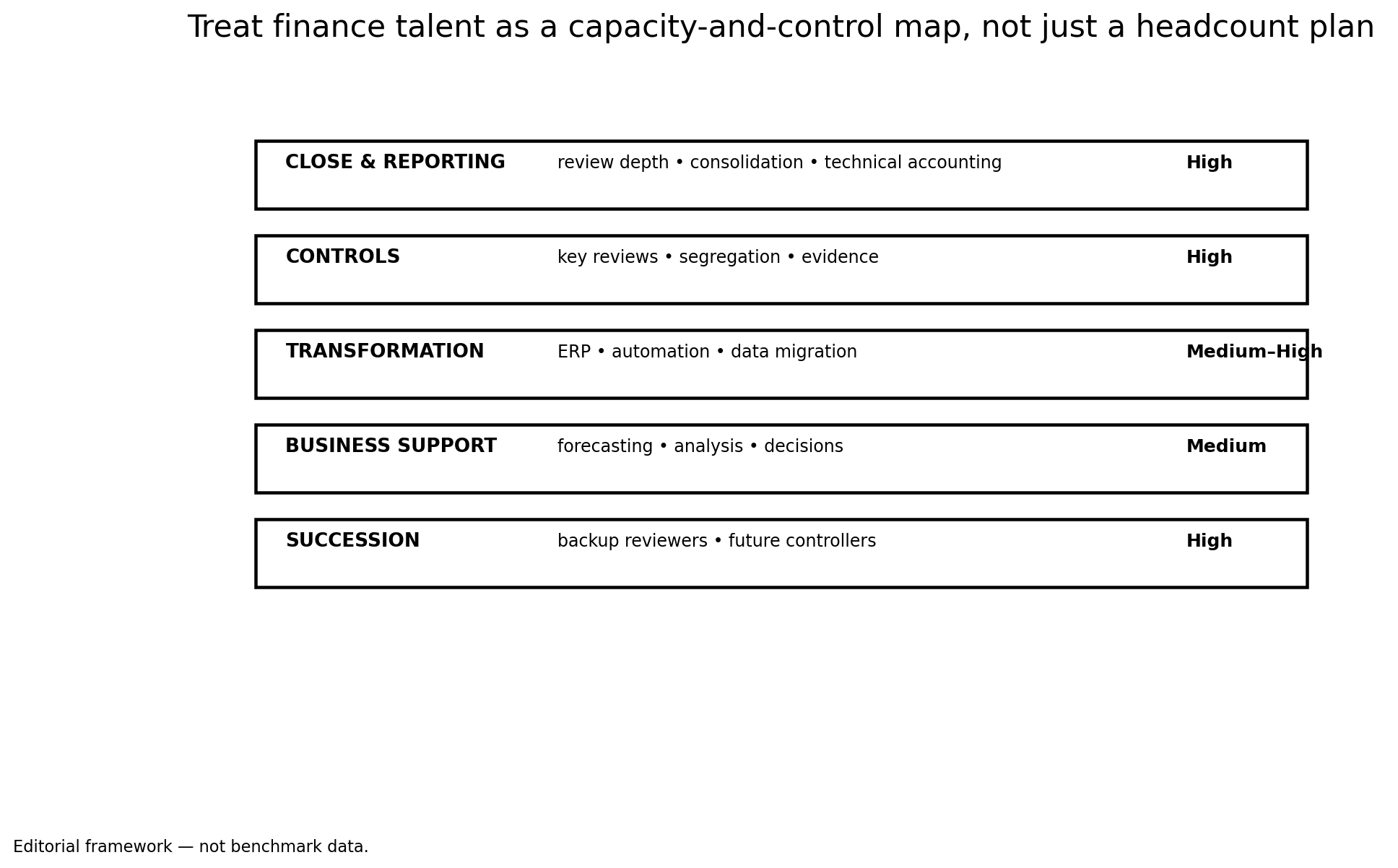
This is workforce planning as internal control.
Compensation cannot be the only response
Controllers Council says finance compensation increases nearly doubled year over year in its 2026 study.
Pay matters.
But a bidding war does not create more experienced controllers.
Companies need to build supply internally.
That means earlier succession planning, cross-training, clearer career paths and selective use of external providers for capacity peaks or specialist expertise.
It also means removing work that consumes scarce expertise without requiring it.
A controller should not spend hours repairing exports if the same capacity is needed for technical accounting and controls.
Technology has the highest talent ROI when it protects scarce judgment.
The CFO should maintain a capability inventory
Headcount plans answer how many people finance has.
A capability inventory answers what finance can actually do.
List the critical capabilities: consolidation, revenue recognition, SEC reporting where applicable, tax, treasury, FP&A modeling, data engineering, ERP ownership, controls, M&A integration.
For each one, identify depth.
How many people can perform it independently? How many can review it? Who is developing behind them? What is the external fallback?
This turns succession planning into something operational.
It also reveals where automation is most valuable.
The shortage may be cyclical. The response should still be structural.
No survey can tell finance leaders exactly what the labor market will look like in 2028.
Economic weakness could reduce hiring demand. AI could change staffing ratios. Accounting education reforms could affect supply.
The correct response does not depend on predicting permanence.
A finance organization with stronger succession, better documentation, more automation, deeper cross-training and clearer capability ownership is more resilient in either market.
If talent loosens, those investments still improve the function. If the shortage persists, they become essential.
The trend is no longer abstract
For years, accounting talent discussions focused on pipeline statistics and future retirements.
The 2026 data brings the issue inside the company.
More respondents are reporting shortages now. Hiring is accelerating now. Compensation is moving now. Work-model choices are changing the available talent pool now.
For controllers and CFOs, the question is therefore no longer whether the profession has a long-term pipeline problem.
It is whether today’s finance organization has enough experienced capacity to close, control, transform and advise the business at the same time.
That is a finance risk, not merely an HR metric.
Key takeaways
- CFO
- Maintain a capability inventory alongside the headcount plan: who can perform each critical capability independently, who can review it and what the external fallback is.
- Controller
- Map key-person dependency like system dependency. Any close, technical-accounting or control step with one qualified reviewer is a capacity risk.
- Finance Operations
- Design apprenticeship into automation — exception review, rotations and documented reasons for accepting or rejecting machine-prepared output.
Sources & further reading
- Controllers Council2026 Corporate Finance & Accounting Talent Research StudyJune 30, 2026 — 350+ controllers, CFOs, CAOs and VPs of finance in North America; surveyed May–June 2026. Indexes are proprietary study measures.
- Controllers CouncilIs the Accounting Talent Shortage Becoming Permanent?July 15, 2026 — 2026 breakout: 46% minor, 15% significant, 38% no shortage
- Controllers CouncilOnsite Work Returns to the Forefront for Finance and Accounting TeamsJuly 20, 2026 — 46% fully onsite, 43% hybrid, 11% fully remote
- Controllers CouncilAI Has Moved Beyond Experimentation in Corporate FinanceAugust 12, 2026 — 53% evaluating, piloting or implementing AI with internal staff
- Robert Half2026 Finance and Accounting Hiring and Job Market OutlookSeparate methodology — 74% plan to add full-time headcount in H2 2026; 61% say skilled talent is harder to find
Controllers Council is a professional member association and the publisher of the underlying benchmark; its Talent Shortage, Talent Surplus and Hiring Indexes are proprietary study measures, not official labor statistics. Robert Half data uses a different methodology and is reported separately, not combined numerically. The year-over-year reversal does not establish that the shortage is permanent. The capacity map is a The Finance Observer editorial framework, not benchmark data. No facts published after September 6, 2026 are used and no quotes are invented.
- Topics
- For
- CFO · Controller · Accounting Manager · VP Finance · Finance Operations
- Level
- All Levels

About the author
Maya ChenAccounting Technology Correspondent
Maya covers how technology is reshaping accounting and the financial close, with a focus on practical innovation, emerging platforms and the changing role of accounting teams.
The Finance Observer content is for informational purposes only and is not professional financial, tax, legal or investment advice.
Related reading

CFOs Want to Shape Value. Most Still Don’t Own the Hardest Investment Decisions.
EY’s survey of 1,610 finance leaders finds ambition running ahead of authority: most CFOs believe they should shape value creation, but only a quarter lead the investment decisions where returns are uncertain or long term.
The 2026 CFO Playbook Is Built for a World Where the Base Case Keeps Breaking
Deloitte’s Q1 2026 UK survey shows cost and cash priorities jumping while CapEx appetite falls. The leadership shift is toward liquidity as optionality, reversible capital commitments and governance that can move faster than the annual plan.

Finance Is Deploying AI Agents Faster Than It Can Govern Them
A vendor-sponsored survey of more than 1,500 finance leaders finds 92% under pressure to prove agentic-AI ROI, only 7% prioritizing governance over speed and 30% who have not updated controls in the past year.