
CFOs Want to Shape Value. Most Still Don’t Own the Hardest Investment Decisions.
EY’s 2026 global CFO research exposes a leadership gap: 60% say CFOs should shape how the business creates value, but only 25% lead investment decisions where returns are uncertain, indirect or long term. The modern CFO mandate is expanding faster than finance’s authority.
For CFO · VP Finance · FP&A Leader · Controller · Financial Analyst
Level All Levels

The modern CFO job description has become enormous.
Protect margin. Allocate capital. Govern AI. Build resilience. Transform finance. Develop talent. Advise the CEO. Explain performance to the board. Help the company grow.
The question is no longer whether CFOs want a strategic role.
It is whether they have converted that ambition into decision rights.
EY’s 2026 Global DNA of the CFO Survey, based on 1,610 CFOs, finance directors and heads of finance across 28 countries, exposes a striking gap.
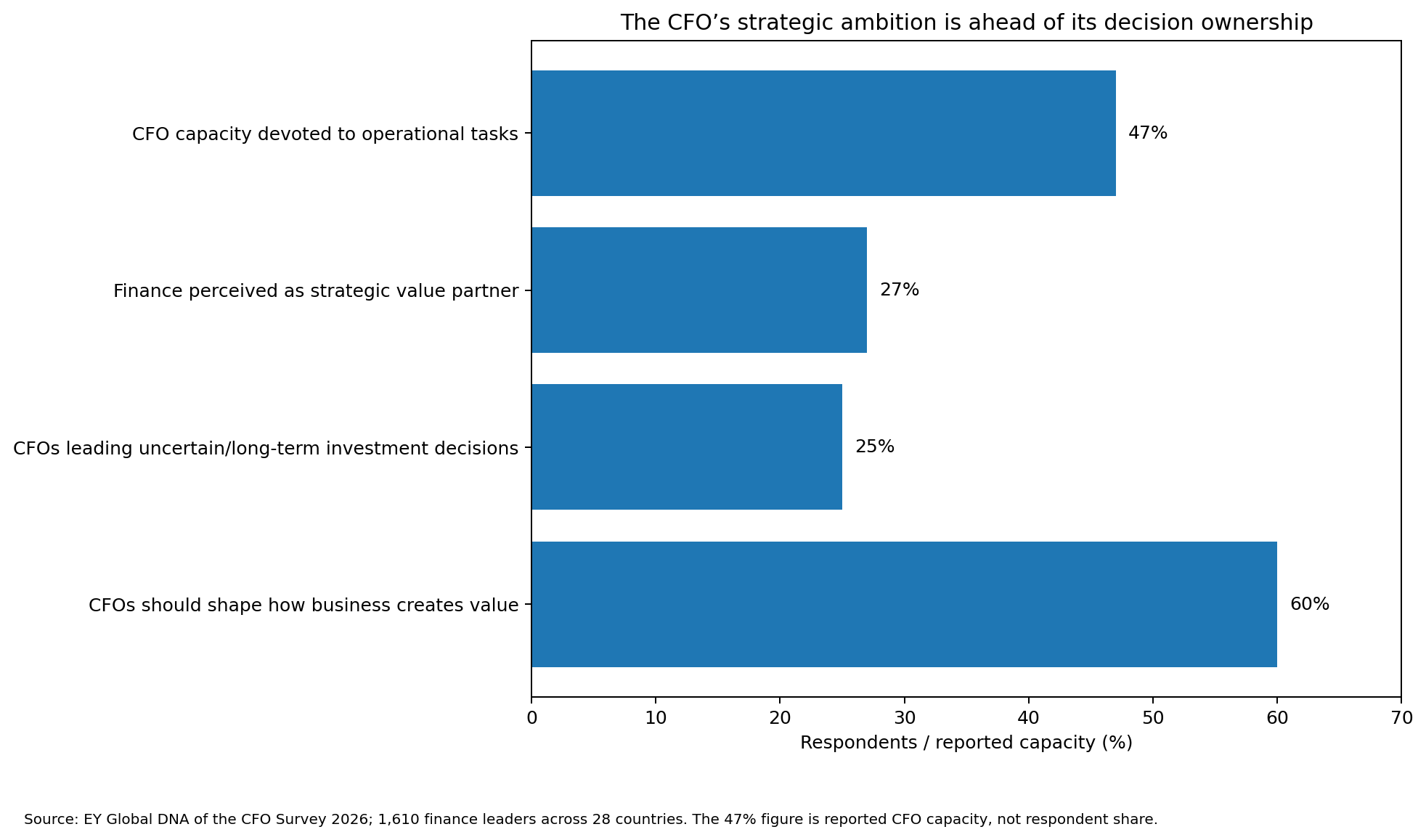
Sixty percent of respondents say CFOs should define and shape how the business creates value.
Only 25% say they actually lead investment decisions where returns are uncertain, indirect or long term.
And only 27% say finance is most commonly perceived across the business as a strategic partner in value creation.
That is not a branding problem.
It is a leadership operating-model problem.
Finance can call itself strategic while still entering the room after the biggest choices have already been framed.
The CFO mandate has expanded faster than CFO authority
Finance has accumulated responsibilities because many of the hardest enterprise questions now contain a financial dimension.
AI investments need ROI frameworks and governance. Supply-chain redesign changes working capital and margin. Talent decisions affect productivity. Cyber risk can become a balance-sheet event. Sustainability investment can alter capital needs and long-term value.
CFOs are naturally pulled into those decisions.
But participation is not ownership.
EY found that just 26% of CFOs lead discussions about which value drivers matter most to the organization and how those drivers are changing.
Meanwhile, CFOs report that 47% of their capacity is still devoted to operational tasks including regulation, reporting, internal controls and core finance processes.
The CFO has acquired a larger mandate without fully escaping the old one.
The hardest investments are exactly where finance should matter most
Traditional capital allocation is comfortable when the economics are visible.
A machine has a purchase price, useful life and expected output. A warehouse has rent and throughput. A conventional acquisition has a model.
The strategic investments dominating 2026 are harder.
AI capability. Data infrastructure. Cyber resilience. Workforce redesign. Platform modernization. New business models.
Their benefits can be indirect, uncertain or delayed.
Traditional finance instinct can respond by demanding precision the investment cannot honestly provide.
That creates two bad outcomes.
Either finance blocks potentially valuable investments because the business case is not sufficiently certain, or it accepts weak narratives because conventional ROI cannot capture the value.
Leadership requires a third option: improve how uncertainty is measured.
The CFO needs a portfolio language for uncertain value
A serious investment framework should distinguish among different kinds of value.
Some initiatives create direct cash returns.
Others create capacity.
Some reduce downside risk.
Some create strategic options—the ability to enter a market, scale an AI capability or respond faster later.
Those benefits should not be collapsed into a fictional single-point ROI.
CFOs can instead require ranges, milestones and explicit assumptions.
What must be true for the investment to create value? Which assumptions can be tested in six months? What would cause finance to stop funding it? What option becomes available if the first stage succeeds?
That is disciplined finance without pretending uncertainty does not exist.
Traditional metrics are becoming a leadership constraint
EY found 67% of CFOs say they urgently need to reevaluate how enterprise value is measured, while 71% say traditional metrics are insufficient for initiatives combining people and technology.
That matters well beyond AI.
The finance system was built to measure assets and activities that are relatively legible in financial statements.
Modern value creation increasingly depends on capabilities: data quality, software, customer relationships, organizational learning, talent and resilience.
Not every capability deserves a custom KPI.
But CFOs need a measurement architecture that connects nonfinancial drivers to financial outcomes.
Otherwise finance will continue to report the value after it appears rather than shape the decisions that create it.
Being strategic means choosing what not to fund
The strategic-CFO narrative often sounds additive.
Finance should do more analytics, more transformation, more business partnering.
Leadership also requires subtraction.
Capital is finite. Management attention is finite. Technology teams are finite.
The CFO’s value is partly the willingness to force trade-offs.
If the organization has 40 AI pilots and no scalable data foundation, the answer may be fewer pilots.
If every business unit calls its transformation program strategic, finance should define which ones are actually enterprise priorities.
The CFO becomes more strategic not by approving more innovation, but by making the portfolio coherent.
AI governance is becoming a test of CFO influence
Deloitte’s Q2 2026 CFO Signals survey shows how quickly the remit is expanding.
Ninety-three percent of surveyed finance chiefs said their organizations use AI across key operations. Nineteen percent said they have the greatest responsibility for AI governance at their company, and 59% identified balancing deployment speed with risk as the top challenge to effective enterprise AI governance.
AI is a useful test case because no single function owns the entire problem.
Technology understands models and infrastructure. Legal understands liability. Security understands access. Business teams understand use cases.
Finance understands capital, control and value.
The CFO’s leadership role is not to become the chief technologist.
It is to force those perspectives into one decision system.
Finance cannot lead value creation from the reporting calendar
The 47% operational-capacity finding should be read as a leadership constraint.
A CFO whose calendar is dominated by close issues, reporting, control remediation and routine approvals has less capacity to shape enterprise decisions.
Automation can help.
But delegation matters just as much.
The CFO needs a finance leadership team capable of owning the core while the CFO operates at enterprise level.
That makes controller, FP&A, treasury and finance-transformation leadership development part of the CFO’s own strategic capacity.
A weak bench pulls the CFO downward.
A strong bench expands the role upward.
Leadership development has not caught up with the job
EY found 68% of CFOs believe they need new skills and leadership styles rather than relying on prior experience or expertise. Sixty-seven percent say they should be challenged to move beyond their comfort zones into digital, strategic and people leadership.
Yet the most common development method remains self-directed learning: 61% report relying on reading or online resources. Only 37% participate in reverse mentoring with junior colleagues.
That is a mismatch.
A role becoming more cross-functional cannot be developed only through individual study.
CFOs need operating exposure.
Lead an AI investment committee. Sponsor a commercial transformation. Rotate future finance leaders through business roles. Use reverse mentoring for emerging technology. Put high-potential finance executives on cross-functional initiatives where the answer is not controlled by finance.
Leadership is learned through decisions.
The finance team needs permission to challenge the CFO too
Strategic influence can create a new risk: finance becomes overconfident.
The CFO is not automatically right because the CFO owns the model.
Long-term investments contain assumptions that finance may understand less well than product, engineering, operations or customers.
A strong CFO creates a decision process where those assumptions can be challenged—including finance’s assumptions.
That means separating analytical discipline from veto power.
The objective is not to financialize every strategic decision.
It is to make the economics visible without destroying the strategic context.
A new CFO scorecard
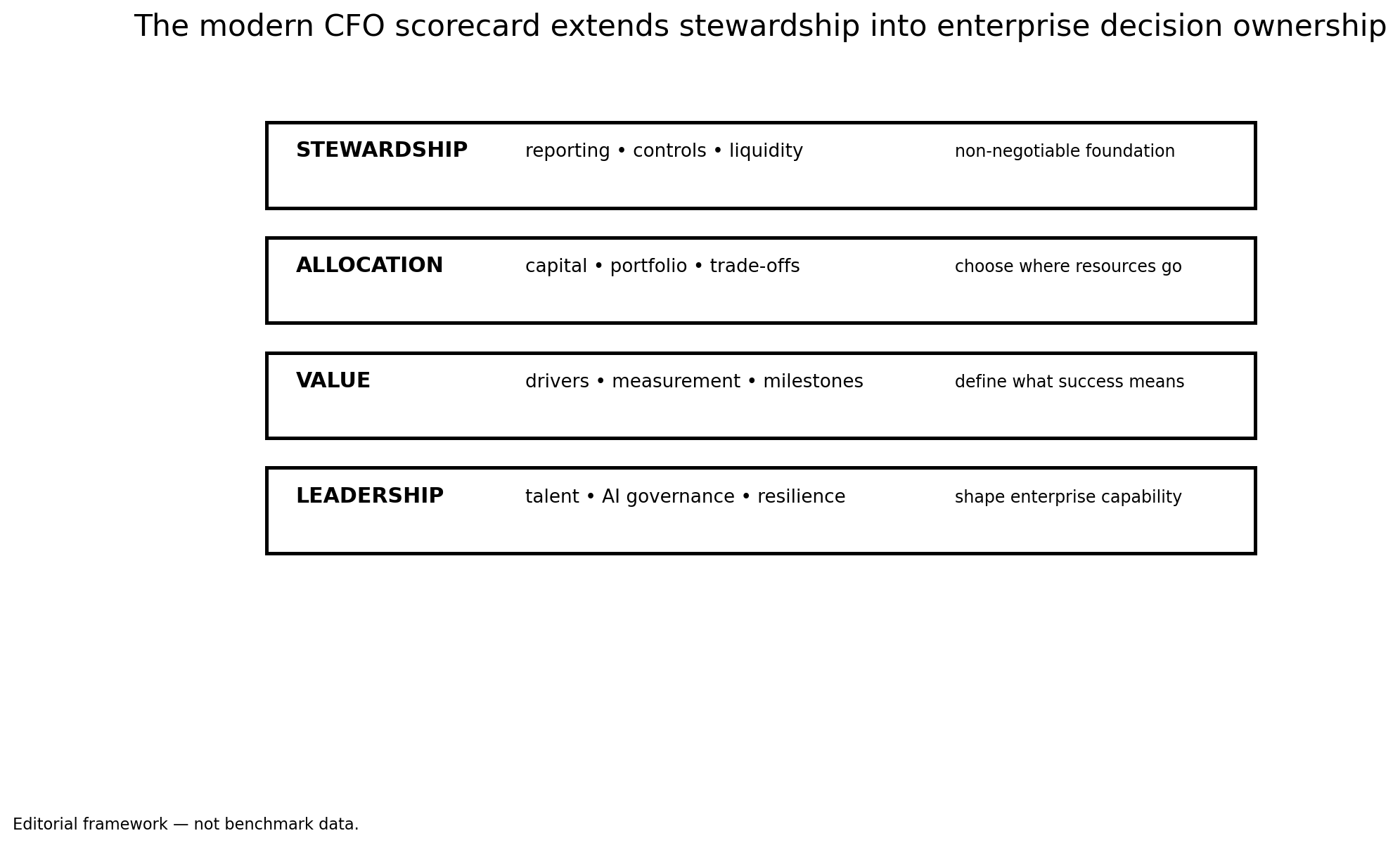
Boards traditionally evaluate CFOs through financial stewardship: reporting quality, liquidity, capital structure, controls, investor credibility.
Those remain essential.
The expanded mandate needs a second layer.
How effectively does the CFO allocate capital under uncertainty? How much low-value work has finance removed? How quickly can management make a high-quality decision? Does the company understand its key value drivers? Is the finance bench strong enough to produce successors? Can finance govern AI without freezing innovation?
These are harder to measure than close timeliness.
They are also closer to the leadership job companies increasingly expect.
The strategic partner label has to be earned through ownership
Only 27% of EY respondents say finance is most commonly perceived as a strategic partner in value creation.
Finance can respond by improving communication.
That is not enough.
Perception follows behavior.
If finance arrives after the strategy is defined to calculate the budget, it is not the strategic partner.
If finance frames the alternatives, tests the assumptions, defines how value will be measured, helps choose the investment and tracks whether the thesis is working, it is.
The difference is ownership.
The next CFO is not a bigger controller
The expansion of the CFO role does not mean stewardship becomes less important.
It means stewardship becomes the foundation rather than the ceiling.
The future CFO still needs reliable reporting, controls, liquidity and credibility.
But the differentiating work is increasingly upstream of the financial statements—where capital, technology, talent and strategy are being combined before the outcome is known.
EY’s 60%-versus-25% gap captures the state of the role.
CFOs know where they want to go.
Most organizations have not yet given finance—or finance has not yet taken—the corresponding decision rights.
The leadership challenge for 2026 is to close that gap.
Key takeaways
- CFO
- Ask where finance enters the hardest investment decisions. If the first involvement is budgeting, the strategic-partner label is not yet earned.
- VP Finance
- Replace single-point ROI on capability investments with ranges, milestones, explicit assumptions and a defined stop condition.
- FP&A Leader
- Build a measurement architecture that links nonfinancial value drivers — data quality, capability, resilience — to financial outcomes.
Sources & further reading
- EY2026 Global DNA of the CFO SurveyJune 3, 2026 — 1,610 CFOs, finance directors and heads of finance across 28 countries and 22 industries; fielded February 16–March 30, 2026
- DeloitteQ2 2026 CFO SignalsJuly 23, 2026 — separate survey: 93% use AI across key operations; 19% say the CFO has greatest responsibility for AI governance; 59% cite balancing speed and risk
EY and Deloitte findings come from separate surveys with different samples and methodologies and are not combined into a common benchmark. The 47% operational-capacity figure is reported CFO capacity, not a respondent share. The CFO scorecard is a The Finance Observer editorial framework, not benchmark data. No information published after September 6, 2026 is included and no quotes are invented.
- Topics
- For
- CFO · VP Finance · FP&A Leader · Controller · Financial Analyst
- Level
- All Levels

About the author
Daniel BrooksFP&A & Analytics Editor
Daniel covers planning, forecasting and financial analytics, focusing on how finance teams are using better data, technology and new planning methods to improve business decisions.
The Finance Observer content is for informational purposes only and is not professional financial, tax, legal or investment advice.
Related reading
The Finance Talent Market Flipped in One Year. Controllers Should Treat It as a Capacity Risk.
A Controllers Council study of 350+ finance executives shows reported talent shortages jumping to 61% in a single year, with hiring and pay rising and onsite work overtaking hybrid — a capacity risk for close, controls and transformation.
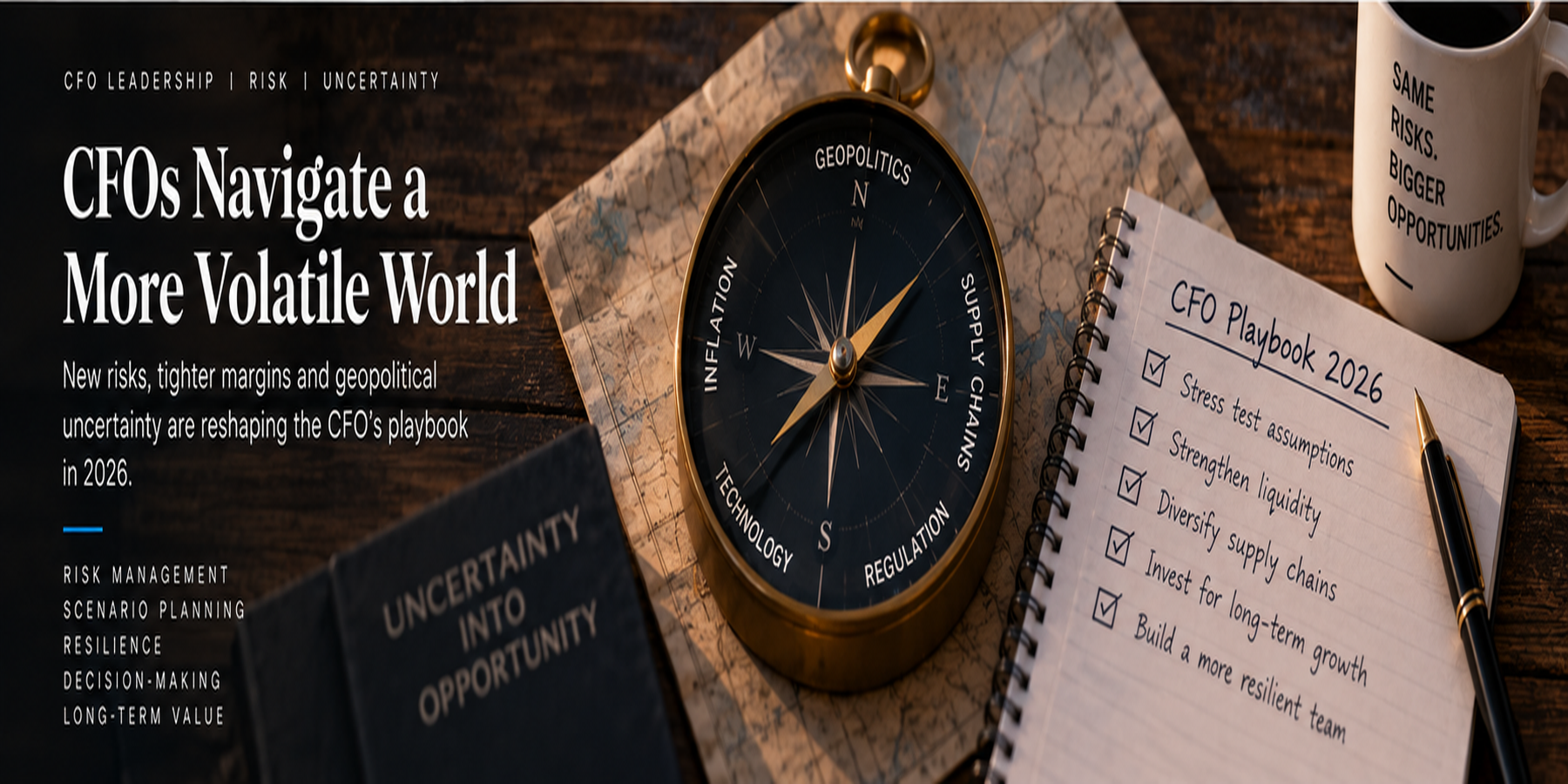
The 2026 CFO Playbook Is Built for a World Where the Base Case Keeps Breaking
Deloitte’s Q1 2026 UK survey shows cost and cash priorities jumping while CapEx appetite falls. The leadership shift is toward liquidity as optionality, reversible capital commitments and governance that can move faster than the annual plan.

Finance Is Deploying AI Agents Faster Than It Can Govern Them
A vendor-sponsored survey of more than 1,500 finance leaders finds 92% under pressure to prove agentic-AI ROI, only 7% prioritizing governance over speed and 30% who have not updated controls in the past year.