
The 2026 CFO Playbook Is Built for a World Where the Base Case Keeps Breaking
UK CFOs entered spring with geopolitics at record concern, 68% prioritizing cost reduction and only 12% prioritizing higher capital expenditure. Across global finance teams, scenario planning and agile governance are moving from FP&A techniques to leadership disciplines.
For CFO · VP Finance · FP&A Leader · Treasurer · Controller
Level All Levels
The CFO’s annual plan has a shorter shelf life than it used to.
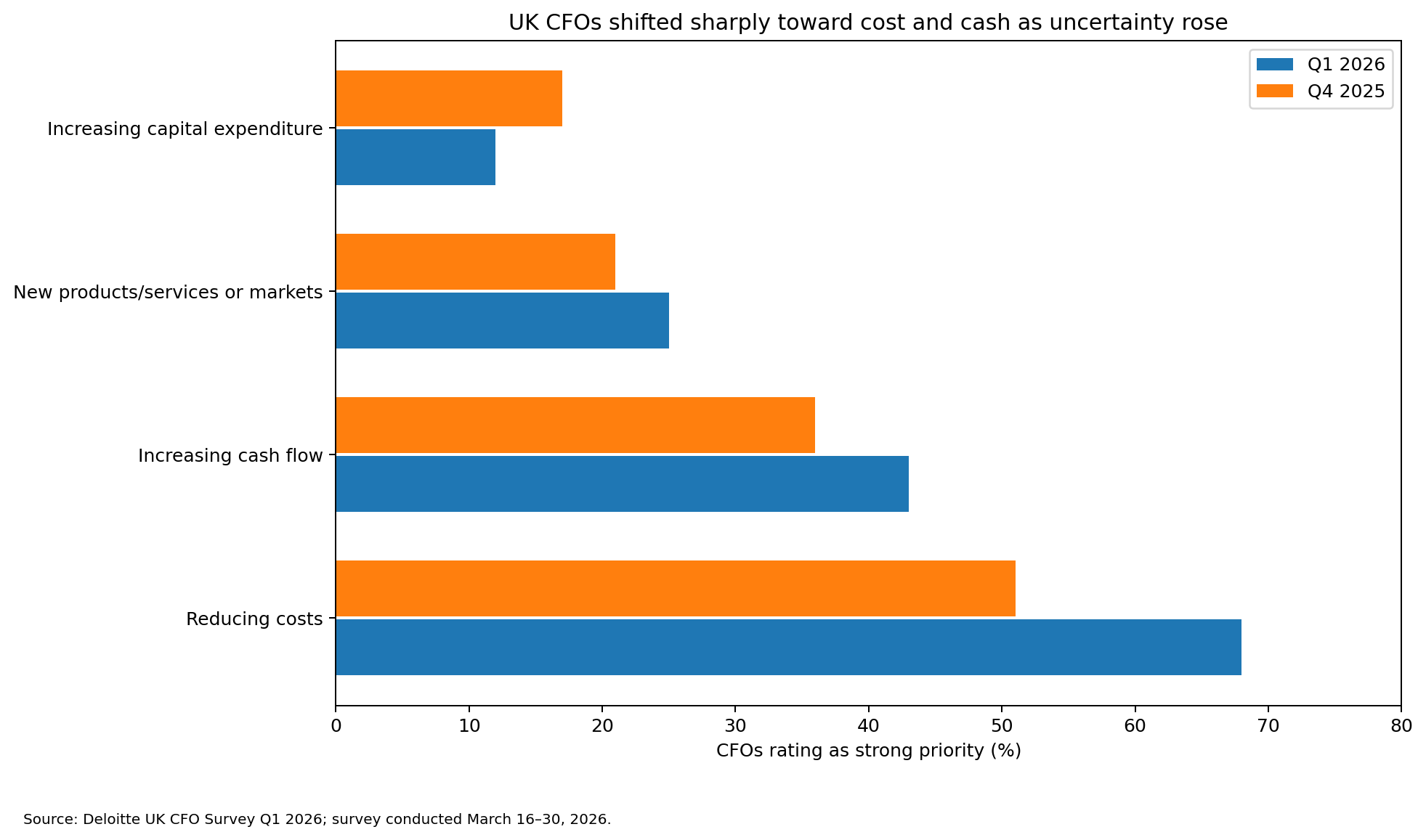
In March, Deloitte’s survey of UK finance chiefs found business optimism at a six-year low and concern about geopolitical developments at a record high. Cost reduction jumped to the top of the corporate agenda: 68% called it a strong priority for the next 12 months, up from 51% in the previous quarter.
Cash followed.
Forty-three percent prioritized increasing cash flow.
Only 12% put increasing capital expenditure among their strong priorities.
This is what leadership looks like when the base case keeps moving.
The CFO cannot predict every shock. The job is to build a company that can change its financial posture before the shock becomes the result.
That is why scenario planning, liquidity, capital flexibility and faster governance are becoming leadership disciplines rather than technical finance exercises.
Uncertainty is no longer a temporary planning assumption
The UK survey is unusually stark.
Deloitte reported CFO confidence at a net -57%, down from -13% in the prior quarter. Geopolitical risk remained the top external concern, with energy prices and interest rates close behind.
Other European surveys point in the same direction, although the samples and markets differ.
Deloitte Denmark found 49% of CFOs still rated financial and economic uncertainty as high in spring 2026. Seventy-one percent cited the economic outlook as a significant risk and 70% cited geopolitical risk.
Deloitte Ireland’s spring/summer survey found 90% of CFOs did not believe it was a good time to take additional balance-sheet risk.
These are regional surveys, not a global composite.
Together they describe a leadership environment where resilience has become part of capital allocation.
Cost control is becoming capital strategy
It is tempting to read a 68% cost-reduction priority as retrenchment.
That misses the more interesting dynamic.
Deloitte’s North American Q1 CFO Signals research found 52% of CFOs said cost-management considerations were redirecting operating-expense investments, while 46% were redirecting capital-expenditure investments.
The operative word is redirecting.
CFOs are not simply cutting.
They are trying to create room for technology, resilience and growth while protecting margins.
That requires a different cost conversation.
A blunt percentage reduction treats every dollar as equivalent.
Strategic cost management distinguishes between expense that maintains yesterday’s operating model and expense that creates tomorrow’s capability.
The CFO’s job is to make that distinction credible.
The base case should stop pretending to be the forecast
Most planning processes still create a psychological anchor.
Management debates assumptions, approves a plan and then begins measuring deviations from it.
The approved plan acquires authority simply because it was approved.
In a volatile environment, that can be dangerous.
The base case should be one scenario, not the truth.
Finance leadership should maintain a small number of coherent alternative states: demand shock, margin compression, supply disruption, funding stress, upside acceleration.
The purpose is not to predict which one happens.
It is to know what the company will do if conditions move toward one of them.
Scenario planning without decision rules is theater
Many companies now produce scenarios.
Fewer connect them to action.
A downside model that shows lower EBITDA is informative. A leadership system defines what happens next.
At what point does hiring slow? Which discretionary programs pause first? How much liquidity buffer must remain? Which pricing actions become acceptable? Which capital projects continue because stopping them destroys more value than finishing them?
Those are decision rules.
Deloitte’s global Finance Trends 2026 research, based on more than 1,300 finance leaders, highlights advanced scenario planning and agile governance as a top trend for navigating uncertainty.
The important word is governance.
Faster modeling has little value if every response still requires a month of committee meetings.
Liquidity is strategic optionality
Cash has traditionally been framed defensively.
In volatile markets, liquidity is also offensive.
A company with balance-sheet capacity can secure inventory when competitors cannot, invest through a downturn, acquire distressed assets, fund pricing moves or accelerate a transformation.
That is why the 43% UK priority on increasing cash flow matters.
The CFO is not merely building a buffer.
The CFO is buying options.
This changes how working capital should be discussed with the business.
Inventory reduction is not automatically good if it increases supply risk. Extending supplier terms is not automatically good if it weakens critical vendors. Accelerating collections is valuable, but not if it damages strategically important customer relationships.
Liquidity leadership optimizes the system, not one metric.
Resilience has a price. Finance has to decide what it is worth.
For years, efficiency programs removed redundancy.
Single suppliers, lean inventory and concentrated platforms reduced cost.
Geopolitical and supply-chain volatility have exposed the trade-off.
Resilience often requires paying for capacity that may not be used: alternative suppliers, inventory buffers, backup infrastructure, hedging, redundant routes.
The CFO has to evaluate insurance-like economics.
What loss is the resilience investment protecting against? How probable is the disruption? How quickly can the company recover without it? What revenue, margin or customer relationship is at risk?
The answer will never be perfectly precise.
But forcing the questions improves the decision.
Capital allocation needs reversible and irreversible buckets
One useful leadership distinction is reversibility.
Some decisions can be changed cheaply.
A pilot can stop. A hiring plan can slow. Marketing spend can move.
Other decisions create long commitments: factories, acquisitions, large platform migrations, debt structures.
When uncertainty is high, CFOs can preserve flexibility by sequencing irreversible commitments and accelerating reversible learning.
This is not an argument against long-term investment.
It is an argument for structuring investment so management learns before committing the next dollar where possible.
The CFO needs a faster governance clock
Annual planning and monthly reviews were designed for a slower information environment.
A volatile company may need multiple clocks.
Daily liquidity monitoring.
Weekly operating signals.
Monthly forecast and capital reviews.
Quarterly portfolio decisions.
The CFO should decide which decisions belong on which cadence.
If every issue goes to the executive committee, the company becomes slow.
If every business unit can react independently, the company loses control.
Agile governance means pre-authorizing some actions within clear limits while escalating the decisions that materially change risk.
Do not confuse caution with passivity
The strongest CFO response to uncertainty is not permanent defensiveness.
Deloitte Ireland found 82% of surveyed CFOs still prioritized organic growth even while 83% prioritized cost reduction. Sixty-seven percent prioritized digitization or technology transformation.
That combination is important.
The objective is not to freeze the company until uncertainty disappears.
It may not.
The objective is to protect enough financial flexibility to continue funding the capabilities that matter.
A CFO who cuts every long-term investment can improve next quarter and weaken the next three years.
A CFO who ignores the risk environment can destroy liquidity.
Leadership lives between those failures.
The board needs ranges, not false precision
Boards are often presented with a single forecast plus a sensitivity page.
The leadership conversation should reverse that hierarchy when uncertainty is high.
Show the range.
Show the assumptions that move the outcome.
Show the triggers that management is monitoring.
Show the actions available at each threshold.
Then show the base case.
This communicates uncertainty without surrendering accountability.
The CFO is not saying “we do not know.”
The CFO is saying “we know what matters, what we are watching and what we will do.”
A practical CFO uncertainty system
The operating model can be simple.
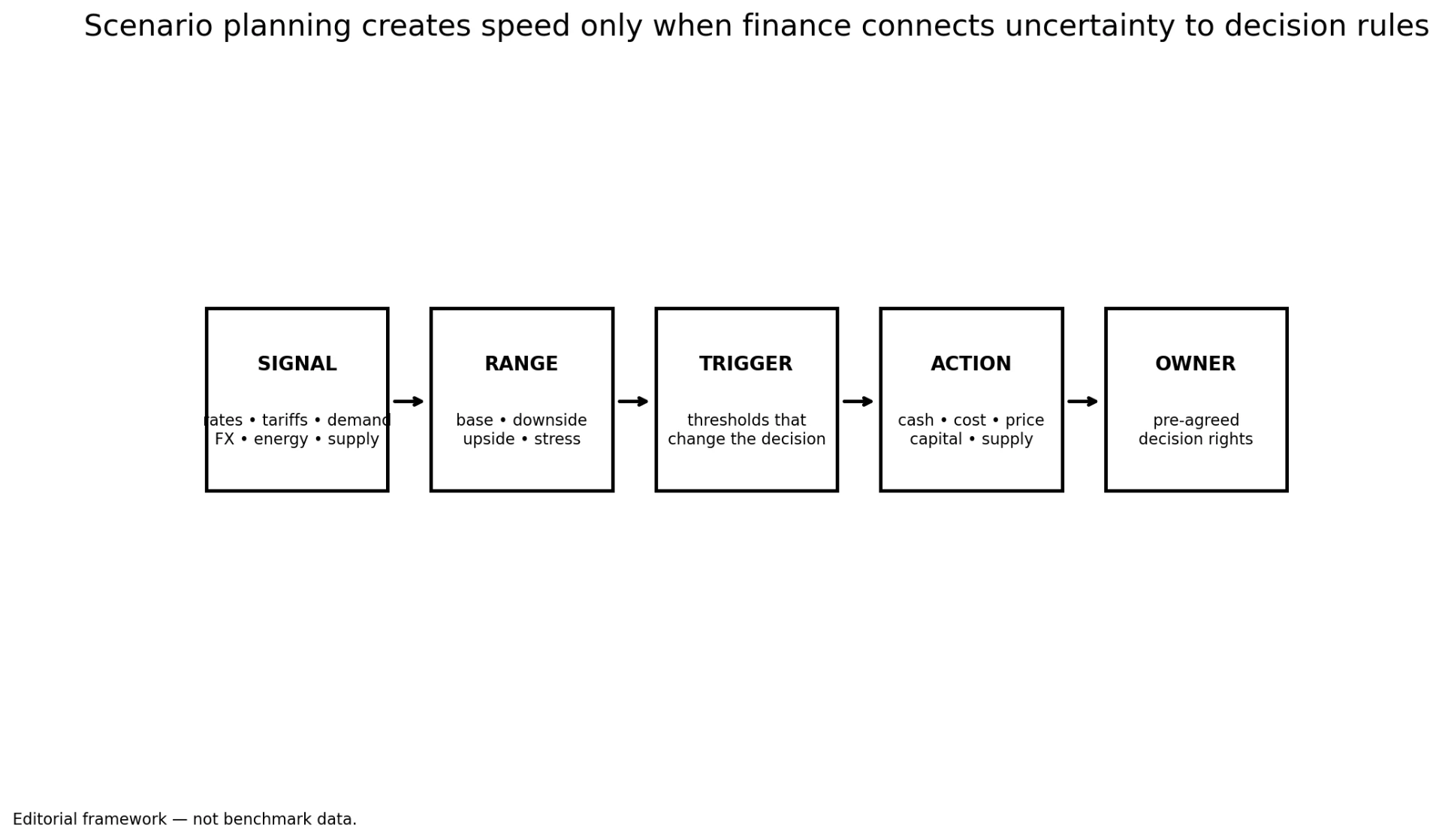
First, define the five or six variables that can materially change the financial outcome: volume, price, FX, energy, tariffs, rates, supply availability.
Second, connect those variables to financial statements, cash and covenants.
Third, define trigger thresholds.
Fourth, pre-agree management actions.
Fifth, assign decision rights.
Finally, review whether the trigger still represents the risk.
That creates a living financial response system rather than a collection of scenarios.
2026 is rewarding CFOs who preserve options
The CFO role has always involved uncertainty.
What is different now is the number of shocks that can move simultaneously and the speed with which assumptions can become obsolete.
The UK data captures the immediate response: more cost discipline, more cash focus, less appetite for incremental CapEx.
But the leadership lesson is broader than caution.
Finance has to help the organization remain movable.
That means liquidity without hoarding, cost discipline without hollowing out capability, scenario planning without analysis paralysis and governance that can accelerate when the evidence changes.
The best CFO forecast in 2026 may not be the one that predicts the year most accurately.
It may be the one that makes the company least dependent on the prediction being right.
Key takeaways
- CFO
- Present the board a range, the assumptions that move it, the triggers being monitored and the actions available at each threshold — then the base case.
- VP Finance
- Split the capital plan into reversible and irreversible commitments, and sequence the irreversible ones so management learns before the next dollar.
- Treasury
- Treat liquidity as optionality: pre-agree the buffer that must remain and the actions unlocked above it, rather than optimizing a single working-capital metric.
Sources & further reading
- Deloitte UKUK CFO Survey Q1 2026Published April 2026 — fielded March 16–30, 2026. UK respondents: net confidence -57%; reducing costs 68%; cash flow 43%; CapEx 12%
- Deloitte USQ1 2026 CFO SignalsApril 14, 2026 — North American respondents: 52% redirecting OpEx and 46% redirecting CapEx investments
- DeloitteFinance Trends 2026Global research of 1,300+ finance leaders — advanced scenario planning and agile governance as a leading trend
- Deloitte IrelandSpring/Summer 2026 CFO SurveyIrish respondents: 83% cost reduction, 82% organic growth, 67% digitization; 90% say it is not a good time to take balance-sheet risk
- Deloitte DenmarkCFO Survey 2026Danish respondents: 49% report high uncertainty; 71% economic outlook and 70% geopolitical risk as significant risks
Each survey result is reported with its geography — UK, North American, Irish and Danish samples are separate studies with different methodologies and are not combined into a global benchmark. The decision architecture is a The Finance Observer editorial framework, not benchmark data. No information published after September 6, 2026 is included, and no quotes are attributed to individuals.
- Topics
- For
- CFO · VP Finance · FP&A Leader · Treasurer · Controller
- Level
- All Levels

About the author
Daniel BrooksFP&A & Analytics Editor
Daniel covers planning, forecasting and financial analytics, focusing on how finance teams are using better data, technology and new planning methods to improve business decisions.
The Finance Observer content is for informational purposes only and is not professional financial, tax, legal or investment advice.
Related reading
The Finance Talent Market Flipped in One Year. Controllers Should Treat It as a Capacity Risk.
A Controllers Council study of 350+ finance executives shows reported talent shortages jumping to 61% in a single year, with hiring and pay rising and onsite work overtaking hybrid — a capacity risk for close, controls and transformation.

CFOs Want to Shape Value. Most Still Don’t Own the Hardest Investment Decisions.
EY’s survey of 1,610 finance leaders finds ambition running ahead of authority: most CFOs believe they should shape value creation, but only a quarter lead the investment decisions where returns are uncertain or long term.

Procurement’s Cost Mandate Is Back. Resilience Is Making It Harder to Deliver.
Cost control is back as the dominant executive measure of procurement — but supplier diversification, longer contracts and safety stock all cost money. The 2026 question is which premium is worth paying.