
Accounting, Close & Reporting · AI & Automation
BlackLine Wants AI to Prepare the Reconciliation. Accountants Still Own the Sign-Off.
Verity Prepare, generally available since July, moves agentic AI into one of the close’s most control-sensitive workflows. The product can assemble reconciliation packages and surface exceptions, but the more consequential design choice is the audit trail around the agent.
For Accountant · Accounting Manager · Controller · Finance Systems · CFO
Level All Levels

Account reconciliation is a revealing place to test the limits of agentic AI in accounting.
It is repetitive enough to invite automation, but not mechanical enough to make judgment disappear. A preparer may need to pull evidence from several systems, decide whether two items genuinely belong together, investigate an unexplained balance, document the reason for a reconciling item and leave a package that a reviewer—and eventually an auditor—can follow.
BlackLine is now asking AI agents to do much more of that preparer work.
On July 27, the financial-close software company made Verity Prepare generally available. BlackLine describes it as a multi-agent system that can ingest supporting documents, analyze evidence, match transactions, isolate anomalies, explain variances and compile a reconciliation package for human sign-off. The company says every AI-generated recommendation includes reasoning, a confidence score and an audit trail.
That combination makes Verity Prepare more interesting than another accounting copilot. It pushes AI from answering questions about the close into producing work that may become part of the close evidence itself.
When AI drafts an email, a bad answer is inconvenient. When AI prepares a reconciliation, a bad answer can contaminate a control.
From assistant to preparer
The first generation of generative-AI features in finance largely sat beside accounting work: summarize a report, explain a variance, search policy, draft commentary. Verity Prepare is designed to sit inside the workflow.
BlackLine says multiple specialized agents coordinate the preparation process rather than relying on one general-purpose assistant. The system can work across structured and unstructured supporting documentation, identify reconciling items and assemble the output for review.
The company’s language is ambitious, and buyers should keep the source of performance claims in view. BlackLine says early adopters achieved up to a 92% reduction in manual reconciliation preparation time. That is a vendor-reported best-case figure, not an independently audited benchmark across customers. It says something about potential task compression; it does not establish the typical ROI a controller should put into a business case.
What is independently observable is that BlackLine has moved the product from preview and early adoption into general availability, and that management is beginning to describe Verity as a commercial product line. In its August 4 second-quarter results, CEO Owen Ryan said adoption of Verity agents was accelerating and that usage had begun generating direct revenue. BlackLine reported 4,260 customers at June 30, although it does not disclose how many use Verity Prepare.
That leaves finance buyers with the right question: not “does agentic AI work?” but “which parts of reconciliation preparation can we delegate while preserving the evidence and accountability the control requires?”
The reconciliation is not the control
A common automation mistake is to treat completion of the artifact as completion of the control.
They are not the same thing.
A reconciliation package can be perfectly formatted and still be wrong because the source population is incomplete, the matching logic is inappropriate, the threshold is too generous or the explanation accepts an economically implausible difference. An AI agent can make preparation faster without making the accounting conclusion safer.
That is why BlackLine’s emphasis on human sign-off matters more than its use of the word autonomous.
The company says human judgment remains the final authority. Its release also says AI recommendations carry reasoning, confidence scoring and a complete audit trail. Those features create the raw material for a control framework, but finance still has to design the framework.
A controller needs to decide which accounts are eligible for AI preparation; which exceptions always require escalation; what confidence scores mean operationally; whether evidence provenance is preserved; how model or workflow changes are governed; and what reviewers must inspect rather than merely approve.
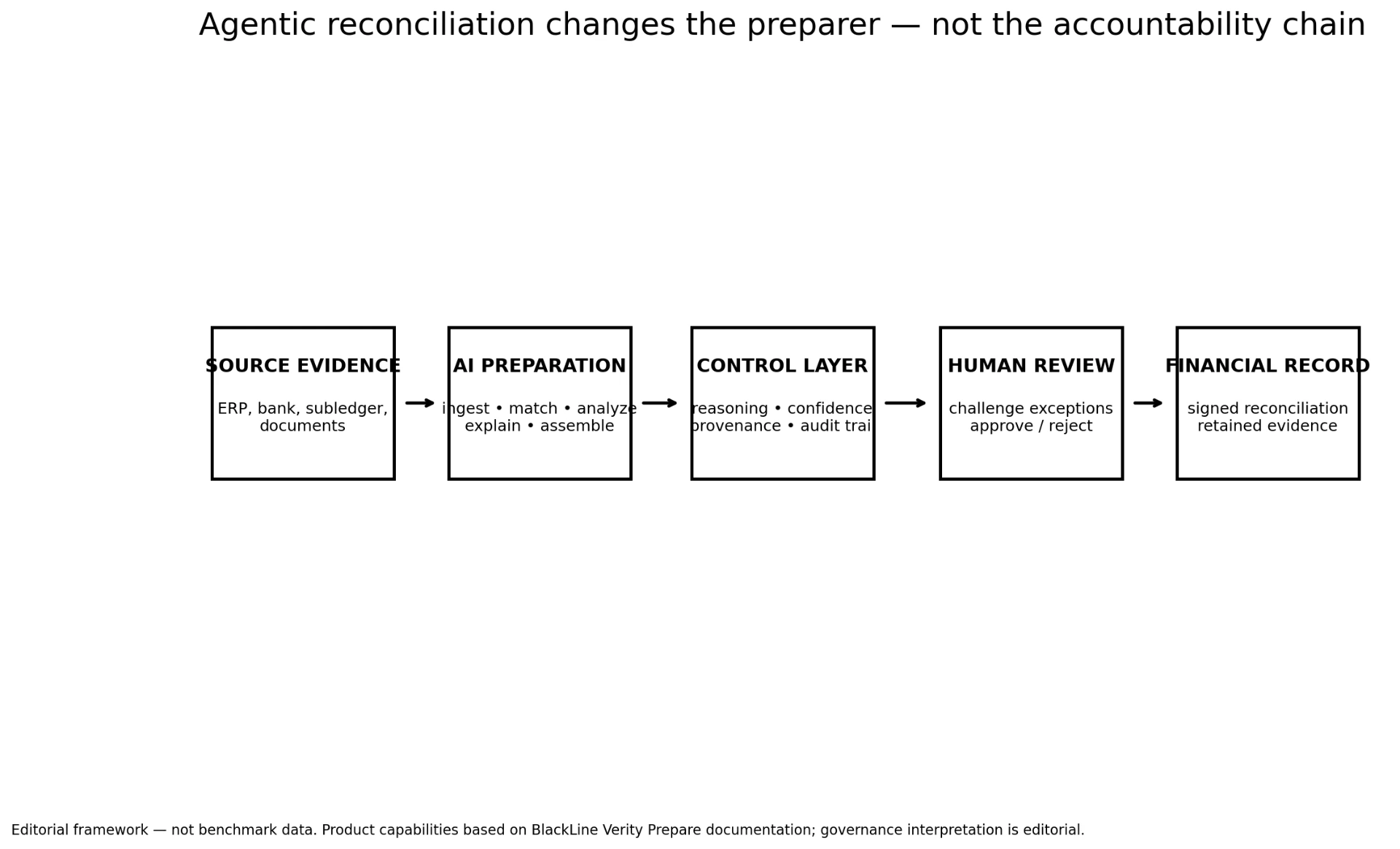
The practical objective is not to force a human to repeat everything the agent did. That would erase much of the productivity gain. It is to make the agent’s work reviewable enough that the human can concentrate on the assertions most likely to fail.
What “glass box” should mean in accounting
BlackLine has framed its broader Agentic Financial Operations strategy around a “glass box” architecture. In April, Ryan said finance leaders need to be able to validate AI outputs rather than accept a black box.
That principle is directionally right, but “explainable” can become a marketing word unless it maps to accounting evidence.
For reconciliation, useful transparency is concrete. The reviewer should be able to identify the source documents and transactions used, understand why items were matched, see what was excluded, inspect adjustments and reconciling items, distinguish AI-generated explanations from source facts, and reconstruct the approval path.
A fluent narrative is not an audit trail.
Confidence scoring has the same limitation. A 95% confidence indicator may help prioritize review, but it is not an accounting assertion and it does not replace materiality, risk assessment or professional skepticism. Finance teams need to know what the score measures and how it behaves on unusual accounts, sparse histories and changed business conditions.
This is where an agent designed specifically for financial operations has an advantage over a general-purpose model—but also where implementation discipline matters most.
Start with the account population, not the demo
The safest adoption path is likely to be portfolio-based.
Controllers can segment reconciliations by risk and complexity: high-volume/low-judgment accounts; stable balance-sheet accounts with predictable support; accounts with recurring timing differences; accounts involving estimates or unusual transactions; and highly material or judgment-heavy accounts.
The first group is the obvious proving ground. The last should be treated cautiously.
Finance should also establish a baseline before turning the agent on. How long does preparation take today? How many items are rejected by reviewers? How many reconciling items age beyond policy? How often is support missing? Which accounts generate late adjustments?
Without those measures, a dramatic reduction in “preparation time” can conceal a transfer of work into review.
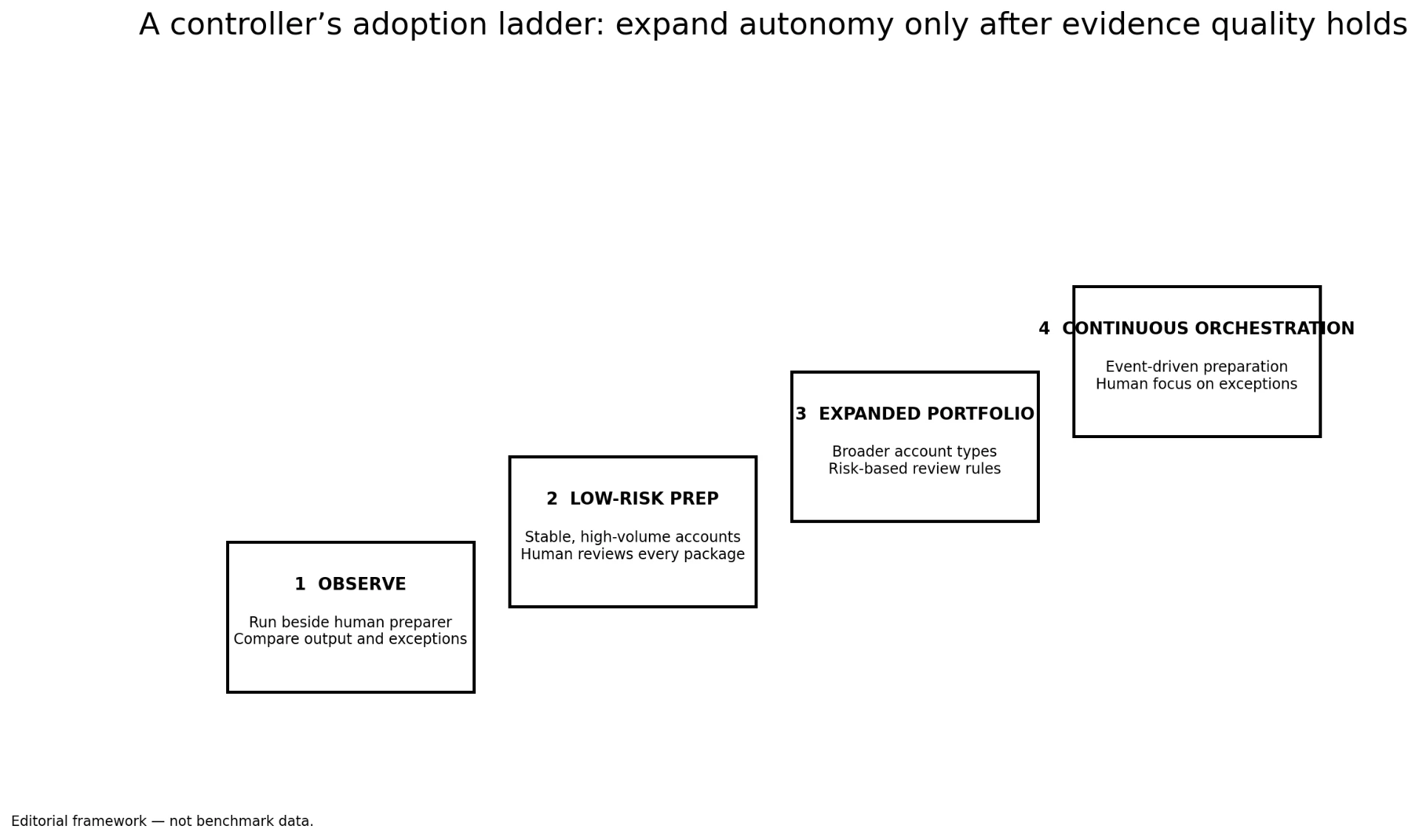
A good pilot would measure both speed and control quality. Time saved per reconciliation matters. So do reviewer rework, exception accuracy, late adjustments and the percentage of AI-prepared reconciliations requiring substantive human correction.
The economics may favor scarce accounting talent
There is a second reason this product arrives at an interesting moment.
Accounting teams are trying to automate while experienced controllership talent remains difficult to recruit. That makes reconciliation preparation an attractive target: it consumes trained-accountant time but much of the work is evidence gathering, comparison and documentation.
If agents can absorb a meaningful share of that preparation, the benefit is not necessarily fewer accountants. It can be more reviewer capacity and less close-period compression.
That matters because the close has a fixed deadline. Work removed from Day 3 does not simply disappear from a timesheet; it can create time for anomaly investigation, technical accounting, management review and better control execution before reporting deadlines arrive.
The organizational risk is that companies bank the labor saving too early. If staffing is cut before the agent has demonstrated stable performance across periods and account types, reviewers can become the new bottleneck.
BlackLine’s competitive bet
BlackLine is not the only close vendor embedding AI. Oracle Cloud EPM, for example, added AI-assisted transaction matching and reconciliation-assignment capabilities in its April 2026 update and released Account Reconciliation assistants in June for natural-language administrative and user tasks.
The market is therefore moving beyond the question of whether close software has AI.
The differentiators are becoming more specific: how much work the AI can execute; whether it acts or only recommends; how it inherits permissions; how evidence is retained; how exceptions are surfaced; whether actions are reversible; and how an auditor can understand what happened.
BlackLine’s bet is that governance itself can be a product advantage.
That is plausible in accounting because the cost of an opaque shortcut is unusually high. The financial close is full of workflows where the fastest possible answer is not the objective. The objective is a defensible answer delivered before the deadline.
A new preparer, an old accountability model
Verity Prepare is a meaningful product milestone because it crosses a boundary.
Software has automated reconciliation rules for years. AI assistants have helped accountants search and explain. A multi-agent system that assembles a reconciliation package moves closer to performing the preparer role.
But the accountability structure has not moved with it.
Management still owns the financial statements. Controllers still own the close environment. Reviewers still need sufficient evidence to approve the work. Auditors will still care about the completeness, accuracy and operation of controls.
That makes the most important design question almost boring: can a qualified accountant understand what the agent did well enough to take responsibility for the result?
If the answer is yes, agentic reconciliation could remove a large block of manual close work. If the answer is no, faster preparation simply produces a new class of review problem.
The future of the close will not be determined by how autonomous the agent sounds. It will be determined by whether the evidence survives the automation.
Key takeaways
- For accountants
- A formatted reconciliation package is not a completed control. Check population completeness, matching logic and threshold appropriateness before approving AI-prepared work.
- For controllers
- Decide which accounts are eligible for AI preparation, which exceptions always escalate, and what a confidence score means operationally.
- For finance systems teams
- Explainability only counts if it maps to accounting evidence: source documents, exclusions, adjustments and a reconstructable approval path.
- For CFOs
- Do not bank the labor saving before the agent has demonstrated stable performance across periods and account types.
Sources & further reading
- BlackLineBlackLine Advances Governed AI for Finance with General Availability of Verity PrepareJuly 27, 2026
- BlackLineBlackLine Unveils Agentic Financial Operations to Close AI’s Governance and Trust GapApril 14, 2026
- BlackLineSecond Quarter 2026 Financial ResultsAugust 4, 2026
- OracleOracle Cloud EPM 26.04 Release NotesApril 2026
- OracleAccount Reconciliation AI AssistantsJune 2026
The “up to 92%” reduction is vendor-reported early-adopter evidence from BlackLine, not an independently audited benchmark. BlackLine discloses a company-wide customer count only; no Verity Prepare customer count is claimed. No information published after September 6, 2026 is used.
- For
- Accountant · Accounting Manager · Controller · Finance Systems · CFO
- Level
- All Levels

About the author
Maya ChenAccounting Technology Correspondent
Maya covers how technology is reshaping accounting and the financial close, with a focus on practical innovation, emerging platforms and the changing role of accounting teams.
The Finance Observer content is for informational purposes only and is not professional financial, tax, legal or investment advice.
Related reading
The Close Is Becoming an Agent Workflow
The financial close is full of work that is repetitive but not trivial. Agentic close software promises to prepare, reconcile and explain — as long as every action can be audited.
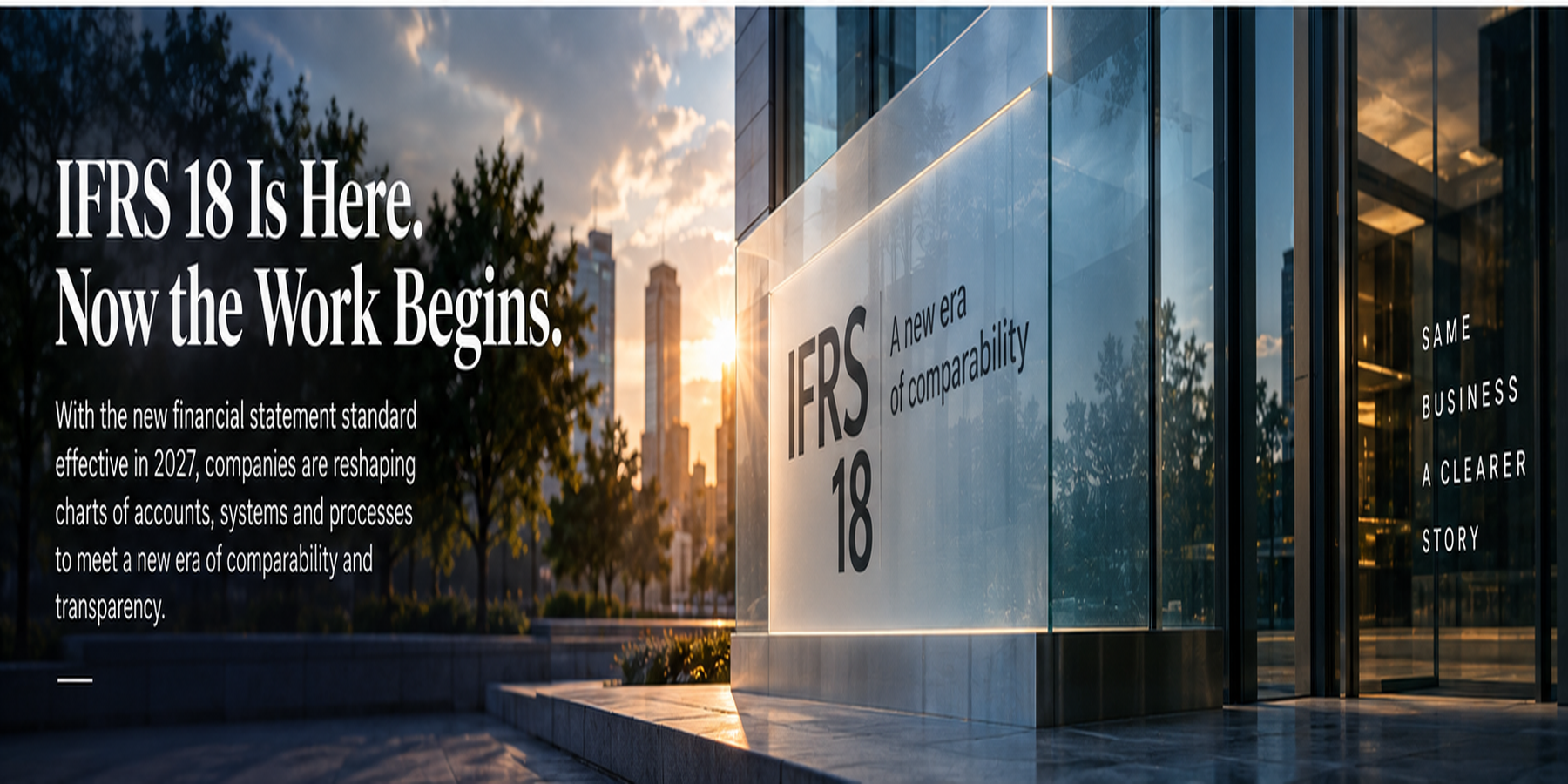
IFRS 18 Starts in 2027. For Accounting Teams, the Real Deadline Is This Close.
IFRS 18 is mandatory for annual periods beginning on or after January 1, 2027 — but comparatives make it a 2026 close problem. The work sits in account mappings, consolidation rules, expense dimensions and MPM governance.

The Month-End Close Is Being Rewritten
AI agents and continuous accounting are beginning to shift the close from a monthly sprint toward a continuously managed financial process.
Related across formats
Curated video and audio that share this article's finance topics.
SAP’s Autonomous Finance Vision: What CFOs Should Look For Beyond the AI Demo
SAP
In this SAP Finance Connect keynote, SAP presents how AI assistants and agents could fit into core finance workflows, from accounting and consolidation to planning, billing and payments. As a vendor-hosted keynote, its product capabilities and reported benefits are SAP and participant claims rather than independently verified outcomes.
1Password’s CAO on Where AI Fits in a Well-Run Accounting Team
Senad Mustafic · Chief Accounting Officer, 1Password
Senad Mustafic, Chief Accounting Officer at 1Password, joins Kinter controller Armen Aklian, CPA, for an on-demand fireside chat (The CFO Track) about his path from financial analysis into controllership, how his thinking on AI has changed, and his approach to AI adoption at 1Password.

CFO Weekly
Why Accounting Judgment Still Matters When AI Does the Work
Host Megan Weis and Kerrie Jones, Financial Controller at Peak Living, on why following the correct process doesn’t guarantee a sensible outcome — and how controllers can teach accountants when to question the output, including AI’s. CFO Weekly is produced by Personiv.
CFO Weekly
Editor's PickThe Rise of AI-Driven Finance Teams
A forward-looking discussion on AI agents transforming accounts receivable, the shift from finance operators to finance architects, “headless finance,” and what the CFO function could look like in the next three to five years.