
Accounting, Close & Reporting
IFRS 18 Starts in 2027. For Accounting Teams, the Real Deadline Is This Close.
The new presentation standard changes the architecture of the income statement, pulls management-defined performance measures into audited disclosures and requires comparatives. With 2027 opening balances approaching, implementation is becoming a chart-of-accounts, consolidation and close-design project.
For Accountant · Accounting Manager · Controller · Finance Systems · VP Finance · CFO
Level All Levels

IFRS 18 does not become mandatory until annual reporting periods beginning on or after January 1, 2027.
That date can make the standard feel like a 2027 reporting problem. For accounting teams, it is increasingly a 2026 close problem.
The reason is comparatives.
IFRS 18 replaces IAS 1 Presentation of Financial Statements and reshapes how companies using IFRS present and explain financial performance. It introduces defined operating, investing and financing categories in the statement of profit or loss; requires specified subtotals including operating profit and profit before financing and income taxes; creates disclosures for management-defined performance measures; and adds principles for aggregation and disaggregation.
Companies adopting in 2027 will need comparative information. That means the classifications, data lineage and management-measure reconciliations required under the new standard cannot simply appear at the end of next year. Accounting teams need a way to reconstruct and validate the prior period under the new presentation.
The implementation clock is therefore already running.
This is more than a financial-statement redesign
At first glance, IFRS 18 looks like a presentation standard. The journal-entry logic for many underlying transactions does not change.
Operationally, however, presentation sits at the end of a long chain.
General-ledger accounts feed consolidation mappings. Consolidation mappings feed reporting lines. Reporting lines feed management packs, investor materials and regulatory filings. Alternative performance measures may be calculated outside the ledger in spreadsheets or reporting tools. Expense classifications can depend on dimensions that were never designed for the new disclosure.
Change the required output and the weakness can travel backward through the entire close architecture.
For a non-financial company, IFRS 18 generally requires income and expenses to be classified into operating, investing and financing categories, with income taxes and discontinued operations also presented in their specified categories. The operating category is effectively the residual category after applying the standard’s classification requirements.
That sounds straightforward until an accounting team maps hundreds or thousands of accounts across entities, currencies and local charts of accounts.
Banks, insurers and other entities with specified main business activities face additional classification considerations because income and expenses that would be investing or financing for many companies can belong in operating when investing in assets or providing financing to customers is a main business activity.
Operating profit becomes defined
One of IFRS 18’s central objectives is comparability.
Before the new standard, companies commonly reported an operating-profit subtotal, but IFRS did not prescribe a single structure that made those subtotals comparable across entities. IFRS 18 creates defined categories and requires operating profit.
For investors, that is a presentation improvement.
For accounting, it is a mapping requirement.
Every income and expense line has to land in the correct category based on the standard’s principles and the entity’s facts. The close process needs controls around those classifications, particularly where an account contains transactions with different economic characteristics.
This is where “we can fix it in reporting” becomes dangerous. If the reporting layer repeatedly reclassifies ledger data through opaque rules or manual spreadsheets, the new subtotal may be technically produced while the close becomes harder to control.
The better implementation question is whether the chart of accounts and dimensional model provide enough information to classify consistently at source—or whether a governed consolidation mapping is the more practical answer.
There is no universal architecture. There does need to be one controlled architecture.
Management’s favorite KPI is moving closer to the audit
The most consequential change for many controllers may sit outside the face of the income statement.
IFRS 18 requires disclosures about management-defined performance measures, or MPMs. Broadly, these are subtotals of income and expenses used in public communications outside the financial statements to communicate management’s view of an aspect of the company’s financial performance, subject to the standard’s definition and exclusions.
That pulls a class of measures often associated with investor relations and management reporting into a defined financial-statement disclosure framework.
The disclosure requirements include information that helps users understand what the measure communicates and how it compares with measures defined by IFRS Accounting Standards. The IFRS Foundation’s implementation materials emphasize clear, non-misleading labels and descriptions.
For close teams, the operational consequence is governance.
A company needs an inventory of potential MPMs used across earnings releases, investor presentations and other public communications. It needs to determine which measures meet the IFRS 18 definition. It needs controlled calculations and reconciliations. It needs owners. And it needs a process for identifying when management starts using a new measure publicly.
This is not a one-time accounting memo. It is a recurring close control.
The issue is live enough that the IFRS Interpretations Committee was still working through implementation questions in June 2026. Its tentative agenda decisions addressed, among other topics, hypothetical income and expenses in MPMs, what counts as public communication, labels of subtotals and presentation of operating expenses. Comments on several tentative decisions remain open until September 9.
That does not mean implementation should wait. It means companies need a mechanism to monitor interpretation while building the process.
The 2026 comparative trap
The easiest way to underestimate IFRS 18 is to focus on the first 2027 annual report.
The accounting team should work backward.
Can the company produce a 2026 comparative income statement under the new categories? Can it identify the 2026 MPMs that will require comparative disclosure? Are specified expenses available at the right level of granularity? Can reporting systems retain the mapping logic and evidence? Can the consolidation process run both current and new presentation views during transition?
If the answer to any of those questions is “we will calculate it manually,” the next question is how many entities, accounts and reporting periods that manual process must cover.
A parallel close is often the fastest way to discover the real work.
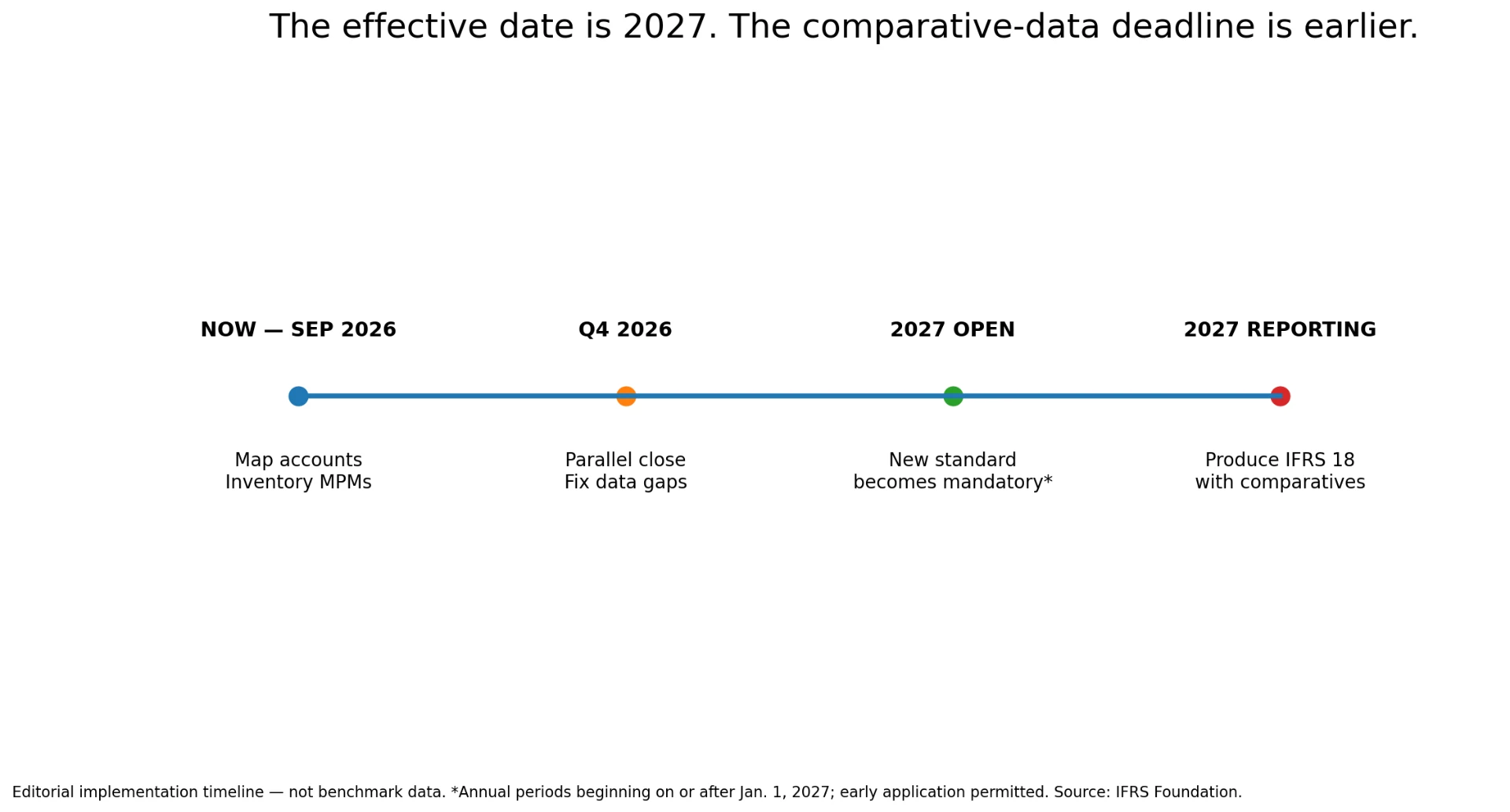
Run the existing reporting process, then produce the IFRS 18 view from the same closed data. Reconcile the two. Record classification judgments. Identify missing dimensions. Test MPM reconciliations. Put the result through review as if it were live reporting.
The point is not to publish the parallel result. It is to expose where the production process breaks before the mandatory period.
Expense presentation can expose data gaps
IFRS 18 also strengthens requirements around aggregation and disaggregation and affects how operating expenses are presented and disclosed.
For companies that present expenses by function, the data challenge can be substantial because specified expense information by nature may need to be disclosed. Payroll, depreciation, amortization, inventory-related costs and other natural expense information may be distributed across functions, entities and systems.
An ERP may hold the data. The consolidation system may not.
Or the consolidation system may hold a summarized value without the dimensional detail needed to generate the disclosure efficiently.
That is why controllers should involve data and systems teams now rather than treating IFRS 18 as a technical-accounting workstream that will hand requirements to IT later.
The implementation should trace every required output back to its source and ask whether the close captures the necessary attributes reliably.
A practical close-readiness test
A controller does not need a hundred-line IFRS 18 project plan to determine whether the organization is behind.
Five tests are enough to expose the risk.
- 01Take the latest consolidated income statement and map every material line to the IFRS 18 categories. Document judgmental items.
- 02Inventory the performance subtotals used in public communications. Identify which may be MPMs and locate the source calculation for each.
- 03Reproduce the required comparative information from the prior-period data currently retained in systems.
- 04Identify disclosures that require expense detail not available in the consolidation layer.
- 05Run the new presentation through the normal review chain — preparer, controller, technical accounting, disclosure committee and auditor where appropriate.
Any step that depends on one person’s spreadsheet is an implementation issue.
Why the close owner should lead
IFRS 18 projects can easily become dominated by technical-accounting interpretation. That expertise is essential, but the controller or close owner should have an equally prominent role.
The standard changes recurring production.
Once policy decisions are made, someone has to ensure every entity applies the mapping, every close captures the required data, every management measure is reconciled, every change is reviewed and every comparative remains reproducible.
Those are operating-model questions.
They are also an opportunity. Many companies will discover during IFRS 18 implementation that their income-statement mappings, alternative performance measures and expense dimensions have accumulated years of workarounds. Fixing those weaknesses can improve management reporting as well as compliance.
The worst outcome would be a technically correct 2027 financial statement supported by a fragile manual close.
January 2027 is too late to learn what the model cannot produce
The effective date remains January 1, 2027 for annual periods beginning on or after that date, with early application permitted.
But an effective date is not an implementation date.
By the time the first mandatory period opens, accounting should know how the new categories map, which management measures are in scope, where the comparative comes from, how expense data flows and who reviews each judgment.
That is why the current close matters.
IFRS 18 will eventually be visible as a different income statement and a new set of disclosures. The quality of that output will depend on work that investors never see: account mappings, data dimensions, consolidation rules, evidence, reconciliations and review.
The standard starts in 2027.
The controlled process for producing it needs to start before then.
Key takeaways
- For accountants
- Map every material income-statement line to the IFRS 18 operating, investing and financing categories, and document the judgmental items.
- For controllers
- Treat management-defined performance measures as a recurring close control with owners, reconciliations and a trigger for newly used public measures.
- For finance systems teams
- Check whether the consolidation layer retains the dimensional detail needed for specified expense disclosures — not just the summarized value.
- For CFOs
- Comparatives make 2026 the implementation year. A parallel close is the cheapest way to find out what the reporting model cannot produce.
Sources & further reading
- IFRS FoundationIFRS 18 Presentation and Disclosure in Financial StatementsIssued standard
- IFRS FoundationIFRS 18 — key termsSupporting implementation material
- IFRS FoundationNew IFRS Accounting Standard will aid investor analysis of companies’ financial performanceApril 2024
- IFRS Interpretations CommitteeIFRIC Update June 2026June 2026
- IFRS FoundationIFRS Accounting Taxonomy illustrative examplesIFRS 18 examples
Effective date language follows the IFRS Foundation: annual reporting periods beginning on or after January 1, 2027, with early application permitted. Implementation recommendations in this article are editorial and are not IFRS requirements. No information published after September 6, 2026 is used.
- For
- Accountant · Accounting Manager · Controller · Finance Systems · VP Finance · CFO
- Level
- All Levels

About the author
Maya ChenAccounting Technology Correspondent
Maya covers how technology is reshaping accounting and the financial close, with a focus on practical innovation, emerging platforms and the changing role of accounting teams.
The Finance Observer content is for informational purposes only and is not professional financial, tax, legal or investment advice.
Related reading

BlackLine Wants AI to Prepare the Reconciliation. Accountants Still Own the Sign-Off.
BlackLine’s Verity Prepare pushes AI from answering questions about the close into producing work that becomes close evidence. The design question is whether an accountant can still take responsibility for the result.
The Close Is Becoming an Agent Workflow
The financial close is full of work that is repetitive but not trivial. Agentic close software promises to prepare, reconcile and explain — as long as every action can be audited.
The Month-End Close Is Being Rewritten
AI agents and continuous accounting are beginning to shift the close from a monthly sprint toward a continuously managed financial process.
Related across formats
Curated video and audio that share this article's finance topics.
SAP’s Autonomous Finance Vision: What CFOs Should Look For Beyond the AI Demo
SAP
In this SAP Finance Connect keynote, SAP presents how AI assistants and agents could fit into core finance workflows, from accounting and consolidation to planning, billing and payments. As a vendor-hosted keynote, its product capabilities and reported benefits are SAP and participant claims rather than independently verified outcomes.
1Password’s CAO on Where AI Fits in a Well-Run Accounting Team
Senad Mustafic · Chief Accounting Officer, 1Password
Senad Mustafic, Chief Accounting Officer at 1Password, joins Kinter controller Armen Aklian, CPA, for an on-demand fireside chat (The CFO Track) about his path from financial analysis into controllership, how his thinking on AI has changed, and his approach to AI adoption at 1Password.

CFO Weekly
Why Accounting Judgment Still Matters When AI Does the Work
Host Megan Weis and Kerrie Jones, Financial Controller at Peak Living, on why following the correct process doesn’t guarantee a sensible outcome — and how controllers can teach accountants when to question the output, including AI’s. CFO Weekly is produced by Personiv.
The Accounting Podcast
Can ChatGPT Agent Mode Reconcile My Checking Account?
A hands-on experiment testing an AI agent on real accounting reconciliation work, including transaction matching, prepayments, bills and the practical limits of agentic accounting automation.