
Accounting, Close & Reporting · AI & Automation
The Close Is Becoming an Agent Workflow
FloQast's auditable AI agents show how accounting automation is moving from checklists to bounded action.
For Accountant · Accounting Manager · Controller · Finance Operations · Finance Systems · CFO
Level All Levels
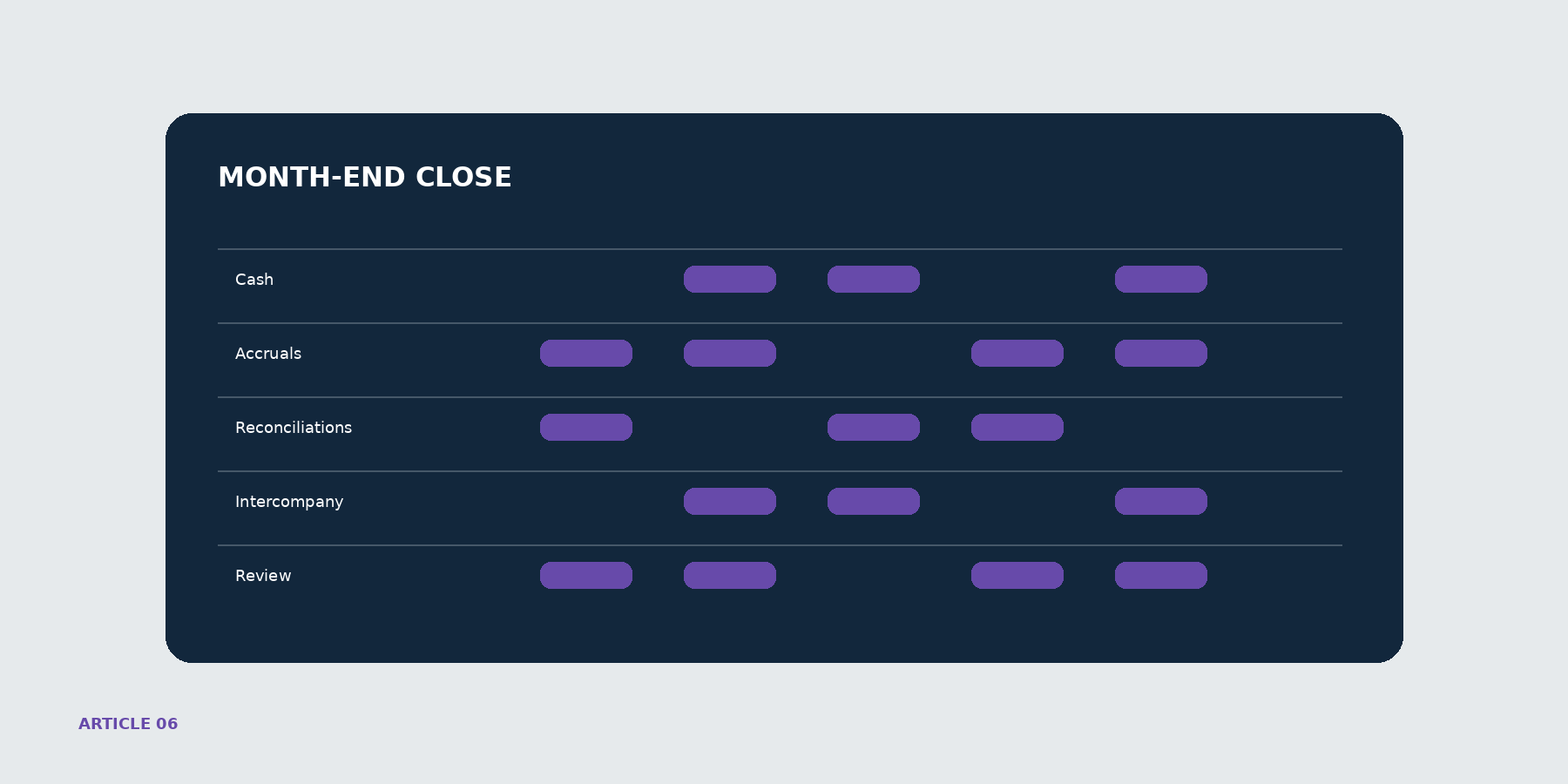
The Month-End Checklist Is Turning Into Software
The financial close is full of work that is repetitive but not trivial: reconciliations, evidence gathering, variance investigation, status checks, follow-ups and documentation. That combination makes close automation attractive — and dangerous. An error can flow directly into financial reporting.
FloQast's March 25, 2025 launch of AI Agents and FloQast Transform is a useful marker. The company positioned the capability around recurring close, compliance and reporting workflows, with accountants able to use prebuilt, templated or custom agents and create workflows through natural language.
The most important word in the announcement may be “auditable.”
Why Auditability Is the Product
Generic automation can save clicks. Accounting automation has to explain itself. For a close agent to be trusted, reviewers need to know what data it used, which action it took, what instruction governed the action and where human approval entered the process. The output is not enough; the evidence path matters.
That changes how finance teams should evaluate AI. Accuracy on a demo task is only one dimension. Traceability, reproducibility, permissions and exception handling are equally important.
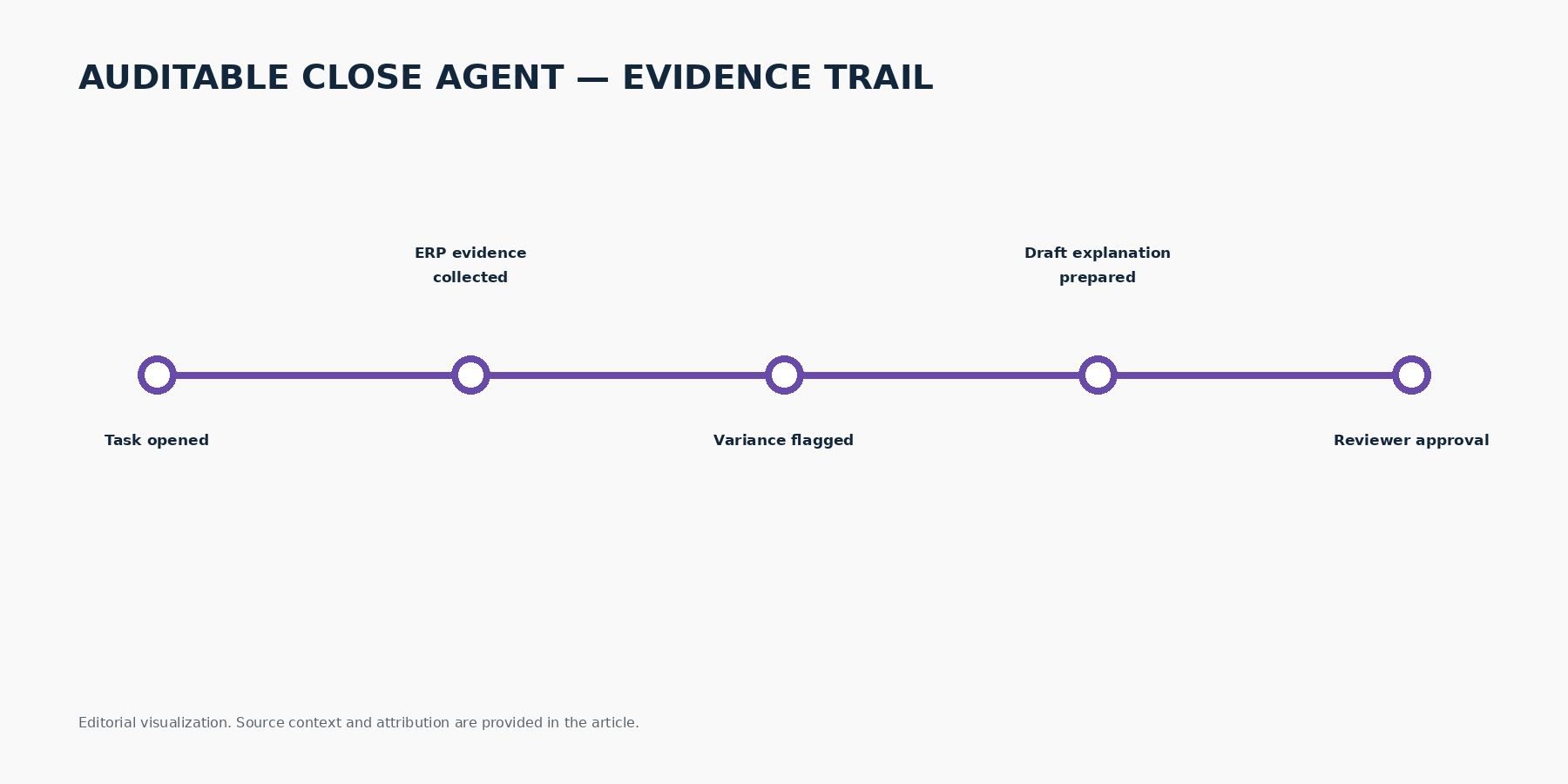
Preparer to Reviewer — With a Catch
FloQast framed the launch around moving accountants from preparers toward strategic reviewers. That is plausible, but review work only becomes higher value if the system surfaces the right evidence. A reviewer forced to reconstruct every automated action has not gained leverage.
What to Automate First
Start with recurring workflows whose inputs and expected outputs are well understood: checklist follow-ups, evidence requests, standardized reconciliations, first-pass variance explanations and routine status reporting. Avoid beginning with the most judgment-heavy accounting issue simply because it makes a dramatic AI demonstration.
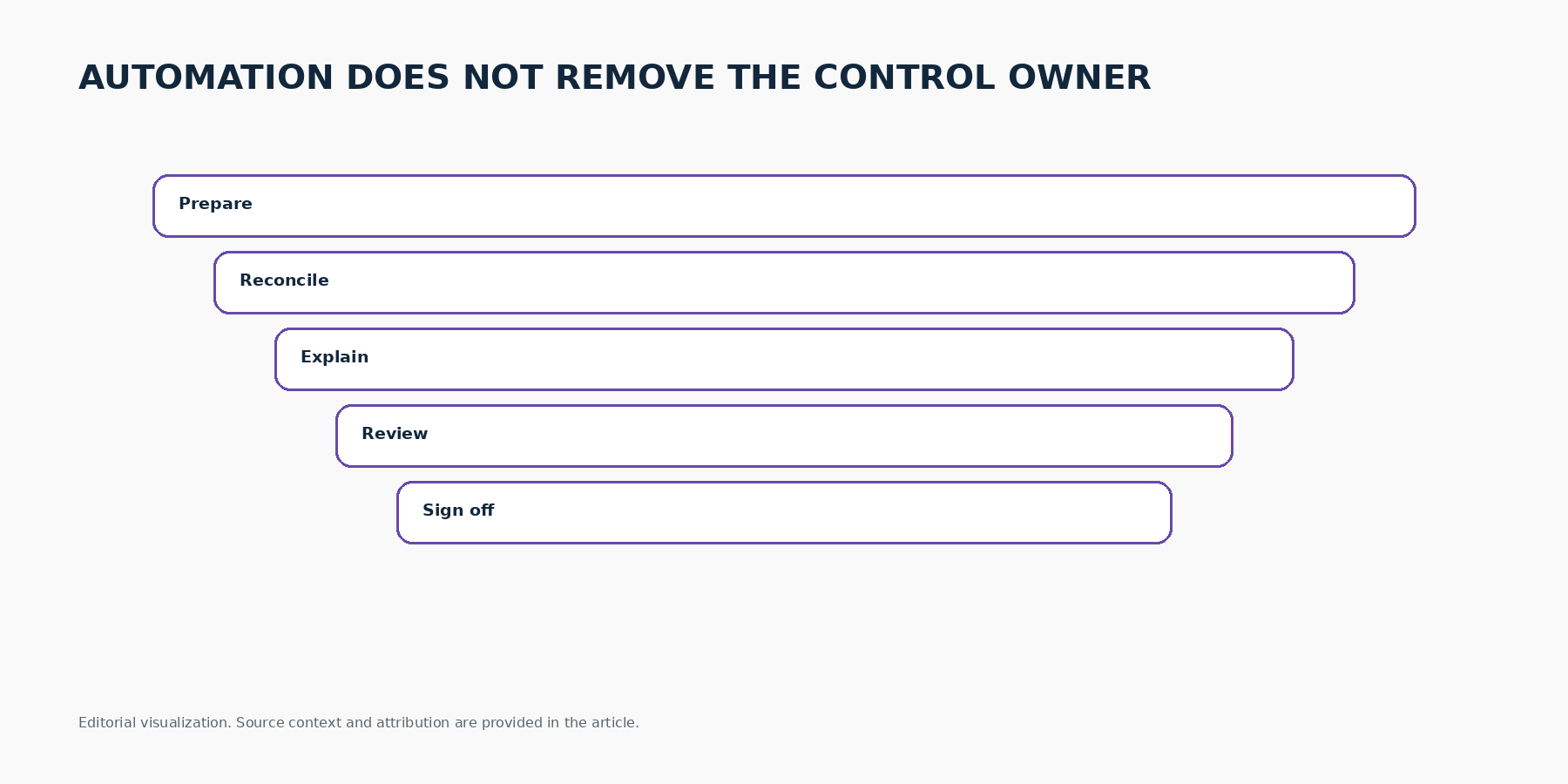
Controls for an Agentic Close
Define who can create an agent, who can change its instructions, which systems it may access, which actions require approval, how exceptions are routed and how the full history is retained. Treat agent instructions like part of the control environment. A prompt that changes behavior is not merely copy; in a finance workflow it can function like business logic.
The Signal
The close is not becoming “one click.” It is becoming a network of smaller workflows in which machines can prepare, reconcile, explain and route while accountants review the evidence and own the judgment. That is a more realistic — and more useful — definition of AI accounting.
Key takeaways
- For analysts
- Focus on traceability, exception handling and understanding the business process behind the automation.
- For managers
- Measure workflow outcomes, not AI activity. Establish a baseline before rollout.
- For controllers / process owners
- Treat permissions, evidence, change management and audit trails as product requirements.
- For CFOs
- Buy technology for a measurable operating problem. AI capability without reliable data and controls is not transformation.
Sources & further reading
Factual product claims and statistics are limited to information available by the publication date. Vendor-reported metrics are identified as vendor/company-reported rather than independent benchmarks.
- For
- Accountant · Accounting Manager · Controller · Finance Operations · Finance Systems · CFO
- Level
- All Levels

About the author
Maya ChenAccounting Technology Correspondent
Maya covers how technology is reshaping accounting and the financial close, with a focus on practical innovation, emerging platforms and the changing role of accounting teams.
The Finance Observer content is for informational purposes only and is not professional financial, tax, legal or investment advice.
Related reading

BlackLine Wants AI to Prepare the Reconciliation. Accountants Still Own the Sign-Off.
BlackLine’s Verity Prepare pushes AI from answering questions about the close into producing work that becomes close evidence. The design question is whether an accountant can still take responsibility for the result.
IFRS 18 Starts in 2027. For Accounting Teams, the Real Deadline Is This Close.
IFRS 18 is mandatory for annual periods beginning on or after January 1, 2027 — but comparatives make it a 2026 close problem. The work sits in account mappings, consolidation rules, expense dimensions and MPM governance.

The Month-End Close Is Being Rewritten
AI agents and continuous accounting are beginning to shift the close from a monthly sprint toward a continuously managed financial process.
Related across formats
Curated video and audio that share this article's finance topics.
SAP’s Autonomous Finance Vision: What CFOs Should Look For Beyond the AI Demo
SAP
In this SAP Finance Connect keynote, SAP presents how AI assistants and agents could fit into core finance workflows, from accounting and consolidation to planning, billing and payments. As a vendor-hosted keynote, its product capabilities and reported benefits are SAP and participant claims rather than independently verified outcomes.
1Password’s CAO on Where AI Fits in a Well-Run Accounting Team
Senad Mustafic · Chief Accounting Officer, 1Password
Senad Mustafic, Chief Accounting Officer at 1Password, joins Kinter controller Armen Aklian, CPA, for an on-demand fireside chat (The CFO Track) about his path from financial analysis into controllership, how his thinking on AI has changed, and his approach to AI adoption at 1Password.

CFO Weekly
Why Accounting Judgment Still Matters When AI Does the Work
Host Megan Weis and Kerrie Jones, Financial Controller at Peak Living, on why following the correct process doesn’t guarantee a sensible outcome — and how controllers can teach accountants when to question the output, including AI’s. CFO Weekly is produced by Personiv.
CFO Weekly
Editor's PickThe Rise of AI-Driven Finance Teams
A forward-looking discussion on AI agents transforming accounts receivable, the shift from finance operators to finance architects, “headless finance,” and what the CFO function could look like in the next three to five years.