
Accounting, Close & Reporting · AI & Automation
The Month-End Close Is Being Rewritten
How AI agents, continuous accounting and a new generation of finance platforms are challenging one of accounting's oldest rituals
For Accountant · Accounting Manager · Controller · Finance Operations · CFO
Level All Levels
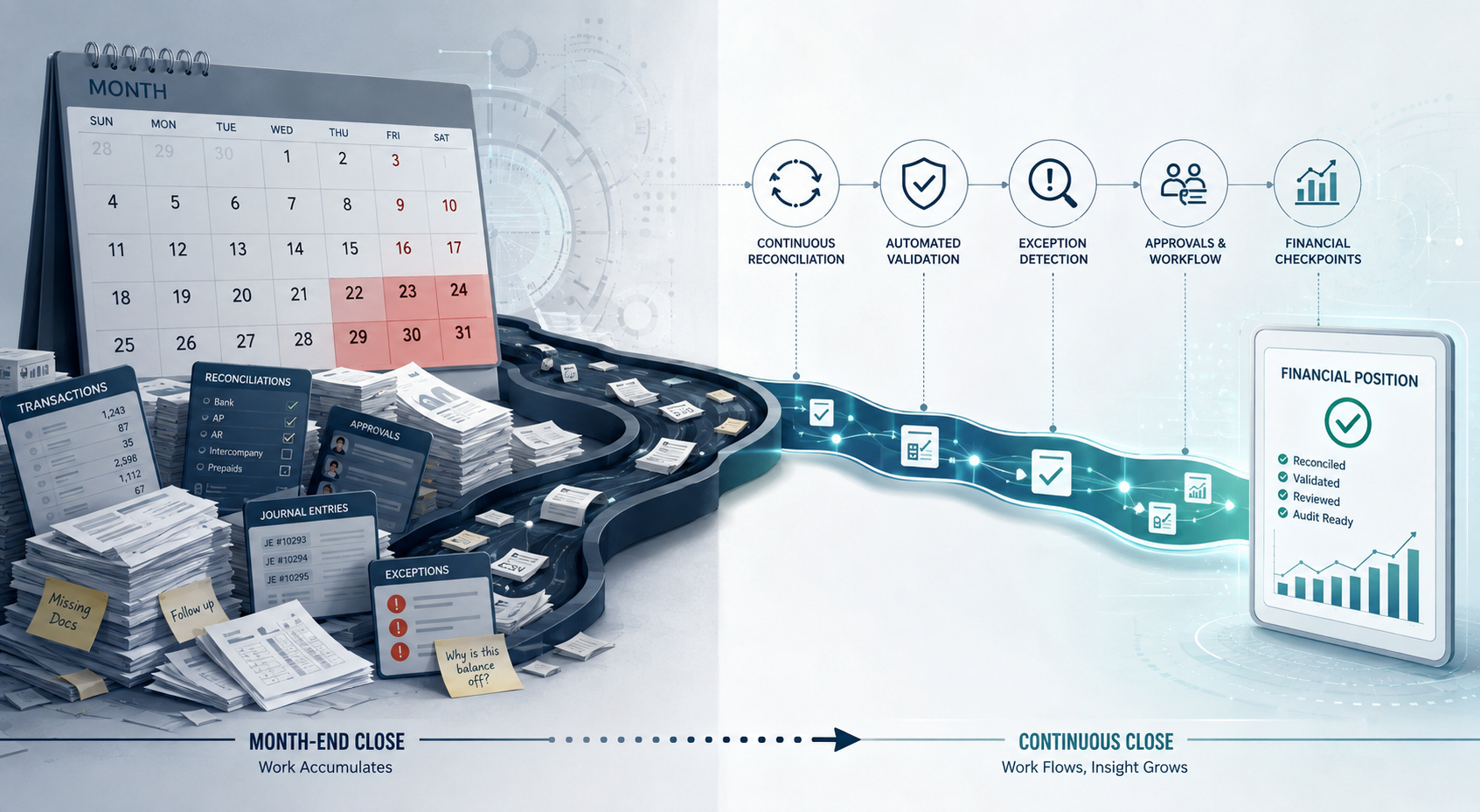
For decades, the financial close has followed essentially the same rhythm.
The month ends. Accounting teams collect missing information, reconcile bank and balance-sheet accounts, calculate accruals, prepare journal entries, match intercompany balances, investigate exceptions and assemble reports.
Then, a few weeks later, they do it again.
Software has made individual steps faster, but the underlying operating model has remained surprisingly persistent:
Business happens continuously. Accounting catches up periodically.
In 2026, that assumption is beginning to come under serious pressure.
The emerging idea is continuous close: move reconciliations, validations, anomaly detection and other repeatable accounting work throughout the month so that substantially less work remains when the period ends.
The question for finance leaders is therefore changing from “How do we close faster?” to:
“How much should actually be left to close?”
From a Faster Close to a Continuous Close
The desire to shorten the close is hardly new.
Finance teams have spent years standardizing close calendars, implementing reconciliation tools, centralizing shared services and replacing spreadsheet-based checklists.
Continuous accounting goes further.
Instead of discovering a reconciliation discrepancy on Day 2 after month-end, software can continuously compare balances and transactions during the month.
Instead of waiting until the books close to investigate an unusual movement, systems can flag exceptions while the underlying transactions are still fresh.
Instead of rebuilding support for predictable journal entries every month, automation can prepare recurring work and route only exceptions for review.
The close therefore starts becoming less of a batch-processing event and more of an exception, judgment and approval process.
Continuous close does not mean eliminating period-end accounting.
Cutoffs still matter. Estimates still matter. Judgment, consolidation, controls, review and formal sign-off still matter.
What changes is how much routine work has been allowed to accumulate before Day 1.
AI Agents Change the Automation Boundary
Traditional finance automation is mostly deterministic.
A system receives an input. A predefined rule tells it what to do. The system executes the rule.
That remains extremely valuable.
But accounting contains enormous amounts of work that sits awkwardly between a rigid rule and a genuinely complex accounting judgment.
- A reconciliation matches — except for one transaction.
- A supplier description is unfamiliar.
- A balance moved materially and somebody needs to understand why.
- Supporting documentation exists, but it lives in another system.
- A journal entry looks unusual compared with previous periods.
Historically, those situations require a person to move between systems, gather context and determine what needs attention.
AI agents potentially expand what can happen before that person becomes involved.
SAP's Financial Closing Assistant illustrates how broad vendors expect that scope to become.
Its documented capabilities include work across receivables and payables, accruals, error resolution, GL review, reconciliation and journal-entry workflows.
That is considerably more ambitious than simply putting a chatbot next to an ERP.
Where Agents Could Enter the Close
Reconciliations
An agent can gather data from multiple sources, perform matching and prepare unresolved exceptions for review.
Journal Preparation
Systems can collect supporting data and prepare proposed entries for repeatable accounting events.
Flux and Variance Analysis
Instead of merely identifying that an account changed materially, an agent can investigate the transactions underneath the movement and prepare a first explanation.
Exception Management
Rather than forcing accountants to review an entire population, systems can prioritize transactions that deviate from expected patterns.
Close Orchestration
Agents can identify missing inputs and dependencies, track progress and route work to the appropriate person.
Meta: Earning the Right to Automate
Meta Chief Accounting Officer Aaron Anderson has described the company's approach to introducing AI into accounting workflows as deliberately incremental.
“We earn the right.”
The principle is straightforward: AI receives greater autonomy only after demonstrating that it can perform the work reliably.
Anderson has also emphasized one of the less glamorous constraints facing AI in finance: data.
The lesson for finance organizations is important.
The sophistication of an AI model matters far less if the underlying financial information is fragmented, poorly governed or difficult to trace.
Source: CFO.com — Meta's accounting chief shares how he's working toward continuous close
OpenAI Is Aiming at a Zero-Day Close
In August 2026, OpenAI CFO Sarah Friar described two bold ambitions for the company's finance function:
- Zero-day close — A reconciled financial position available at any moment.
- Automated, continuously updated forecasting — Planning that refreshes with the business rather than with the calendar.
The idea behind a zero-day close is to give leaders a real-time, reconciled and traceable view of the company's financial position.
Continuous forecasting builds on that foundation by showing how the business is changing, what could happen next and which decisions could alter the outcome.
“Finance has become a real-time function.”
Source: OpenAI
The significance is not whether OpenAI literally reaches zero days.
OpenAI itself says it is still building toward these ambitions.
The more interesting idea is the operating model implied by the target.
Instead of waiting for a reporting event to assemble a trustworthy picture of the business, finance continuously maintains one.
A faster close does not only make accountants' lives easier.
It shortens the gap between what has happened in the business and when management can confidently act on it.
The Accountant Moves From Population to Exception
Perhaps the easiest way to understand the change is to imagine 10,000 transactions.
Traditional accounting processes may require people to touch large portions of that population through reconciliations, spreadsheet manipulation, supporting-document searches and control procedures.
The emerging model attempts to automatically process the routine population and escalate what the system cannot confidently resolve.
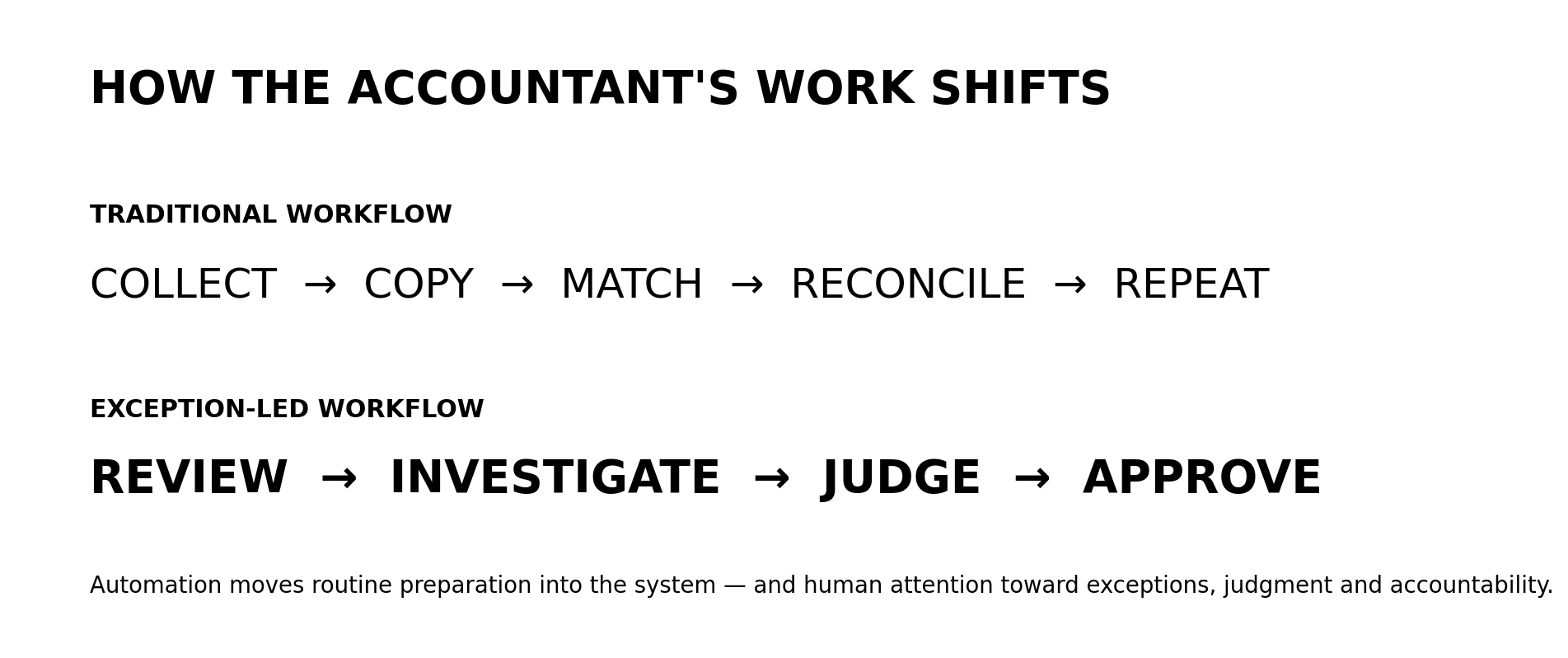
The accountant increasingly works on the second sequence.
That does not make controls less important. It makes them more important.
Generative AI is probabilistic. Accounting math is not.
A model that produces a plausible answer can be extremely useful for drafting an explanation.
The reliability standard is very different when software is allowed to post material entries to a general ledger.
The best use of AI therefore differs dramatically by task.
Where Automation Fits
| Finance task | Automation potential | Human role |
|---|---|---|
| Transaction Matching | Very High | Review exceptions |
| Routine Reconciliation | High | Investigate unresolved items |
| Document Gathering | Very High | Validate evidence |
| Flux Analysis | High | Challenge explanation |
| Routine Journal Preparation | High | Review / approve |
| Anomaly Detection | High | Determine significance |
| Accounting Estimates | Moderate | Judgment |
| Complex Policy Interpretation | Lower | Accounting expertise |
| Material Sign-Off | Low | Accountability |
Automation-potential ratings are an editorial framework, not external research data.
The goal is not maximum autonomy everywhere. It is the right autonomy for each task.
AI Is Already Inside the Finance Function
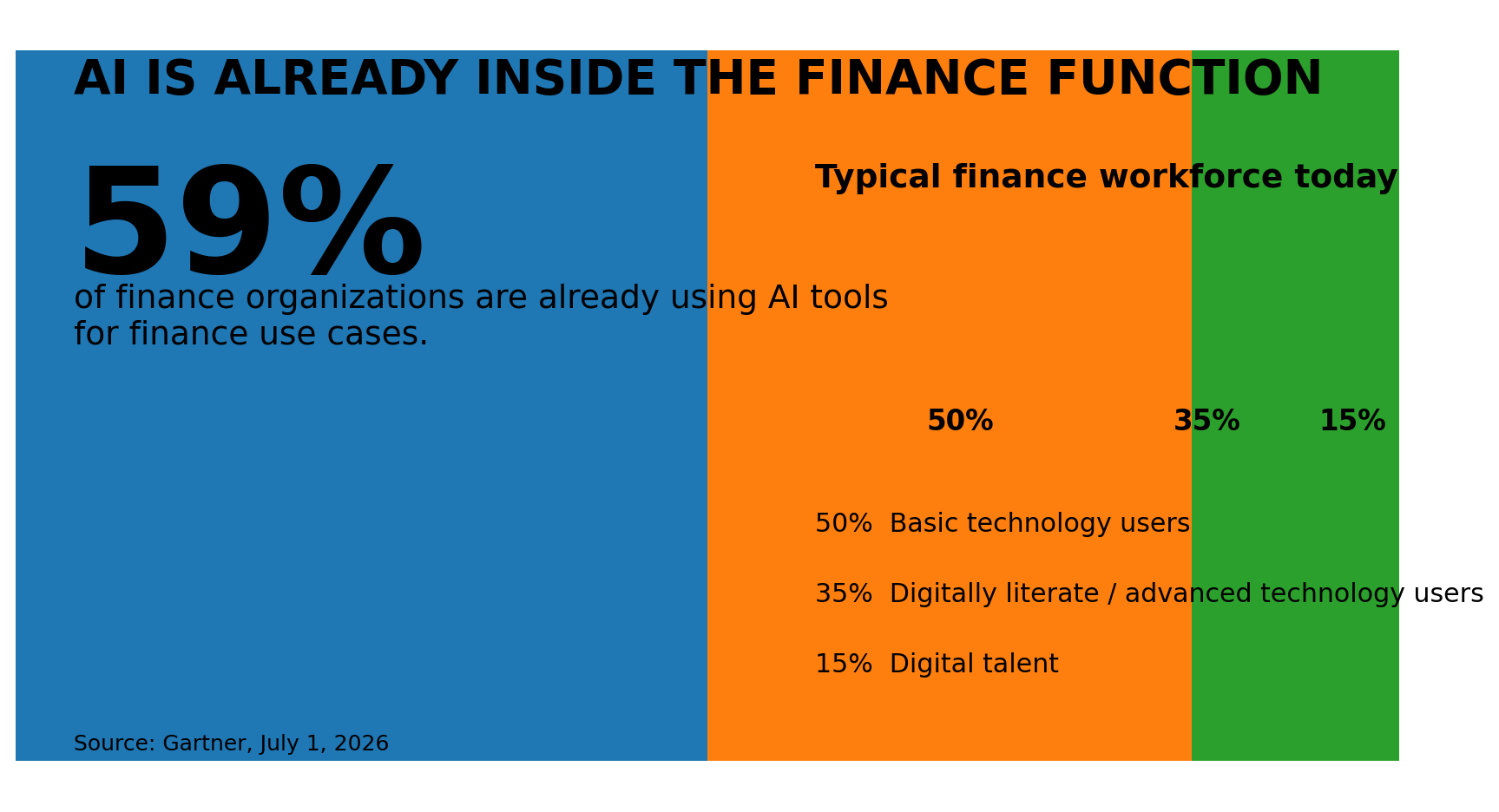
Gartner reports that 59% of finance organizations are already using AI tools for finance use cases.
The typical finance workforce described by Gartner currently consists of:
- 50% — basic technology users
- 35% — digitally literate and advanced technology users
- 15% — digital talent
Gartner also predicts that by 2028, 20% of finance organizations will stop hiring and developing nondigitally literate talent and allocate all talent-related investment toward advanced digital capabilities.
Source: Gartner, July 1, 2026
What Happens to the Junior Accountant?
This may ultimately be more consequential than whether a company closes in four days or six.
Many traditional entry-level accounting activities are precisely the work automation handles most easily: transaction matching, data gathering, repetitive reconciliations, checklist administration, first-pass variance identification, and preparation of recurring support.
This does not necessarily mean the disappearance of junior accountants.
It means the definition of a valuable junior accountant is changing.
The old question Can you perform the reconciliation? increasingly becomes:
Can you understand why it failed, determine whether the exception matters, validate what the system did and improve the process so it does not fail again?
Those are different skills.
For employees, the implication is straightforward:
Learning the accounting is no longer enough.
Understanding how accounting systems, data and automation interact with that accounting is increasingly becoming part of the profession.
The Biggest Obstacle May Not Be AI
An AI agent cannot reconcile data the organization itself cannot reliably connect.
It cannot consistently apply an accounting policy that exists only in the head of a senior accountant.
It cannot know which of three spreadsheets is the real source of truth unless the organization knows.
And giving an agent permission to write to the general ledger creates a fundamentally different risk profile from asking a chatbot to summarize a memo.
- 01Clean enough data — Clearly governed sources, definitions and ownership.
- 02Standardized processes — If five entities perform the same reconciliation five different ways, automation becomes considerably harder.
- 03Explicit controls — Teams need to know what an agent may perform, what requires review and what it must never do autonomously.
- 04Auditability — The organization must be able to demonstrate how automated work was controlled, reviewed and approved.
A broken close does not become a good close because an AI agent is added to it. It may simply become a faster broken close.
What Should a Finance Team Automate First?
- 01Map where the close actually loses time — Identify waiting, handoffs, searches, rework and repeated investigations.
- 02Find high-volume repeatable work — Reconciliations, matching, data gathering and recurring support are natural candidates.
- 03Separate preparation from judgment — An agent may be able to prepare an entry long before the organization is comfortable allowing it to approve one.
- 04Identify reliable data domains — Start where data lineage and ownership are already reasonably strong.
- 05Define the evidence required by controls and auditors — Do this before deployment, not after.
- 06Design the exception path — What happens when confidence is low? Who receives the item? What information accompanies it?
- 07Measure human intervention — Automation rate alone can be misleading. A process that is “90% automated” but requires constant investigation of the remaining 10% may deliver little value.
Stop Measuring Only Days to Close
Days-to-close will remain important.
But continuous accounting suggests several additional operational measures.
- Percentage of reconciliations completed before period end
- Percentage of transactions processed without human touch
- Number of unresolved exceptions entering Day 1
- Hours spent searching for supporting evidence
- Percentage of journals automatically prepared
- Human interventions per 1,000 transactions
- Average age of unreconciled items
- Time from business event to decision-ready financial insight
These measures reveal something days-to-close cannot:
whether the close is genuinely becoming more continuous or merely becoming a faster sprint.
So, Is This the End of Month-End?
Not yet.
There will still be accounting periods.
There will still be cutoffs, estimates, consolidation, management review, judgment and formal reporting.
But the shape of the work around period-end can change dramatically.
The most interesting metric may eventually stop being “How many days does your close take?” and become:
“How much work is still waiting when the month ends?”
That is the deeper promise of continuous accounting.
If AI agents become reliable enough to operate within well-governed financial workflows, month-end may gradually stop being the recurring fire drill around which accounting departments organize their lives.
Instead, it becomes something quieter:
a controlled checkpoint in a financial system that has been closing all month.
Key takeaways
- For accountants
- Expect repetitive preparation to decline and exception investigation, validation, data fluency and system oversight to become more valuable.
- For accounting managers & controllers
- Do not begin with the AI tool. Begin with process standardization, data, controls and the specific work you want to eliminate.
- For CFOs
- The opportunity is larger than taking another day out of the close. Continuous accounting can reduce the latency between business activity and reliable management insight.
- For finance operations & systems
- Integration, permissions, audit trails, monitoring and agent governance may ultimately matter as much as model intelligence.
Sources & further reading
- OpenAIWhat Building an AI-Native Finance Function Taught MeSarah Friar · August 10, 2026
- GartnerFinance Organizations and Advanced Digital CapabilitiesJuly 1, 2026
- GartnerCurrent State of AI in Finance, 2026July 9, 2026
- SAPFinancial Closing Assistant
- CFO.comMeta's Accounting Chief Shares How He's Working Toward Continuous CloseSeptember 1, 2026
- For
- Accountant · Accounting Manager · Controller · Finance Operations · CFO
- Level
- All Levels

About the author
Maya ChenAccounting Technology Correspondent
Maya covers how technology is reshaping accounting and the financial close, with a focus on practical innovation, emerging platforms and the changing role of accounting teams.
The Finance Observer content is for informational purposes only and is not professional financial, tax, legal or investment advice.
Related reading
The Close Is Becoming an Agent Workflow
The financial close is full of work that is repetitive but not trivial. Agentic close software promises to prepare, reconcile and explain — as long as every action can be audited.
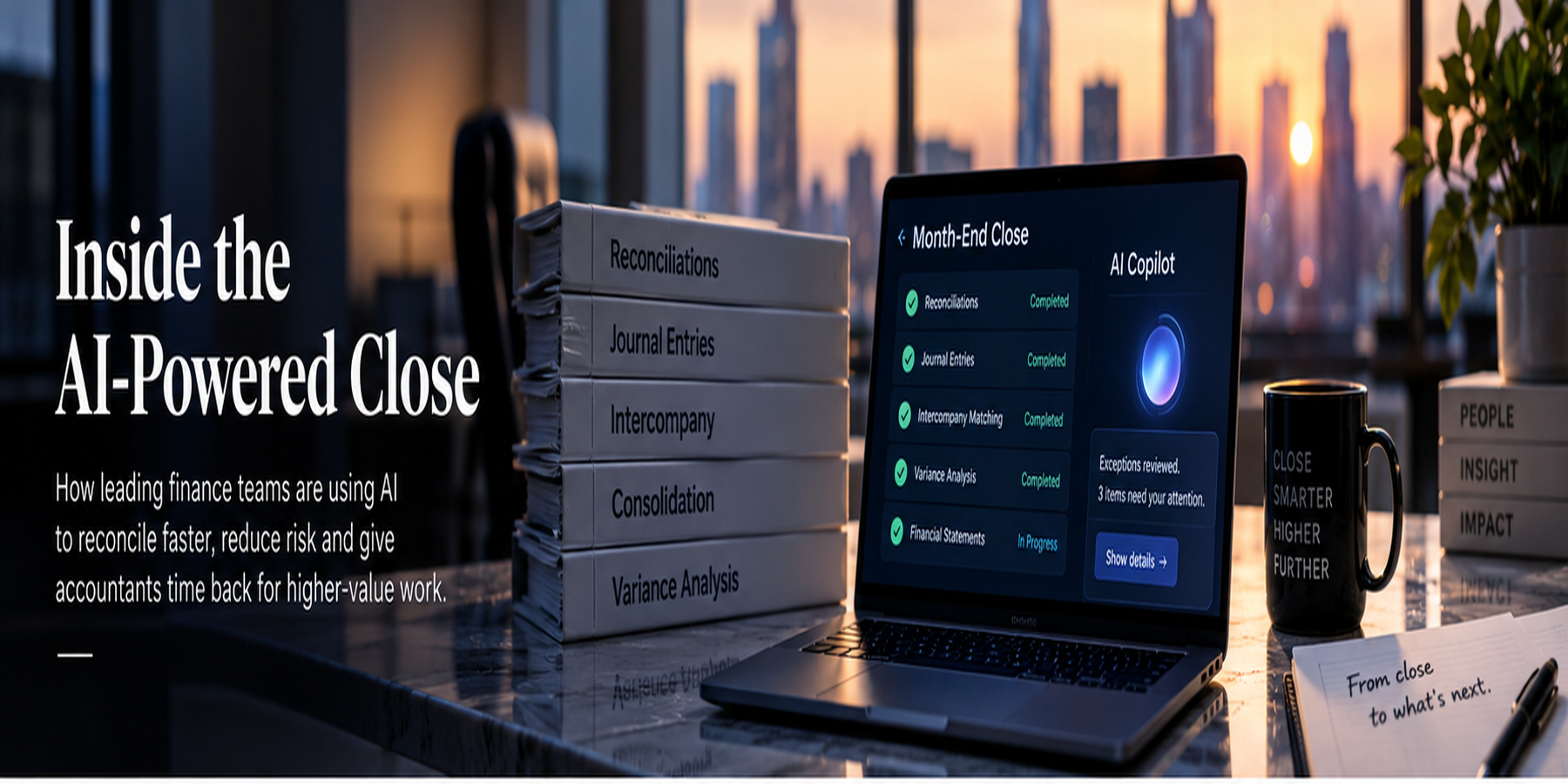
BlackLine Wants AI to Prepare the Reconciliation. Accountants Still Own the Sign-Off.
BlackLine’s Verity Prepare pushes AI from answering questions about the close into producing work that becomes close evidence. The design question is whether an accountant can still take responsibility for the result.
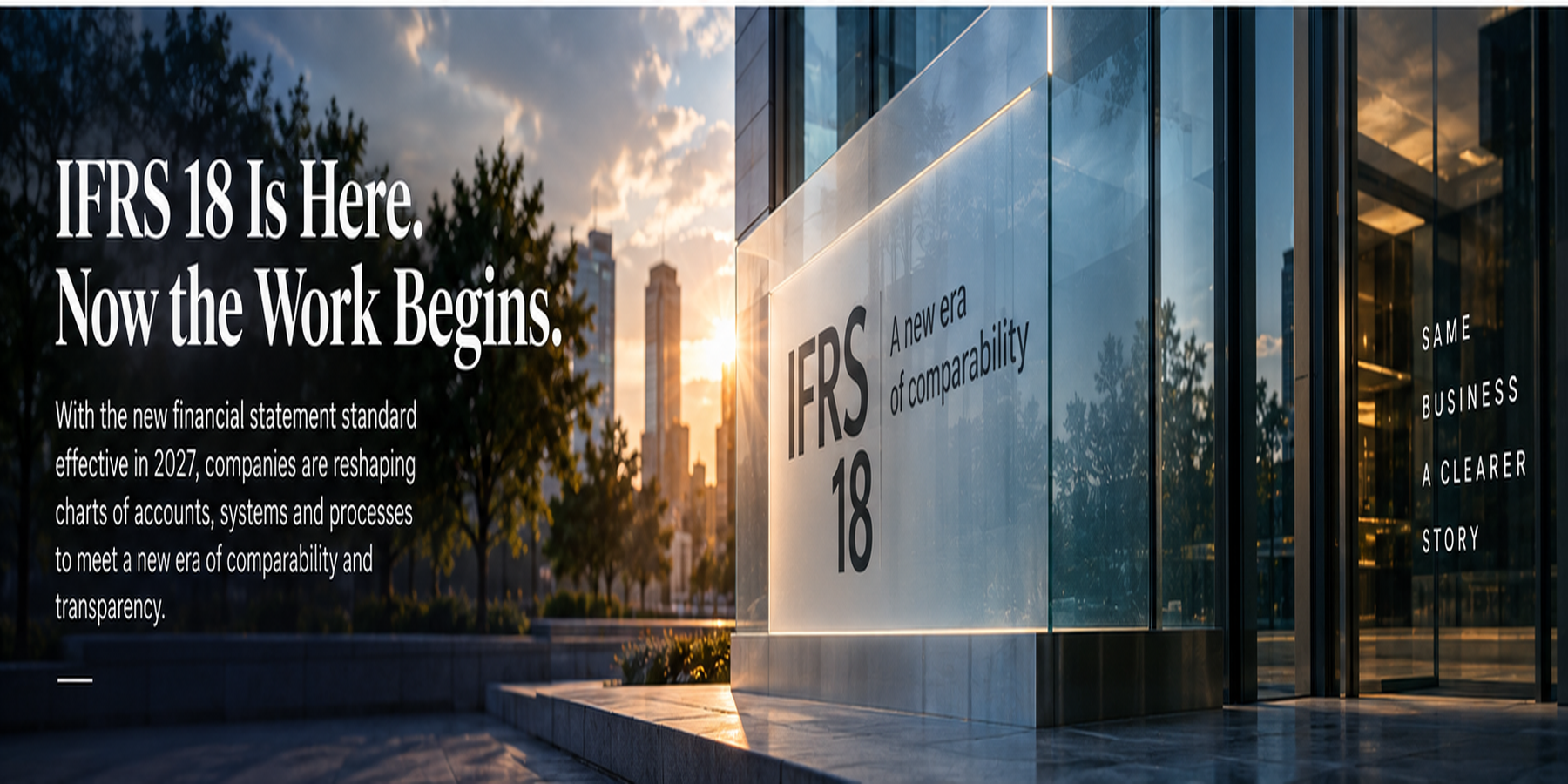
IFRS 18 Starts in 2027. For Accounting Teams, the Real Deadline Is This Close.
IFRS 18 is mandatory for annual periods beginning on or after January 1, 2027 — but comparatives make it a 2026 close problem. The work sits in account mappings, consolidation rules, expense dimensions and MPM governance.
Related across formats
Curated video and audio that share this article's finance topics.
SAP’s Autonomous Finance Vision: What CFOs Should Look For Beyond the AI Demo
SAP
In this SAP Finance Connect keynote, SAP presents how AI assistants and agents could fit into core finance workflows, from accounting and consolidation to planning, billing and payments. As a vendor-hosted keynote, its product capabilities and reported benefits are SAP and participant claims rather than independently verified outcomes.
1Password’s CAO on Where AI Fits in a Well-Run Accounting Team
Senad Mustafic · Chief Accounting Officer, 1Password
Senad Mustafic, Chief Accounting Officer at 1Password, joins Kinter controller Armen Aklian, CPA, for an on-demand fireside chat (The CFO Track) about his path from financial analysis into controllership, how his thinking on AI has changed, and his approach to AI adoption at 1Password.

CFO Weekly
Why Accounting Judgment Still Matters When AI Does the Work
Host Megan Weis and Kerrie Jones, Financial Controller at Peak Living, on why following the correct process doesn’t guarantee a sensible outcome — and how controllers can teach accountants when to question the output, including AI’s. CFO Weekly is produced by Personiv.
CFO Weekly
Editor's PickThe Rise of AI-Driven Finance Teams
A forward-looking discussion on AI agents transforming accounts receivable, the shift from finance operators to finance architects, “headless finance,” and what the CFO function could look like in the next three to five years.