
Treasury, Cash & Banking · AI & Automation
Konica Minolta’s AI Cash Forecasts Changed How It Borrowed
Its treasury team connected better cash visibility to debt repayment and credit-line sizing. The case shows where financial AI can earn a return—and why the data pipeline matters as much as the prediction.
For CFO · Treasurer · Controller
Level Leadership

For Konica Minolta’s treasury team, the financial return from AI forecasting came through a familiar balance-sheet decision: how much cash to keep while carrying debt.
Glisson Inguito, the company’s treasurer, estimated annual savings approaching $1.5 million in interest and commitment fees, according to EuroFinance’s July 2026 conference account. That company estimate, unaudited, links cash visibility to debt and credit-line decisions. [1]
The distinction matters. An accurate forecast does not earn interest savings by existing. Someone must use it to change the amount, timing or terms of financing. Konica Minolta’s experience offers CFOs a way to examine that link: connect cash-data improvements to funding choices, and judge the technology by the decisions it makes possible.
The problem started upstream of the forecast
The journey began with staff manually matching receipts to invoices. Machine-learning cash application preceded the forecasting work, Inguito told the summit. [1]
That sequence is revealing. An unsettled receivable can mean several different things: the customer has not paid, the payment has arrived but has not been matched, or the cash movement has not reached the reporting process. Those situations call for different actions. A forecast built over an unresolved accounting picture risks confusing a processing delay with a liquidity shortage.
This is an architectural lesson for finance. Before asking a model to predict receipts, establish which invoices are actually open and how quickly a payment changes that status. Better prediction cannot compensate indefinitely for a ledger that is describing yesterday’s collections.
The Working Capital Forum’s account of Konica Minolta’s 2024 forecasting award identifies another obstacle: inconsistent subsidiary inputs and limited spreadsheet analysis. The implementation introduced categorized cash movements and consolidated entity forecasts. Those changes made the information more usable across the organization, not merely faster to assemble. [2]
What the AI was doing
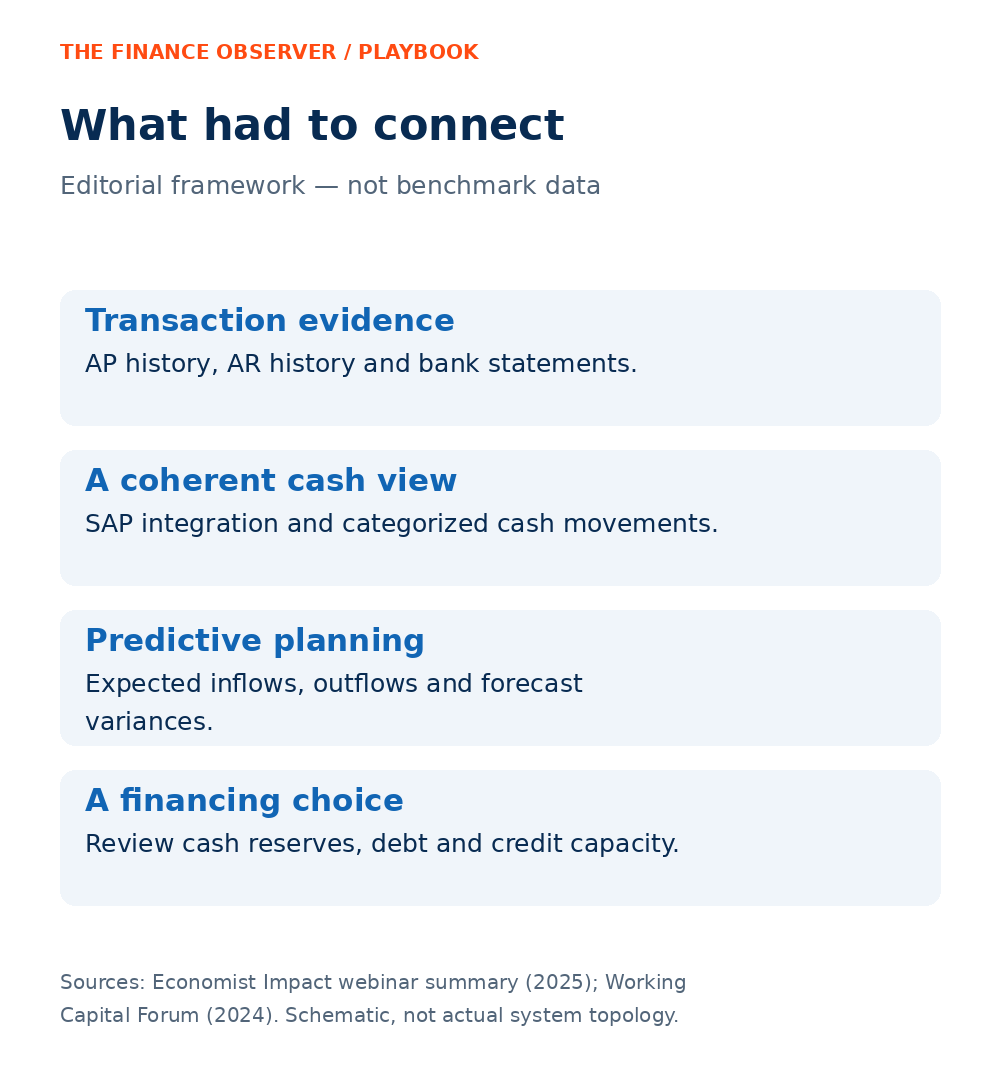
A separate Economist Impact webinar summary provides detail about the forecasting inputs. Inguito described loading a year of accounts-payable history and six months of accounts-receivable history. The company used historical cash information to support predictions across horizons from weekly to 13 months. He also identified integration with SAP and bank data as an implementation challenge. [3]
The aim, then, was predictive cash planning grounded in transaction history. That is different from asking a general-purpose chatbot to draft commentary about a spreadsheet. The public sources do not disclose the model architecture or offer a controlled comparison with a simpler statistical forecast. They do establish that the implementation combined prediction with a substantial effort to make enterprise data available to it.
For a CFO evaluating a similar proposal, that distinction changes the questions. A model demonstration should show how an expected receipt becomes a cash-flow assumption, how its date changes when new information arrives, and how a treasury user can challenge the result. An elegant explanation of a forecast is useful only if the underlying assumptions remain accessible.
The integration work also affects ownership. If finance cannot reconcile the incoming data to its books and banks, the team will struggle to distinguish an unusual business event from a broken feed. The quality of the process around the model determines whether an exception prompts investigation or an unnecessary borrowing decision.
From information to financing
By 2026, daily SFTP feeds supported a forecast generated automatically each Wednesday, with variance analysis at least twice a month, according to EuroFinance. Inguito described the financing consequence directly:
“Because of better forecasting, we’re able to reduce our excess cash and use that to pay down debt.”
There are two economic levers in that account. Repaying debt reduces interest-bearing balances. Resizing credit arrangements can also affect commitment fees, depending on the facility’s terms. The first changes funding already used; the second addresses the capacity the company pays to keep available. Neither benefit should be inferred from forecast accuracy alone.
A cash buffer is protection against uncertainty. As treasury gains more confidence in the timing of receipts and obligations, some of that protection may become unnecessary. But releasing the buffer remains a judgment about downside risk. A model can inform the decision; it cannot establish the board’s liquidity tolerance or remove contractual restrictions on available cash.
This is why the case belongs on a CFO’s agenda. The product choice is one part of the story. The operating decision is whether a more dependable forecast supports a different mix of cash, drawn borrowing and standby credit. That decision connects treasury technology to financing expense.
What the reported savings establish
The financing estimate has a longer history. In December 2024, HighRadius reported $400,000 in interest savings on 90-day short-term loans. Its announcement named Holly DeSantis, EVP and CFO of Konica Minolta Business Solutions U.S.A., and included her endorsement of the forecasting initiative. [4]
That supports describing a CFO-backed transformation, with Inguito providing the operational account. It does not justify attributing the design or execution solely to DeSantis, or extending the U.S. executive’s endorsement to every operation of the Japanese parent.
The later estimate approaching $1.5 million includes commitment fees and is annual in scope; the earlier figure concerns interest on 90-day loans. They are not interchangeable measurements. The available reporting does not provide a reconciliation, implementation costs or enough facility-level detail to independently calculate net ROI. Neither amount should be added to the other or presented as a guaranteed return from the forecasting model.
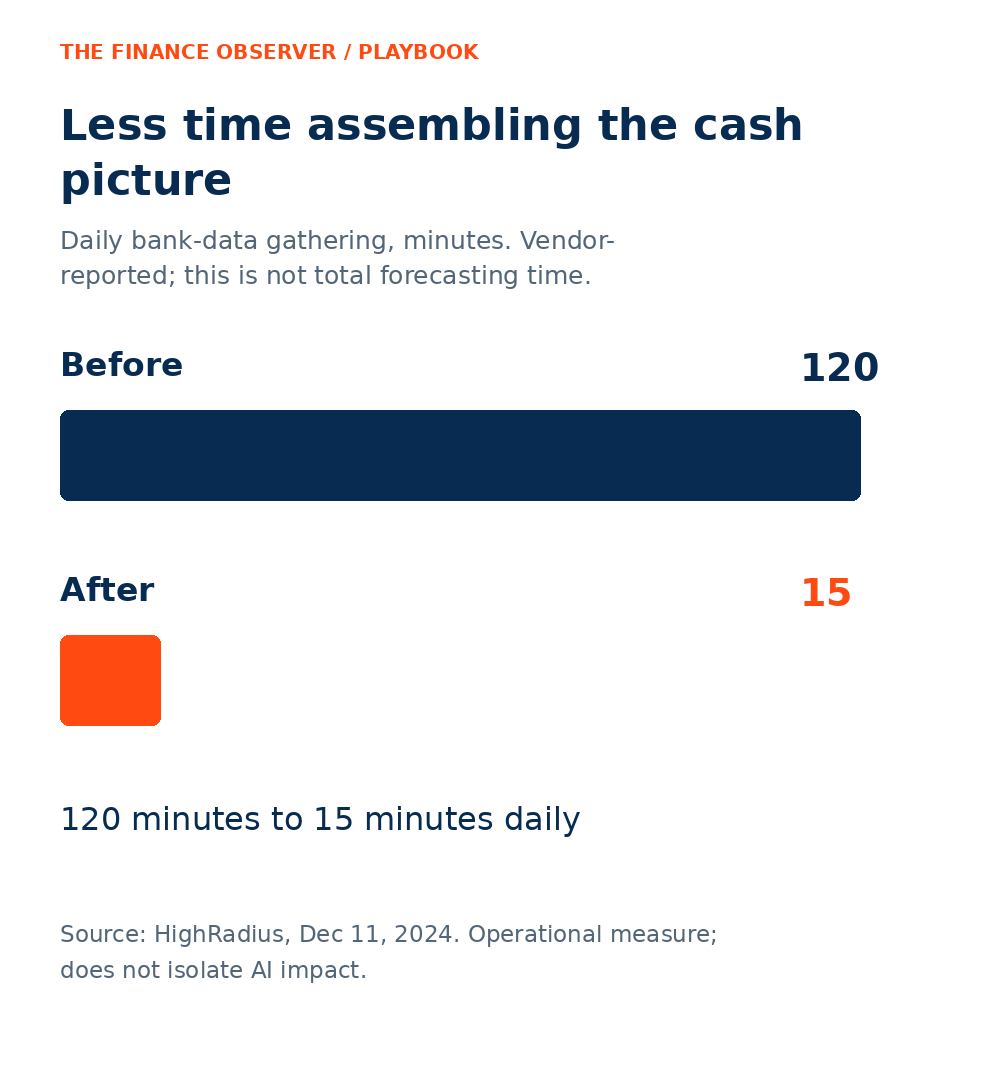
HighRadius also reported a 20% improvement in forecast accuracy and a reduction in daily bank-data gathering from two hours to 15 minutes. The former lacks a published error definition in that announcement; the latter is a preparation-time measure. Both help describe the change, but neither substitutes for evidence of the financing action. [4]
The evidence is therefore stronger on what changed in the workflow and how management used it than on the exact contribution of AI to each dollar saved. That boundary leaves a useful financial case without turning a customer account into a product-performance guarantee.
The control issue beneath the technology
Inguito also argued for company ownership of the data pipeline when dealing with the provider. [1]
That is a practical allocation of responsibility. Treasury needs to own the business meaning of the forecast: which balances are accessible, which receipts are uncertain, and which obligations cannot move. Technology teams need clear responsibility for extraction, transmission and reliability. A provider can supply the platform without becoming the final authority on whether finance should trust a particular number.
The arrangement also helps preserve an exit route. A company evaluating a forecasting product should ask whether it can retrieve its inputs, assumptions, snapshots and overrides in a usable form. A forecast that is difficult to examine will be difficult to defend when the funding decision is challenged.
STEAL THIS: Connect one forecast to one borrowing choice
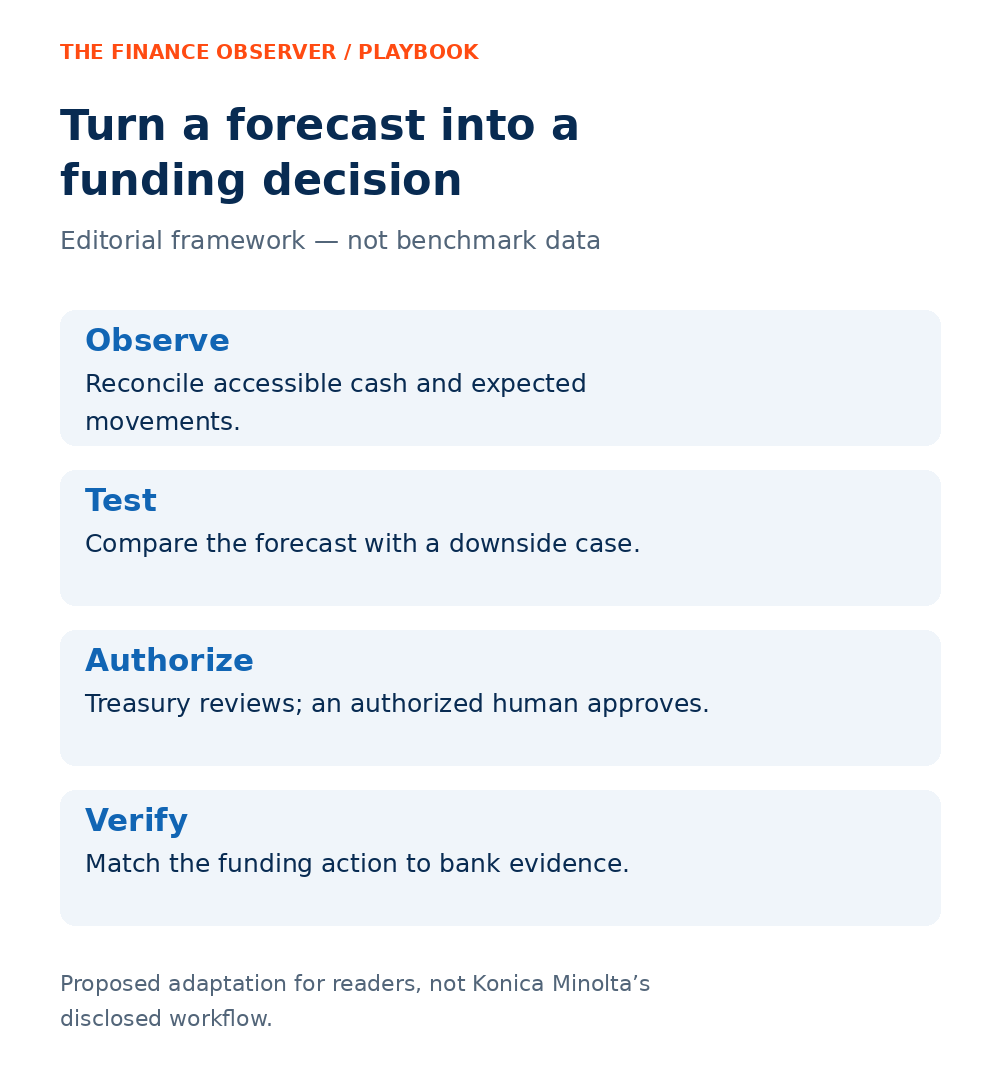
The most portable adaptation is a small, controlled financing test. It does not require copying Konica Minolta’s system architecture. The following is our suggested method, not the company’s disclosed internal procedure.
Have the treasury manager select one facility and preserve the existing funding plan before reviewing an alternative forecast. Record the proposed draw or repayment, the expected cash movements and the required liquidity floor. The CFO should approve the boundaries within which an action may change.
Then compare the revised decision with what actually happens. Use bank records and the facility’s own rate, fees and day-count convention to assess the financing effect. Keep the explanation specific: did fresher cash information allow an earlier repayment, a smaller draw or a change to standby capacity? Include the cost of the new process before claiming a net return.
A controller reviewing that evidence should be able to separate cash released from expense avoided. Likewise, hours freed in treasury are a capacity benefit; they do not automatically become payroll savings. A single, traceable decision is a better starting point than a large savings estimate assembled from overlapping categories.
DON’T COPY THIS: A smaller buffer without a downside case
The lesson has limits. A company that rarely borrows may gain visibility without realizing a comparable interest benefit. A company with restricted cash, concentrated customer receipts or limited repayment flexibility may have less room to act. Treasury should test those constraints before treating a forecast improvement as permission to lower cash reserves.
For the next funding review, put three items together: the cash forecast, the proposed financing action and the downside liquidity position. Ask what new information would justify changing the action—and what event would stop it.
Konica Minolta’s case is valuable because it reaches that point. Its treasury team describes a chain from receivables and connected data to forecasting and financing. The idea worth stealing is the discipline of completing that chain: a prediction becomes financially useful when it supports a decision that finance can explain afterward.
Sources & further reading
- EuroFinance[1] What closing the treasury automation gap actually looks likeJuly 15, 2026 · Conference organizer’s account of Inguito’s remarks; company estimates, not an independent financial audit.
- Working Capital Forum[2] Konica Minolta: 2024 Best Cash Forecasting InitiativeAward case based on company-reported information.
- Economist Impact[3] Harnessing AI for enhanced cash flow forecasting, webinar summaryAvailable in the organizer’s May 2025 materials; exact publication day unspecified. Supported content; speaker testimony.
- HighRadius[4] Konica Minolta forecasting award announcementDecember 11, 2024 · Vendor-reported metrics and CFO endorsement.
- For
- CFO · Treasurer · Controller
- Level
- Leadership

About the author
Ethan ColeTreasury & Payments Correspondent
Ethan covers corporate treasury, cash management and banking, with a focus on the technologies and practices changing how finance teams manage liquidity, payments and financial risk.
The Finance Observer content is for informational purposes only and is not professional financial, tax, legal or investment advice.
Related reading
Treasury Is Becoming a Real-Time Control System
Corporate treasury is moving toward connected bank data, continuous cash visibility and AI-assisted forecasting — but faster information makes controls more important, not less.

The Always-On Treasury Is Arriving. Cash Management Was Not Designed for It.
FedNow settled almost five million payments in Q2 2026, up 83%, and the network limit is now $10 million. The real prize is not faster vendor payments — it is rethinking prefunding, liquidity buffers and controls.

BILL Cut 30% of Its Workforce. What Should Another CFO Actually Steal?
The useful lesson is a decision every finance team can make: where will the capacity released by automation go—and what evidence will justify changing the plan?
Related across formats
Curated video and audio that share this article's finance topics.
SAP’s Autonomous Finance Vision: What CFOs Should Look For Beyond the AI Demo
SAP
In this SAP Finance Connect keynote, SAP presents how AI assistants and agents could fit into core finance workflows, from accounting and consolidation to planning, billing and payments. As a vendor-hosted keynote, its product capabilities and reported benefits are SAP and participant claims rather than independently verified outcomes.
1Password’s CAO on Where AI Fits in a Well-Run Accounting Team
Senad Mustafic · Chief Accounting Officer, 1Password
Senad Mustafic, Chief Accounting Officer at 1Password, joins Kinter controller Armen Aklian, CPA, for an on-demand fireside chat (The CFO Track) about his path from financial analysis into controllership, how his thinking on AI has changed, and his approach to AI adoption at 1Password.

TreasuryCast
Bank Guarantees Are Still Stuck in Spreadsheets. Treasury Has a Visibility Problem.
Recorded at Treasury 360° Europe, host Eleanor Hill and Surecomp’s Head of Product Achraf Abourida on how fragmented bank portals and spreadsheets obscure guarantee obligations across entities. The guest represents Surecomp, a trade finance technology provider. TreasuryCast is published by TMI.
TreasuryCast
Tokenised Deposits Move From Banking Experiment to Treasury Operations
Host Eleanor Hill with Ant International’s Kelvin Li and HSBC’s Selene Chong and Lewis Sun on using HSBC’s Tokenised Deposit Service to move liquidity between group entities. The speakers represent the provider and its customer; operational benefits are their claims. TreasuryCast is published by TMI.