
Treasury, Cash & Banking · AI & Automation
Treasury Is Becoming a Real-Time Control System
From cash visibility to AI forecasting: why corporate treasury is being rebuilt around connected data
For Treasury Analyst · Treasurer · Controller · Finance Systems · CFO
Level All Levels
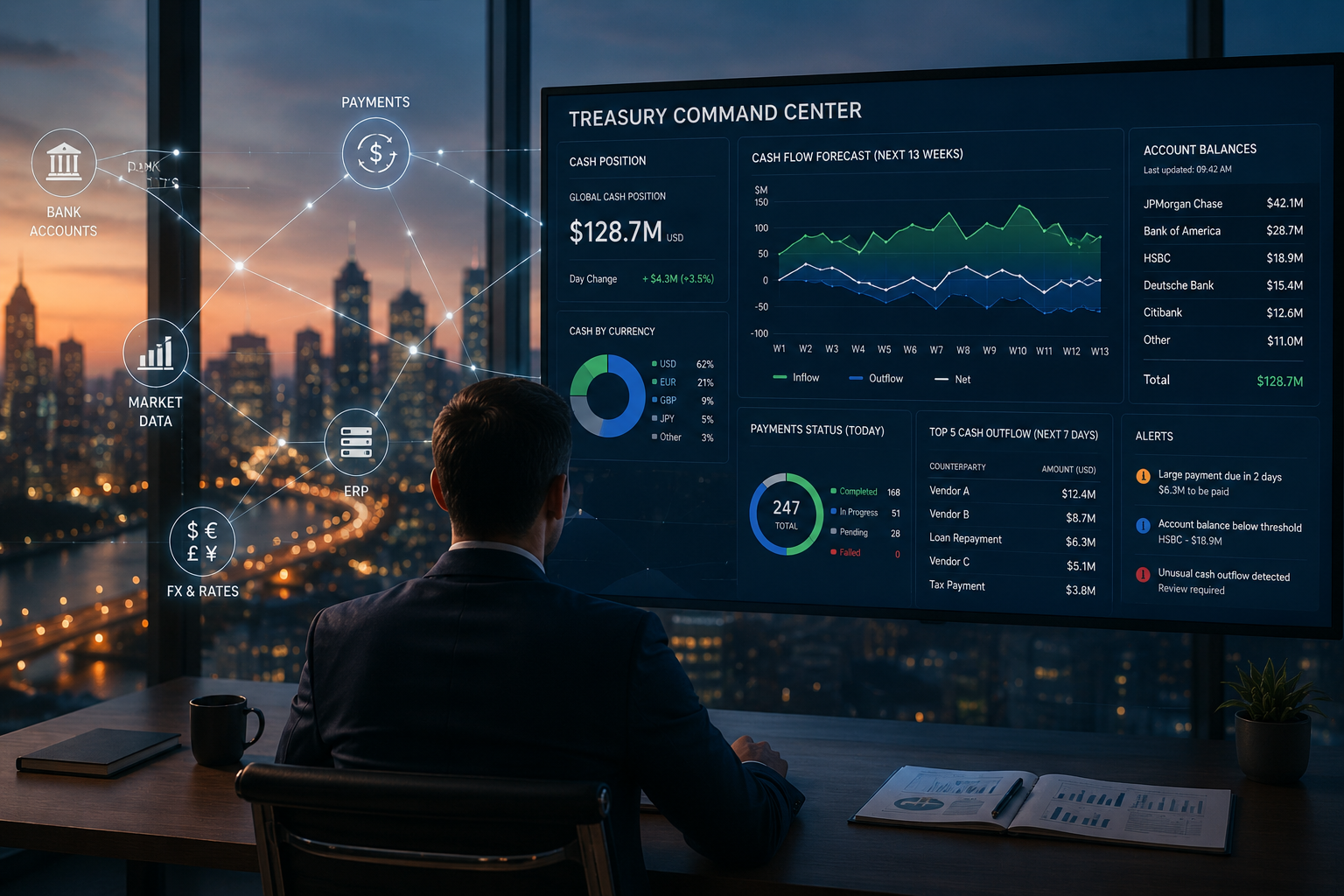
Treasury's Old Information Problem
Treasury has always been responsible for a deceptively simple question: where is the cash, and what can the company safely do with it?
In a global organization, the answer can be scattered across banks, entities, currencies, ERP systems, treasury platforms and spreadsheets. A balance may be accurate but already hours old. A forecast may be carefully constructed but depend on inputs gathered manually from business units. A payment may be initiated in one system, approved in another and tracked in a bank portal.
That operating model is increasingly colliding with a business environment that expects faster decisions.
The emerging treasury architecture is therefore not just about automating individual tasks. It is about shortening the distance between a financial event and treasury's ability to see it, understand it and act.
That is what makes “real-time treasury” more than a technology slogan. At its most useful, it describes a control system: connected bank data, cash visibility, forecasting, risk signals and execution working increasingly close together.
The 2025 Priority: Get the Cash Picture Right
The 2025 EACT Treasury Survey put cash-flow forecasting — including forecasts beyond 13 weeks and monthly rolling forecasts — at the top of corporate treasury priorities. Long-term funding ranked second and treasury technology infrastructure review or replacement third.
PwC's 2025 Global Treasury Survey, based on 350 treasurers, points to the same pressure. Forecasting remains difficult even in large organizations. PwC reported that 38% of companies with more than $10 billion in revenue and 52% of companies between $1 billion and $10 billion still manually collect and consolidate forecasting data.
The barriers were familiar: 76% cited poor data quality, 53% lack of effective tools and 46% limited incentives for business units to contribute.
This is the central contradiction in modern treasury.
Companies want real-time decisions. Many are still assembling the inputs to those decisions manually.
Connectivity Becomes Part of the Treasury Strategy
Historically, corporate-to-bank connectivity has often been file-based. Statements and payment files move on schedules. Treasury receives a picture of the bank position, but not necessarily at the moment it needs it.
APIs change that relationship by allowing systems to request or receive information more directly.
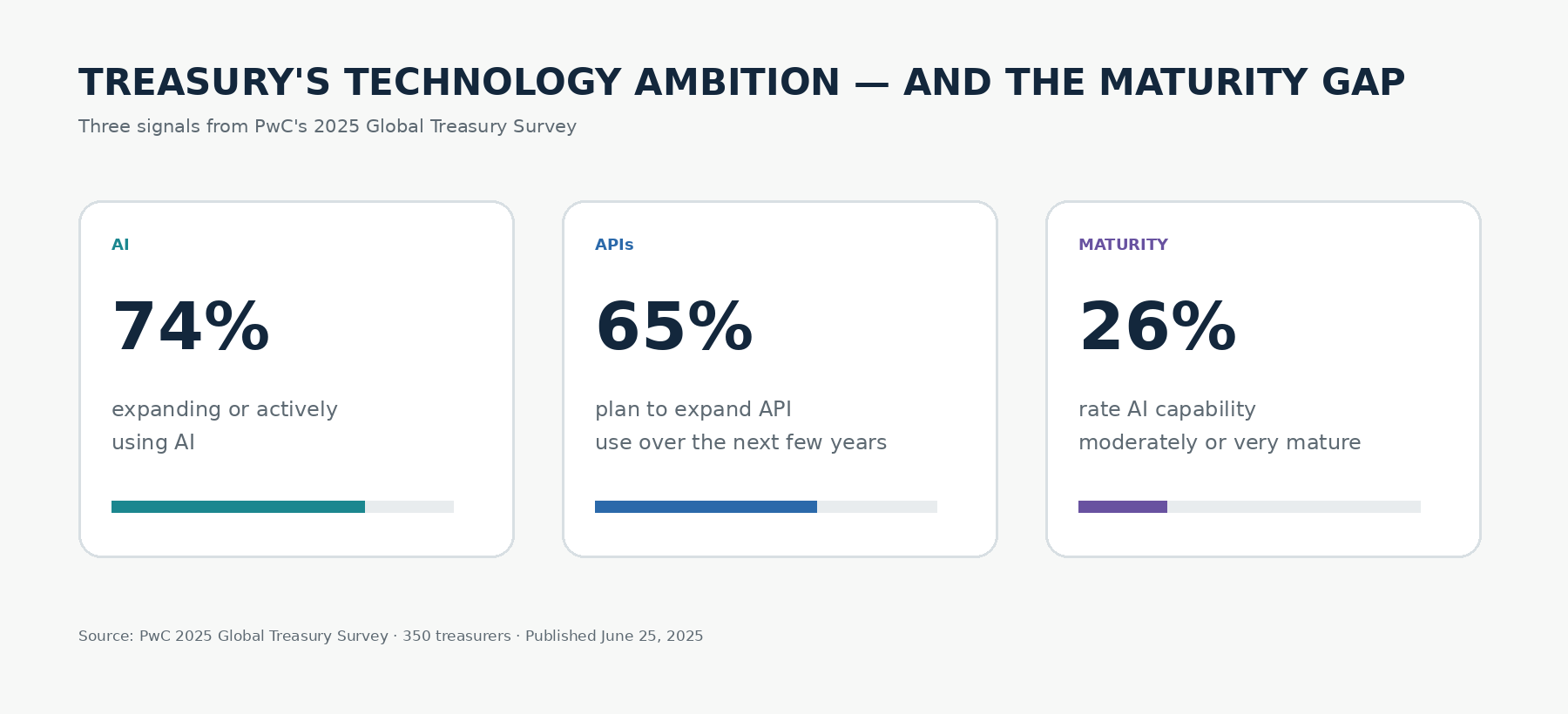
PwC found that 65% of treasury organizations planned to expand API use over the next few years. The objective is not API adoption for its own sake. It is faster integration among banks, ERP systems and treasury management platforms.
For treasury practitioners, the practical distinction is important.
- Real-time balance data can improve visibility.
- Real-time transaction data can accelerate reconciliation and investigation.
- Payment APIs can reduce the gap between approval and execution.
- Integrated data can make cash forecasting less dependent on manual collection.
But “real time” should not automatically mean “automatically move money.” Visibility and execution have different control requirements.
AI Is Arriving Faster Than Treasury Maturity
PwC reported that 74% of respondents were either expanding or actively using AI, particularly machine learning and predictive analytics. Yet only 26% rated their AI capabilities as moderately or very mature; 42% were piloting and 32% were in early development or implementation.
That gap matters.
Treasury is a particularly unforgiving environment for technology hype. A model that writes an imperfect summary creates inconvenience. A system that makes an incorrect liquidity, FX or payment decision can create financial exposure.
The strongest early use cases therefore tend to augment treasury rather than remove it from the loop: cash forecasting, anomaly detection, exposure analysis, reconciliation and investigation.
Prysmian: What the Shift Looks Like in Practice
A 2025 J.P. Morgan case study provides a useful concrete example.
Prysmian's North American treasury operation had ten operating companies and thirteen bank accounts, with a two-person treasury team managing fragmented payment information and daily forecasting requirements.
The company implemented J.P. Morgan Payments' Cash Flow Intelligence, which uses machine learning to support forecasting and cash visibility.
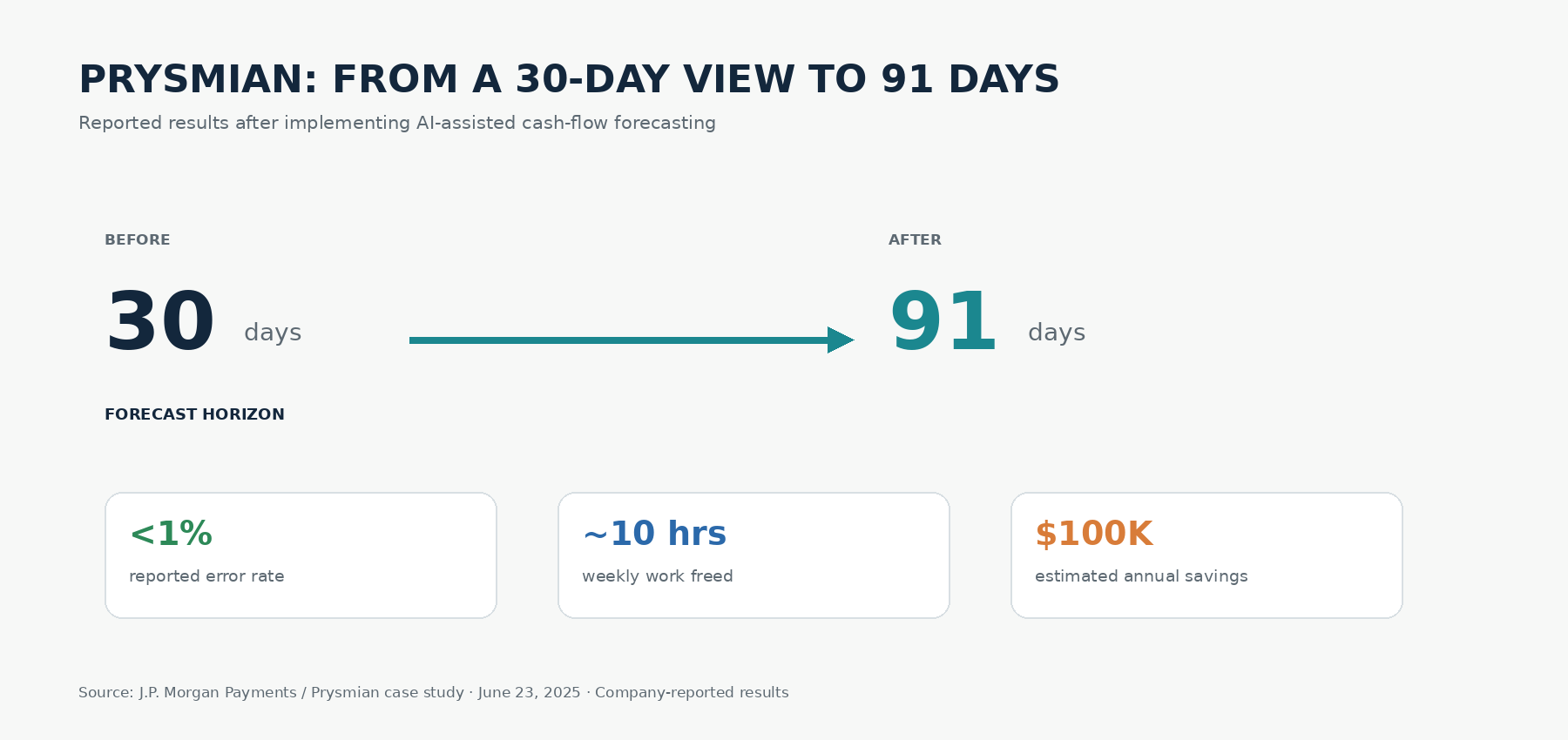
According to Prysmian Vice President & Treasurer Pierluigi Contessa, the forecast horizon expanded from 30 days to 91 days. The company reported an error rate below 1%, roughly ten hours of weekly work freed for one treasury team member and estimated annual savings of $100,000.
Contessa described the impact this way:
“Cash Flow Intelligence has been a game changer for our Treasury team.”
The important part of the case is not simply that AI produced a forecast. Automation removed data collection and reconciliation work that had constrained a small treasury team.
That is a recurring pattern in finance transformation: intelligence becomes more useful after the data path becomes less manual.
Real-Time Treasury Is a Stack, Not a Feature
A useful way to think about modern treasury is as five connected layers.
- 01Connectivity — Bank statements, balances, payments and transaction information need reliable paths into and out of treasury systems.
- 02Visibility — Treasury needs a consolidated view across accounts, entities, currencies and banking relationships.
- 03Intelligence — Forecasting, anomaly detection, scenario analysis and exposure analytics turn data into signals.
- 04Control — Permissions, approvals, limits, segregation of duties and audit trails determine what can happen safely.
- 05Action — Treasury moves liquidity, executes payments, invests surplus cash, funds deficits or manages financial risk.
The order matters.
AI placed on top of fragmented data does not create real-time treasury. It creates faster analysis of an incomplete picture.
What Changes for the Treasury Analyst?
For treasury analysts, the shift is practical.
Less time should eventually go to logging into multiple portals, downloading statements, consolidating balances, formatting recurring reports and manually identifying obvious variances.
More time moves toward investigating exceptions, challenging forecasts, understanding liquidity drivers, monitoring counterparty and FX exposures, validating automated recommendations and deciding when action is required.
That changes the skill mix.
Treasury professionals increasingly need to understand not only cash and risk, but also data flows, system interfaces, automation logic and controls.
The treasury analyst does not become an engineer. But the boundary between financial expertise and technology fluency is getting thinner.
The Control Problem
The attraction of a real-time system is speed.
The risk is also speed.
If data arrives continuously and software can act continuously, a flawed rule, compromised credential or incorrect model output can propagate faster than in a manual process.
That means modernization must strengthen control architecture rather than bypass it.
Treasury teams should distinguish clearly between:
- read access and transaction authority;
- recommendation and execution;
- routine movements and material decisions;
- machine-generated exceptions and human approvals.
The more autonomous the workflow becomes, the more explicit those boundaries need to be.
What Should Treasury Modernize First?
- 01Map the bank data — Identify every bank, account, file, portal, feed and owner.
- 02Define the cash view — Agree which balances and transactions treasury actually needs, at what frequency and for which decisions.
- 03Remove manual collection — Automate repeatable ingestion before attempting sophisticated prediction.
- 04Improve forecast drivers — Separate bank-history prediction from operational drivers such as collections, payroll, purchasing and financing.
- 05Build the exception path — Decide what happens when a transaction, forecast or balance falls outside expected ranges.
- 06Add AI where it has evidence — Use predictive methods where data history and quality justify them. Do not use AI merely because the platform offers it.
- 07Protect execution — Keep approvals, entitlements, limits and auditability central as connectivity becomes faster.
Stop Measuring Treasury Only by Forecast Accuracy
Forecast accuracy matters, but a modern treasury function should also watch:
- percentage of bank accounts visible automatically;
- time required to establish the global cash position;
- percentage of forecast inputs collected without manual intervention;
- age of data at decision time;
- number of manual bank-portal logins;
- exceptions per 1,000 transactions;
- time required to answer a management cash question;
- percentage of payments processed straight-through;
- cash trapped outside central visibility;
- forecast accuracy by horizon.
These metrics reveal whether treasury is actually becoming connected, or simply adding new technology to old workflows.
The End State Is Not “Real Time” Everywhere
Not every treasury decision needs to happen instantly.
A long-term funding decision should not be accelerated merely because data can arrive faster. Neither should a material FX hedge or unusual liquidity movement bypass judgment.
The real opportunity is more selective.
- Make information available at the speed the decision requires.
- Automate activity that is deterministic and well controlled.
- Use predictive tools where they improve the signal.
- Escalate uncertainty to people who understand the financial consequence.
That is a more useful definition of real-time treasury than simply making every process faster.
Treasury becomes a control system when visibility, intelligence, controls and action are connected — and when people can intervene at exactly the points where judgment still matters.
Key takeaways
- For treasury analysts
- Build fluency in bank connectivity, data quality, forecasting drivers and exception analysis alongside traditional treasury skills.
- For treasury managers
- Prioritize visibility and data integration before advanced AI. A predictive model cannot compensate for fragmented cash data.
- For finance systems teams
- Treat APIs as infrastructure with security, entitlement, resilience and monitoring requirements — not merely integrations.
- For CFOs
- The value of treasury modernization is not just lower processing cost. Better liquidity visibility can improve capital allocation, funding and risk decisions.
Sources & further reading
- PwC2025 Global Treasury SurveyJune 25, 2025
- J.P. Morgan PaymentsPrysmian transforms treasury operations with AI-powered treasury insightsJune 23, 2025
- EACTMain Results of the 2025 EACT Treasury Survey
- Strategic Treasurer / TIS2025 Cash Forecasting & Visibility SurveyMay 22, 2025
- For
- Treasury Analyst · Treasurer · Controller · Finance Systems · CFO
- Level
- All Levels

About the author
Ethan ColeTreasury & Payments Correspondent
Ethan covers corporate treasury, cash management and banking, with a focus on the technologies and practices changing how finance teams manage liquidity, payments and financial risk.
The Finance Observer content is for informational purposes only and is not professional financial, tax, legal or investment advice.
Related reading

The Always-On Treasury Is Arriving. Cash Management Was Not Designed for It.
FedNow settled almost five million payments in Q2 2026, up 83%, and the network limit is now $10 million. The real prize is not faster vendor payments — it is rethinking prefunding, liquidity buffers and controls.

Konica Minolta’s AI Cash Forecasts Changed How It Borrowed
Its treasury team connected better cash visibility to debt repayment and credit-line sizing. The case shows where financial AI can earn a return—and why the data pipeline matters as much as the prediction.
The Fed Is on Hold, but Treasury’s Rate Problem Is Getting Harder
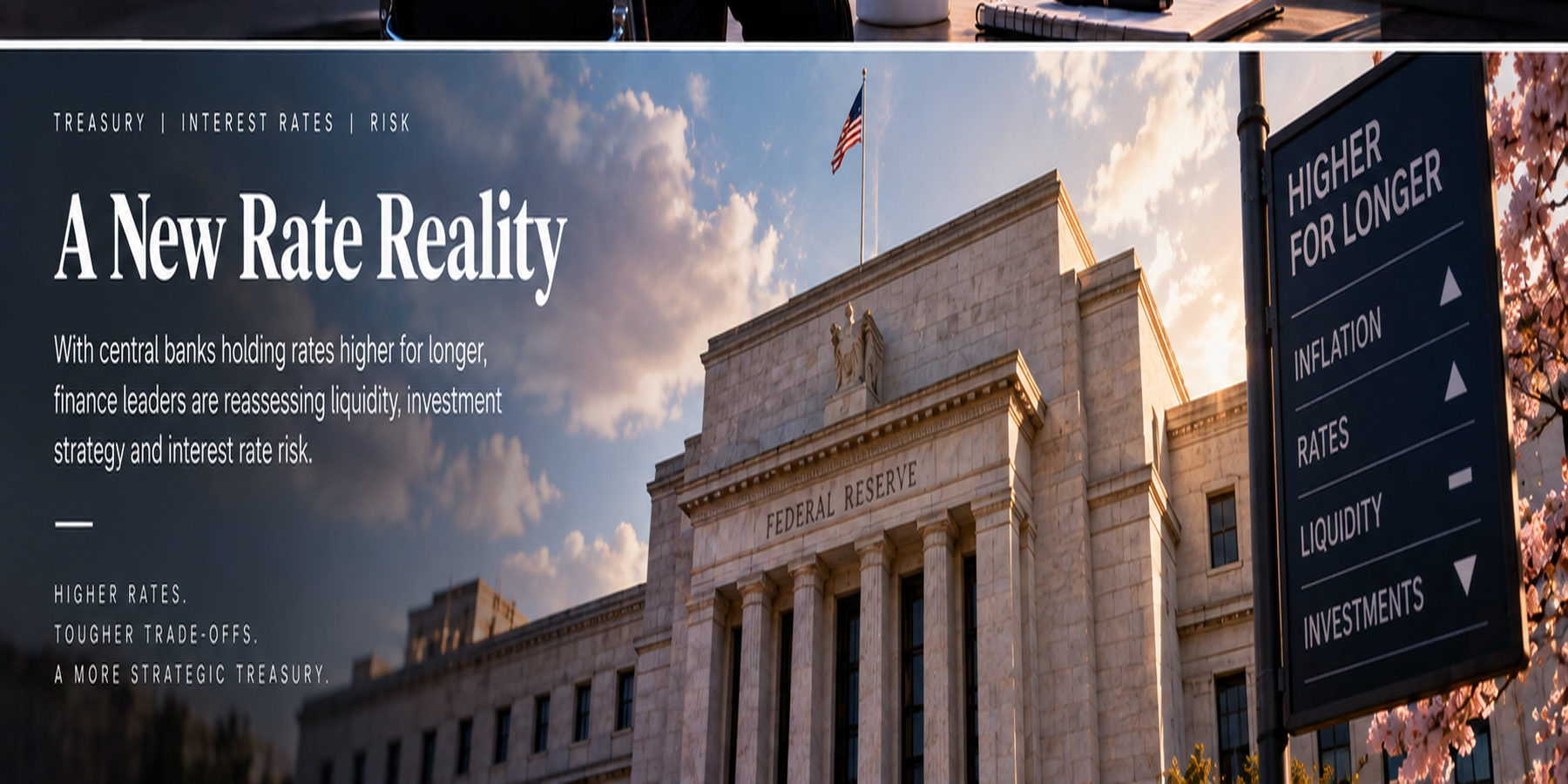
The FOMC held at 3.5%–3.75% in July, but by September 4 the 30-year Treasury yield sat 133 basis points above the three-month. Cash, refinancing and hedging no longer move as one trade.
Related across formats
Curated video and audio that share this article's finance topics.
SAP’s Autonomous Finance Vision: What CFOs Should Look For Beyond the AI Demo
SAP
In this SAP Finance Connect keynote, SAP presents how AI assistants and agents could fit into core finance workflows, from accounting and consolidation to planning, billing and payments. As a vendor-hosted keynote, its product capabilities and reported benefits are SAP and participant claims rather than independently verified outcomes.
1Password’s CAO on Where AI Fits in a Well-Run Accounting Team
Senad Mustafic · Chief Accounting Officer, 1Password
Senad Mustafic, Chief Accounting Officer at 1Password, joins Kinter controller Armen Aklian, CPA, for an on-demand fireside chat (The CFO Track) about his path from financial analysis into controllership, how his thinking on AI has changed, and his approach to AI adoption at 1Password.

TreasuryCast
Bank Guarantees Are Still Stuck in Spreadsheets. Treasury Has a Visibility Problem.
Recorded at Treasury 360° Europe, host Eleanor Hill and Surecomp’s Head of Product Achraf Abourida on how fragmented bank portals and spreadsheets obscure guarantee obligations across entities. The guest represents Surecomp, a trade finance technology provider. TreasuryCast is published by TMI.
TreasuryCast
Tokenised Deposits Move From Banking Experiment to Treasury Operations
Host Eleanor Hill with Ant International’s Kelvin Li and HSBC’s Selene Chong and Lewis Sun on using HSBC’s Tokenised Deposit Service to move liquidity between group entities. The speakers represent the provider and its customer; operational benefits are their claims. TreasuryCast is published by TMI.