
Treasury, Cash & Banking
The Always-On Treasury Is Arriving. Cash Management Was Not Designed for It.
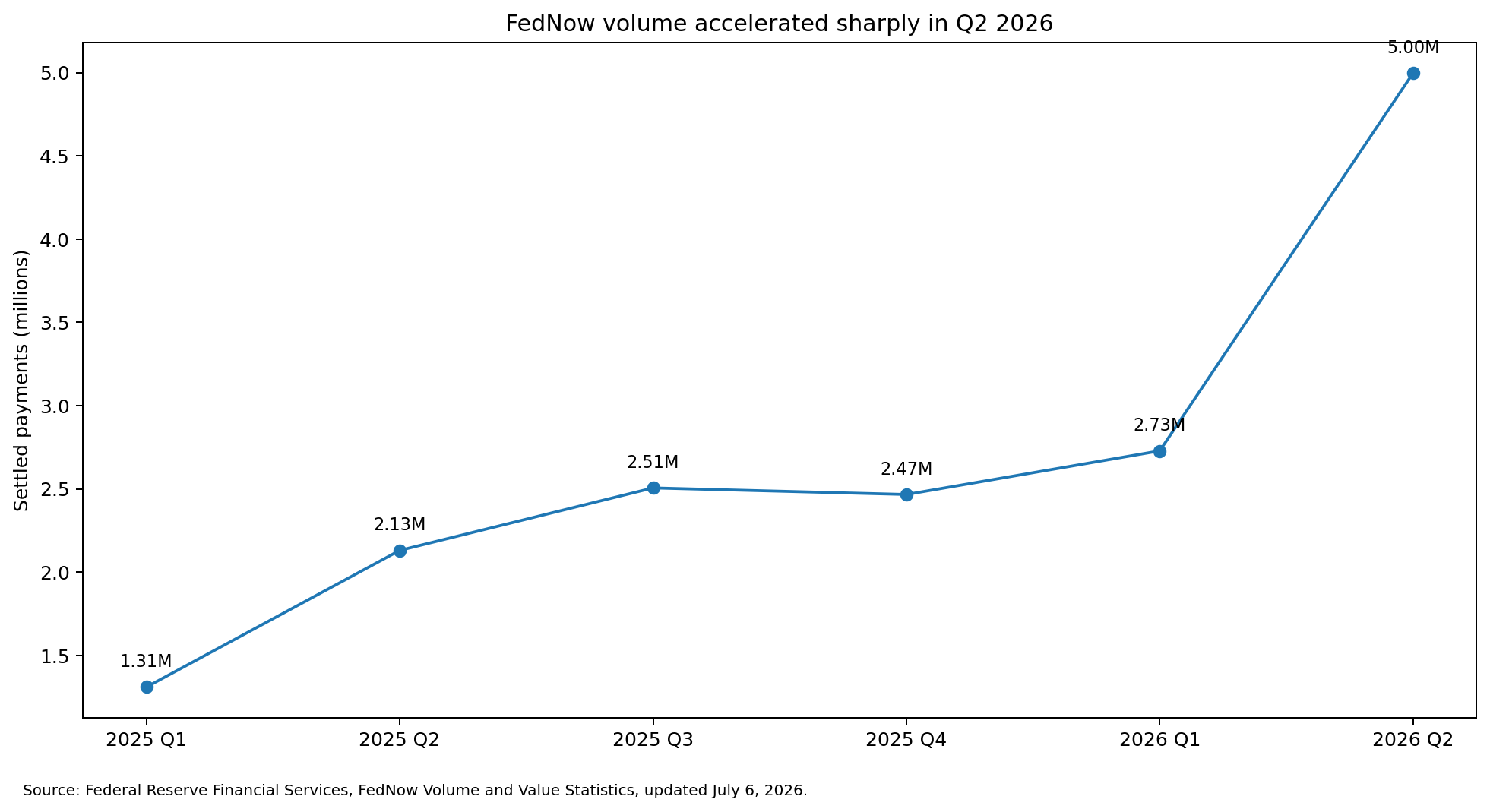
FedNow volume jumped 83% in the second quarter and the U.S. instant-payment limit is now $10 million. The opportunity for corporate treasury is bigger than faster vendor payments: 24/7 rails can change cash concentration, payroll funding and liquidity buffers — but only if controls become real-time too.
For Treasury Analyst · Treasurer · Controller · Finance Systems · CFO
Level All Levels

Corporate treasury has traditionally run on clocks.
Banks open and close. Cutoff times determine whether money moves today or tomorrow. Cash positions are assembled in the morning. Payroll accounts are prefunded. Liquidity buffers cover the hours when a treasurer cannot move money where it is needed.
Instant payments are weakening those assumptions.
The Federal Reserve’s FedNow Service settled 4.998 million payments in the second quarter of 2026, up 83.2% from Q1. The value moved was $274.7 billion. Average daily volume reached 54,921 payments, versus 30,317 in the first quarter.
The numbers are still small relative to established U.S. payment rails, but the trajectory matters. The network’s transaction limit rose to $10 million in November 2025, including liquidity-management transfers. The Clearing House’s RTP network, meanwhile, set a single-day record on May 1 with 2.27 million transactions worth $8.62 billion and explicitly cited cash concentration, portfolio rebalancing and large supplier payments among higher-value uses gaining adoption.
Real-time payments are becoming relevant to treasury, not only consumer payments.
The harder question is whether treasury operating models are ready to become real-time too.
The $10 million threshold changes the use case
A low-value instant-payment rail is useful for refunds and emergency disbursements.
A $10 million rail can move liquidity.
Federal Reserve Financial Services said the higher limit was introduced in response to commercial demand and highlighted corporate treasury transfers, payroll funding and vendor payments as use cases.
That creates a different value proposition.
Consider a company that maintains separate operating, payroll and concentration accounts. In a batch world, treasury may prefund an account because the next reliable movement window arrives later. With a 24/7 rail, funds can potentially move closer to the moment they are required.
That can reduce idle balances.
It can also increase the speed at which a mistake becomes final.
Faster payment is not the same as faster treasury
Moving cash in seconds does not automatically give a company real-time liquidity management.
Treasury needs four things to work together: visibility, decisioning, execution and reconciliation.
A bank may expose an instant rail while the treasury management system still refreshes balances periodically. An ERP may generate payment files in batches. Approval workflows may assume business hours. Cash forecasts may be updated once a day. Reconciliation may occur after settlement.
“If those layers remain slow, the payment rail is real-time but the treasury is not.”
That is why the infrastructure story matters more than the headline settlement speed.
FedNow uses ISO 20022 messages, which can carry structured payment information. The Federal Reserve also positions instant internal transfers as a way to free working capital and streamline reconciliation.
The potential is a tighter loop: see the balance, identify the need, move the cash, receive confirmation and update the position.
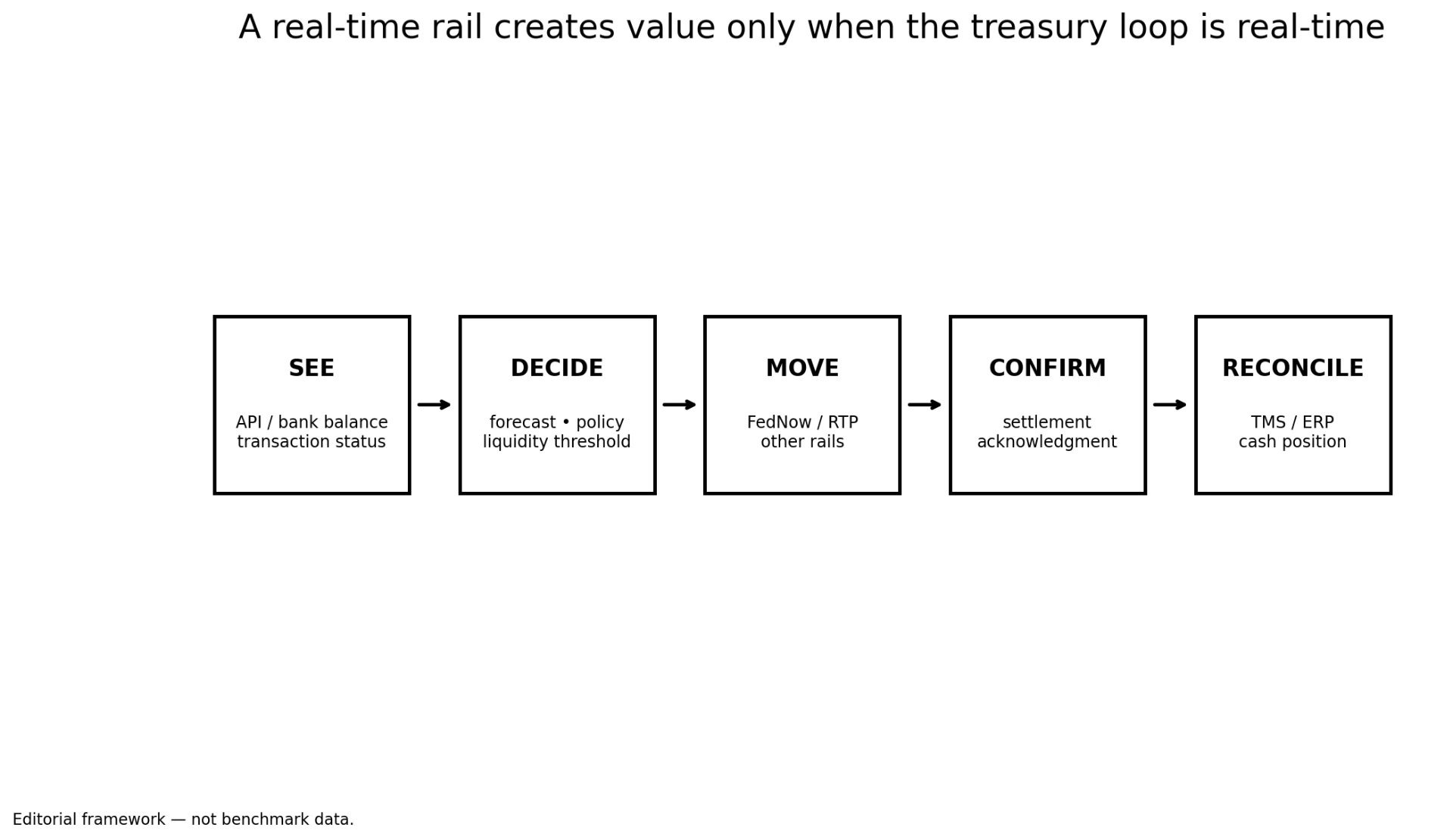
But each link has to exist.
The liquidity buffer deserves another look
Treasury buffers are partly compensation for uncertainty.
A company holds extra cash because receipts may arrive late, payments may leave earlier than expected, banking windows close and internal transfers take time.
Always-on settlement can remove some timing uncertainty.
That does not mean companies should aggressively shrink liquidity buffers. Payment rails do not eliminate forecast error, counterparty risk, operational incidents or bank outages.
The better approach is to decompose the buffer.
How much cash is held for genuine business volatility? How much is held because funds cannot be repositioned quickly? How much sits in payroll or operating accounts simply because treasury does not want to miss a cutoff?
The second and third components may become more addressable as instant rails mature.
That is where the return on instant payments can show up — not in payment fees, but in balance-sheet efficiency.
Payroll funding is a treasury problem hiding in operations
The Federal Reserve specifically calls out payroll funding as a higher-value instant-payment use case.
That is revealing.
Companies often fund payroll accounts in advance because missing payroll is unacceptable. The buffer is operationally rational even if it leaves cash idle.
A reliable instant transfer between corporate accounts or between a company and its payroll processor could reduce the amount of time those funds sit outside the main liquidity pool.
The benefit is not necessarily dramatic for every company. It depends on payroll size, interest rates, account architecture and bank support.
But it illustrates the right way to evaluate the technology.
Do not ask, “Which ACH payments can we make faster?”
Ask, “Which timing constraints force us to hold or move cash inefficiently today?”
The control problem becomes continuous
Instant payments create an uncomfortable asymmetry.
The settlement speed improves immediately. Human review speed does not.
A payment released at 11:30 p.m. on Saturday cannot depend on a treasury manager seeing an email Monday morning.
That pushes controls toward policy.
Transaction limits, account-level thresholds, authorized counterparties, behavioral monitoring, segregation of duties and automated exception routing become more important as payment windows disappear.
The Federal Reserve has added risk tools including account activity thresholds, and financial institutions can set transaction limits below the network maximum.
Corporates should do the same conceptually.
The fact that the rail permits $10 million does not mean every user, account or use case should.
A treasury team might permit high limits for internal concentration accounts, lower limits for established suppliers and require a separate approval path for new beneficiaries.
“Real-time execution needs pre-defined risk appetite.”
Reconciliation can become the hidden win
Payment speed attracts attention. Data quality may create the more durable finance benefit.
Instant-payment messages can carry structured remittance information and confirmation arrives quickly. If that data flows cleanly into ERP and treasury systems, reconciliation can happen closer to settlement.
That matters for cash visibility.
A treasury dashboard that shows a bank balance without understanding the underlying transaction is only partially useful. Finance still has to determine which entity, invoice, supplier or purpose explains the movement.
The richer the payment data, the faster cash becomes economically understandable.
This is also why instant payments and ISO 20022 should be viewed together. The value is not merely money moving faster; it is money moving with structured context.
Two U.S. instant rails means treasury needs routing logic
The United States now has two major instant-payment infrastructures: FedNow and RTP.
That is not necessarily a problem. It does mean corporate reach depends on banks and their network participation.
Treasury should not design a process around the assumption that every counterparty can receive every type of instant payment from every bank.
The operational question becomes routing.
Which bank account supports which rail? Which beneficiary can receive? What are the bank-specific limits and fees? When should an instant payment be preferred to ACH or wire? What happens if the instant route is unavailable?
The optimal treasury architecture will likely be multi-rail.
Instant should be a payment option selected according to urgency, certainty, data and economics — not a replacement for every existing method.
The KPI should be liquidity efficiency
A treasury team can easily measure instant-payment volume.
That is the wrong success metric.
More instant payments do not necessarily mean better treasury.
The useful measures are reduced prefunding, lower idle balances, fewer cutoff-related exceptions, faster reconciliation, improved cash-position accuracy and reduced emergency borrowing.
Those outcomes connect payment modernization to the CFO agenda.
The real-time treasury will arrive unevenly
FedNow’s Q2 growth shows that adoption is accelerating. RTP’s record activity shows higher-value instant payments are already being used for corporate purposes.
But corporate treasury will not switch from batch to real-time in one project.
It will happen use case by use case.
Payroll funding may move first. Internal liquidity transfers may follow. Certain supplier payments may justify instant settlement. APIs and structured messages can gradually pull reconciliation closer to the transaction.
The transformation is therefore less about replacing a payment file than removing time assumptions from treasury processes.
For decades, cash management has been designed around when money *can* move.
As the answer becomes “any time,” treasury has to redesign around when money *should* move.
That is a much more consequential change.
Key takeaways
- For treasury teams
- Decompose the liquidity buffer: separate cash held for real business volatility from cash held only because funds cannot be repositioned quickly.
- For finance systems and controls owners
- Move controls from review windows to policy — account thresholds, beneficiary rules and automated exception routing matter more when settlement is continuous.
- For CFOs
- Measure liquidity efficiency, not instant-payment volume: reduced prefunding, lower idle balances, faster reconciliation and less emergency borrowing.
Sources & further reading
- Federal Reserve Financial ServicesFedNow Service Volume and Value StatisticsUpdated July 6, 2026
- Federal Reserve Financial ServicesFedNow transaction limit increase implementationNovember 12, 2025
- Federal Reserve Financial ServicesFedNow Service $10 million transaction limit — higher-value use casesSeptember 16, 2025
- The Clearing HouseRTP Network Marks May Day with Record-Breaking Volume and ValueMay 14, 2026
- Federal Reserve Financial Services2026 FedNow Fee Schedule2026
All payment volumes, values and network limits trace to primary publications from Federal Reserve Financial Services and The Clearing House. Operating-model and control recommendations are editorial analysis, not benchmark data. No information published after September 6, 2026 is used, and no quotes are invented.
- Topics
- Treasury, Cash & Banking
- For
- Treasury Analyst · Treasurer · Controller · Finance Systems · CFO
- Level
- All Levels

About the author
Ethan ColeTreasury & Payments Correspondent
Ethan covers corporate treasury, cash management and banking, with a focus on the technologies and practices changing how finance teams manage liquidity, payments and financial risk.
The Finance Observer content is for informational purposes only and is not professional financial, tax, legal or investment advice.
Related reading

Treasury Is Becoming a Real-Time Control System
Corporate treasury is moving toward connected bank data, continuous cash visibility and AI-assisted forecasting — but faster information makes controls more important, not less.
The Fed Is on Hold, but Treasury’s Rate Problem Is Getting Harder
The FOMC held at 3.5%–3.75% in July, but by September 4 the 30-year Treasury yield sat 133 basis points above the three-month. Cash, refinancing and hedging no longer move as one trade.

Konica Minolta’s AI Cash Forecasts Changed How It Borrowed
Its treasury team connected better cash visibility to debt repayment and credit-line sizing. The case shows where financial AI can earn a return—and why the data pipeline matters as much as the prediction.
Related across formats
Curated video and audio that share this article's finance topics.

TreasuryCast
Bank Guarantees Are Still Stuck in Spreadsheets. Treasury Has a Visibility Problem.
Recorded at Treasury 360° Europe, host Eleanor Hill and Surecomp’s Head of Product Achraf Abourida on how fragmented bank portals and spreadsheets obscure guarantee obligations across entities. The guest represents Surecomp, a trade finance technology provider. TreasuryCast is published by TMI.
TreasuryCast
Tokenised Deposits Move From Banking Experiment to Treasury Operations
Host Eleanor Hill with Ant International’s Kelvin Li and HSBC’s Selene Chong and Lewis Sun on using HSBC’s Tokenised Deposit Service to move liquidity between group entities. The speakers represent the provider and its customer; operational benefits are their claims. TreasuryCast is published by TMI.