
AI & Automation
Microsoft Is Moving the Finance Interface Out of the ERP
Finance Agent can now query AP and AR data and take selected actions from Microsoft Copilot, while Dynamics 365 exposes ERP capabilities through MCP. The strategic question for CFOs is no longer whether AI can summarize finance data—it is which system becomes the place where finance work actually starts.
For Finance Systems · Controller · Accounting Manager · CFO
Level All Levels
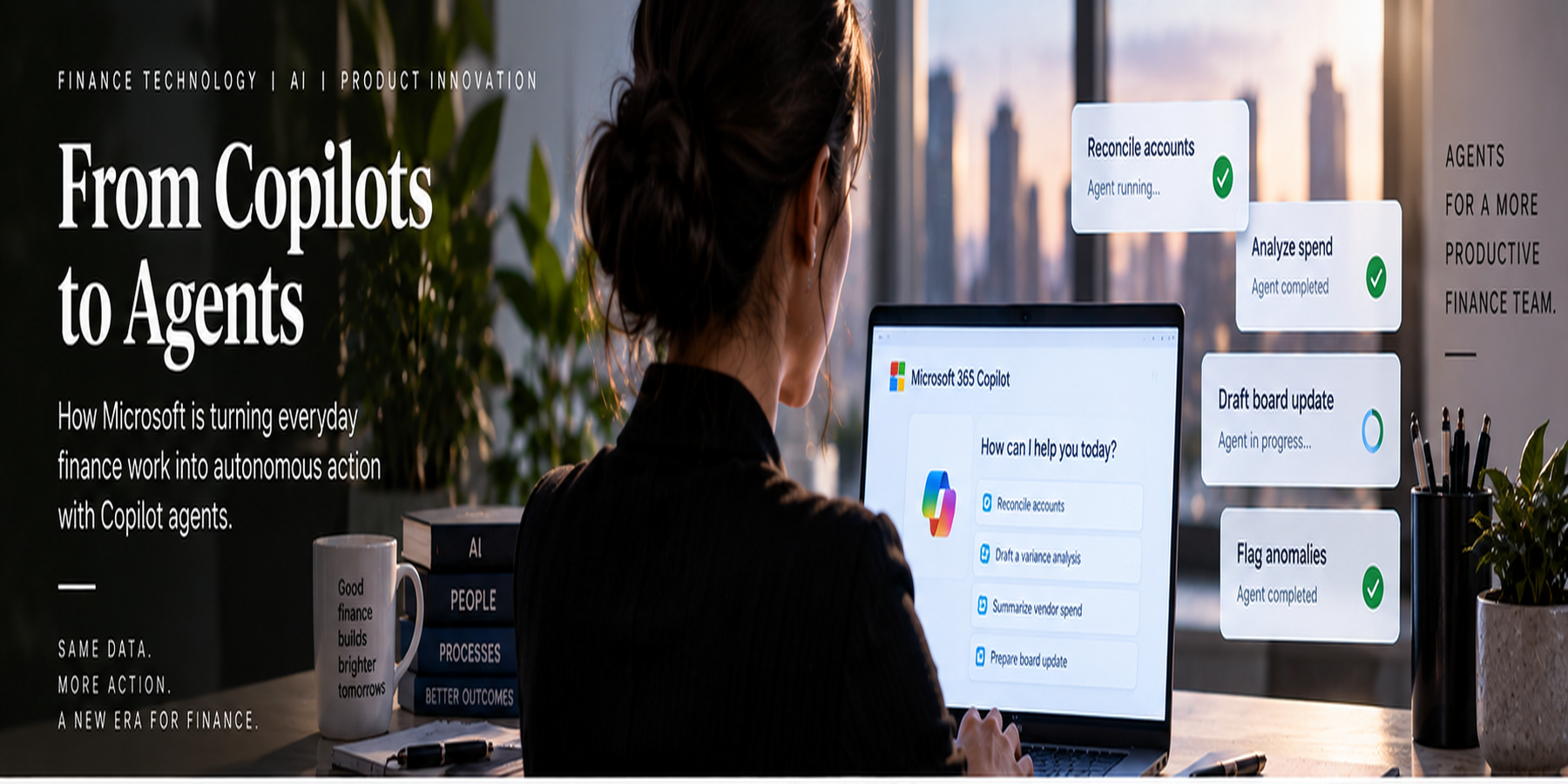
The most consequential finance-software feature Microsoft shipped this year may not look like finance software.
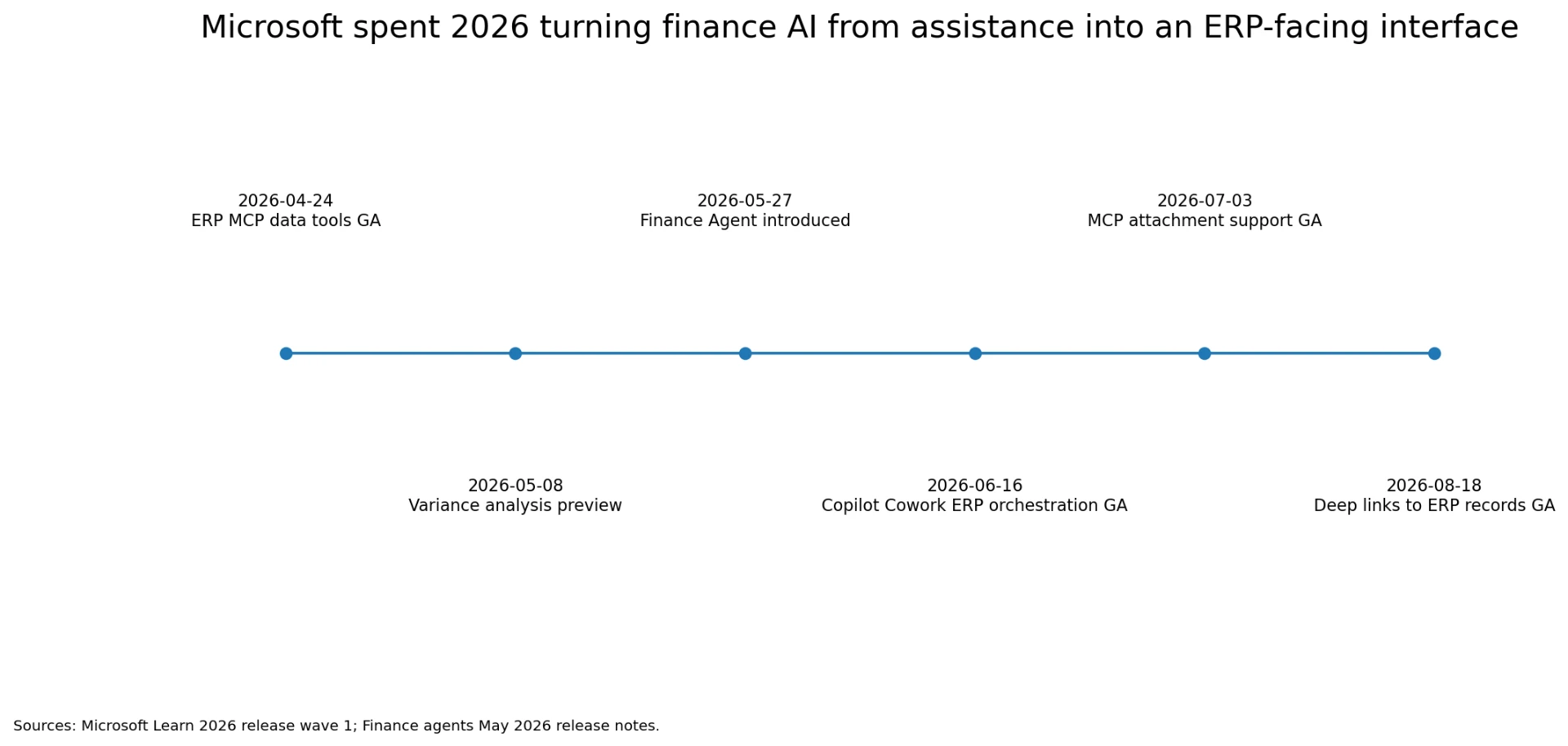
On May 27, Microsoft introduced Finance Agent inside Microsoft Copilot chat as a centralized place for financial insight, business intelligence and interaction with ERP data. By July, its documentation described an agent that could query accounts-payable and accounts-receivable information, combine internal ERP data with external company research and perform selected updates in the underlying system.
The important word is inside.
Finance professionals have spent decades going to the ERP to do ERP work. Microsoft is testing a different model: the user begins in Copilot, asks a question in natural language and reaches the transaction system through an agent.
That sounds like a user-interface improvement. It could become an architectural change.
If the conversational layer becomes the place where people investigate, decide and act, the ERP remains the financial system of record but loses some of its role as the system of engagement.
For CFOs evaluating finance technology, that distinction matters.
From finance copilot to finance interface
Microsoft’s original Copilot for Finance proposition centered on familiar finance tasks in familiar productivity tools: reconciliation and variance analysis in Excel, collections communication in Outlook and access to ERP data without constant application switching.
The 2026 Finance Agent goes further.
Microsoft says the agent can answer natural-language questions about AP and AR, including invoice status and payment history. It can perform some related ERP actions, including updates to vendor and customer information. Its Business Brief capability can combine public information with internal ERP data for suppliers and customers.
This is not autonomous finance. The current scope is narrower than the headline idea of an agent “running finance.”
But the interaction model is important.
A collections analyst could begin with a customer question rather than an AR screen. A finance manager could investigate a supplier using internal and external context in one conversation. The system can return deep links into Dynamics 365 records when the user needs the underlying application.
The ERP becomes something the agent calls.
MCP is the plumbing behind the experience
The technical enabler is Model Context Protocol.
Microsoft’s Dynamics 365 ERP MCP server exposes tools that agents can use to retrieve data and interact with finance and operations applications. In the 2026 release wave, Microsoft added improved data tools, support for agents working with attachments and deep links from Copilot responses back into ERP records.
This is strategically more interesting than another chatbot embedded in an ERP screen.
MCP creates a standardized interface between an agent and enterprise capabilities. Instead of hard-coding every conversational experience into every finance application, Microsoft can let approved agents discover and invoke controlled ERP tools.
That potentially expands who—or what—can become an ERP user.
It also raises a governance question: if an agent can act on the ERP from outside the ERP’s traditional interface, where does authorization live?
Microsoft’s current answer is that ERP access continues to follow the user’s security and privileges. Its documentation requires allowed MCP clients to be configured. Finance Agent and Microsoft 365 Copilot have explicit client identities in that setup.
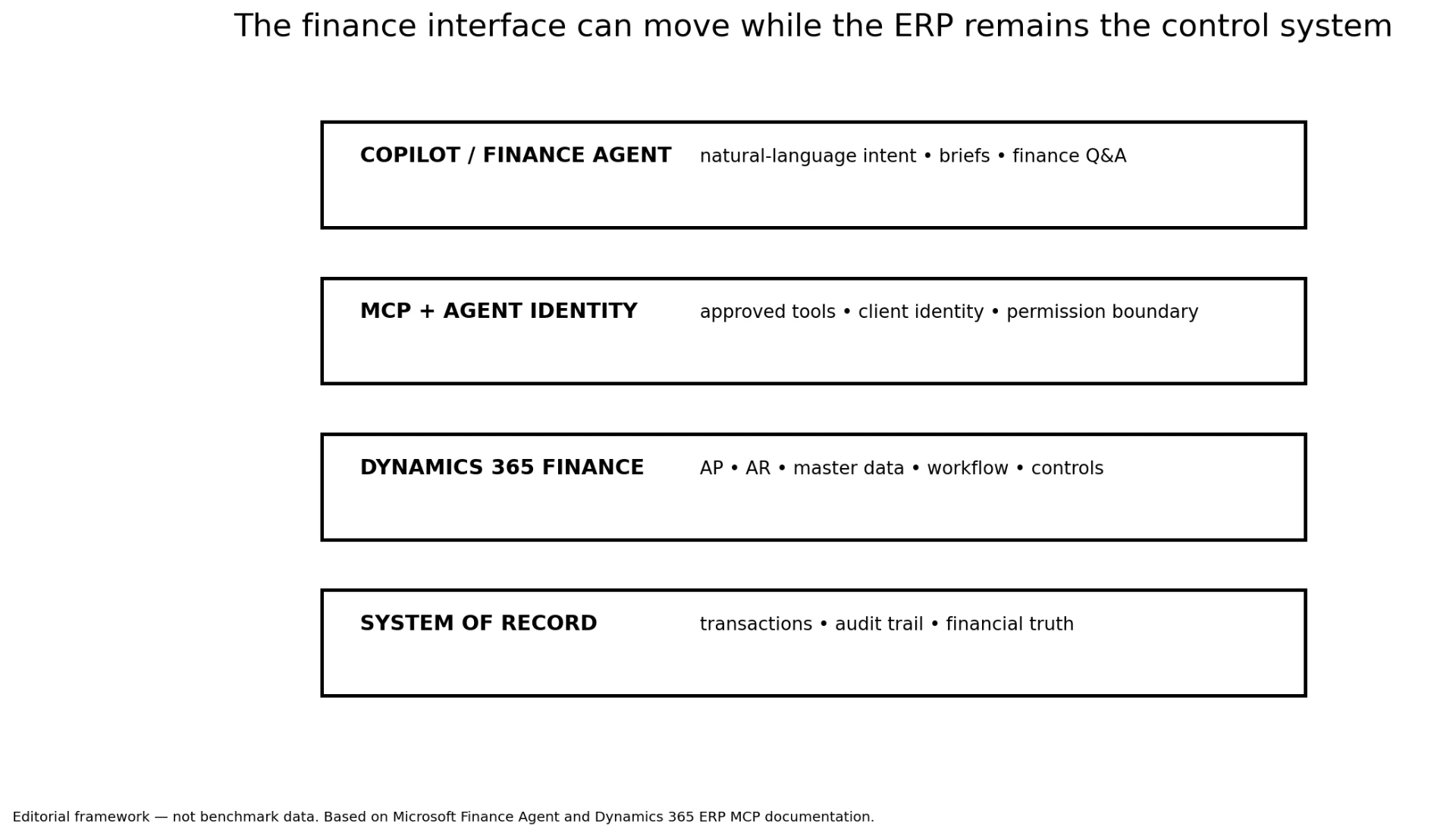
The control boundary therefore does not disappear. It moves into a combination of ERP permissions, agent identity and tool authorization.
There is a major limitation buyers should notice
Microsoft’s August 20 documentation contains an important constraint: connecting Finance Agent to ERP applications and services other than Dynamics 365 Finance is not currently supported.
That sharply defines the product’s present addressable use.
Microsoft talks broadly about ERP-connected finance work, but the current direct connection is most relevant to Dynamics 365 Finance customers. A CFO running SAP, Oracle or another ERP should not read the product vision as evidence of equivalent connectivity today.
This is exactly the kind of distinction buyers need to make as agentic-finance marketing accelerates.
The concept is cross-system. The shipping integration is narrower.
That does not weaken the strategic argument. It makes the implementation reality clearer.
The finance UI is becoming detachable
Enterprise software has historically bundled three things together: data, business logic and user interface.
Agents begin to separate them.
The ERP can continue to own the ledger, customer master, supplier master, approvals and transactional rules. Copilot can become the layer where a user expresses intent. MCP can mediate access to the underlying capabilities.
That creates a new finance stack.
The implication for software vendors is significant.
If users spend less time navigating ERP screens, interface quality becomes less defensible as a competitive moat. The value shifts toward data integrity, process logic, permissions, APIs, semantic context and the quality of actions exposed to agents.
For finance buyers, that can be good news. It creates the possibility of modernizing the experience without immediately replacing the core system.
But it can also deepen platform dependence.
If the agent, productivity suite, identity layer, ERP and workflow tooling all come from the same vendor, integration becomes easier—and switching becomes harder.
Finance Agent is not yet an accounting agent
The name can create confusion.
Microsoft’s Finance Agent is currently positioned around finance insight and selected ERP interaction. It should not be interpreted as a fully autonomous accountant that closes the books, posts every journal or owns financial control.
Its documented ERP engagement currently emphasizes AP and AR.
Variance analysis is another developing area. In May, Microsoft shipped preview capabilities for period-over-period analysis and an action-plan summary that explains how the agent intends to identify variances from natural-language criteria.
Those are useful features. They remain decision support.
The distinction matters because finance software carries a higher burden than general productivity software. A plausible answer is not enough. Finance needs reproducibility, authorization, traceability and evidence.
Excel remains part of the strategy, not a problem to eliminate
One notable aspect of Microsoft’s finance strategy is that it does not treat Excel as legacy behavior to be eradicated.
Finance Agent capabilities continue to support reconciliation, variance analysis and data preparation around Excel workflows.
That is pragmatic.
Many finance transformations fail because they assume the spreadsheet is the enemy. In reality, Excel is often where finance expresses business logic that the ERP cannot model quickly enough.
Microsoft’s approach is to bring governed ERP context and AI assistance closer to that working environment.
The buyer question is whether the result reduces uncontrolled spreadsheet logic—or simply makes it easier to generate more of it.
CFOs should measure the outcome in terms of control and cycle time, not adoption of the agent itself.
What a serious pilot should test
A Finance Agent pilot should not begin with “How many people used Copilot?”
It should test whether the new interface improves a defined finance process.
For AP, choose a supplier inquiry that currently requires several screens or systems. Measure time to answer, accuracy, number of manual handoffs and whether the agent respects role permissions.
For AR, test invoice-status and payment-history investigation. Include customers with complex hierarchies, disputes and partial payments.
Then test failure.
Ask for data the user should not see. Change a master-data permission. Disconnect a source. Give the agent an ambiguous supplier name. Compare the conversational answer with the ERP record.
Agent governance is easiest to evaluate when the test is designed to make the agent fail safely.
The next ERP battle may be above the ERP
Microsoft is not abandoning Dynamics 365. Quite the opposite: the company is making the ERP more accessible to agents.
But that changes the competitive battlefield.
The finance professional may increasingly interact with a conversational workspace while the transaction system operates underneath it. ERP screens become destinations for exceptions, verification and specialized work rather than the universal starting point.
That could make the future of finance software look less like one monolithic application and more like a governed set of services behind an intelligent interface.
The winners will not necessarily be the vendors with the most impressive finance chatbot.
They will be the vendors that can connect intent to trusted data, expose safe actions, preserve controls and show the user exactly what happened.
Microsoft’s 2026 releases are an early, concrete version of that model.
For CFOs, the product question is no longer simply whether Copilot can answer a finance question.
It is whether finance is comfortable letting Copilot become the front door.
Key takeaways
- For Finance Systems teams
- Treat agent access as an authorization design problem: ERP privileges, agent client identity and approved MCP tools together define what the conversational layer may do.
- For Controllers
- Hold agent answers to finance standards — reproducibility, traceability and evidence — and reconcile conversational output against the ERP record before relying on it.
- For CFOs
- Note the shipping boundary: Microsoft’s August 20 documentation says connections to ERPs other than Dynamics 365 Finance are not currently supported. Judge pilots by process cycle time and control, not Copilot adoption.
Sources & further reading
- Microsoft LearnFinance Agent overview (Frontier)Updated July 17, 2026 — Finance Home, Business Briefs, AP/AR ERP Q&A and selected actions
- Microsoft LearnConnect Finance Agent to ERPUpdated August 20, 2026 — Dynamics 365 Finance connection, allowed MCP clients, other ERP connections not currently supported
- Microsoft LearnEngage with ERP data using Finance AgentERP security, privileges and permitted actions
- Microsoft LearnWhat’s new or changed in Finance agents in May 2026May 8 variance-analysis preview; May 27 Finance Agent introduction
- Microsoft Learn2026 release wave 1 — finance and operations cross-app capabilitiesRelease dates for MCP tools, Copilot Cowork, attachments and deep links
- Microsoft Dynamics 365 Blog2026 release wave 1 plansMarch 18, 2026 — product roadmap context for Finance Agent
Capabilities and dates are attributed to Microsoft’s own product documentation and release plans, and roadmap items are described as released only where Microsoft marks a GA or release date. Connectivity to ERPs other than Dynamics 365 Finance is not claimed. Architecture and governance conclusions are editorial analysis, not vendor claims or benchmark data. No information published after September 6, 2026 is used and no quotes are invented.
- Topics
- AI & Automation
- For
- Finance Systems · Controller · Accounting Manager · CFO
- Level
- All Levels

About the author
Sophie GrantFinance Technology Correspondent
Sophie covers finance technology and the systems behind accounting and reporting.
The Finance Observer content is for informational purposes only and is not professional financial, tax, legal or investment advice.
Related reading

SAP’s Clean-Core Strategy Is Becoming an AI Strategy
SAP Domain Models are trained on SAP code, data, metadata and process knowledge — and are being used to generate clean-core-compliant extensions. Clean core is no longer only about easier upgrades; it is becoming the foundation for governable enterprise AI.

PwC Put 100,000 People on One Cloud ERP. The Real Story Is What It Removed.
PwC-reported results from its own SAP Cloud ERP program — 100,000+ professionals, 19 countries, 22 systems retired, 10x faster upgrades — make an architectural point: AI multiplies the value of a simpler core.

Finance AI Is Moving Up the Value Chain. The Best Returns Are No Longer in Automation.
KPMG’s 2026 study of 1,013 finance leaders finds the strongest reported AI gains in decision speed, decision quality and forecast accuracy — not task elimination. Adoption is now broad; exceptional performance is not.
Related across formats
Curated video and audio that share this article's finance topics.
SAP’s Autonomous Finance Vision: What CFOs Should Look For Beyond the AI Demo
SAP
In this SAP Finance Connect keynote, SAP presents how AI assistants and agents could fit into core finance workflows, from accounting and consolidation to planning, billing and payments. As a vendor-hosted keynote, its product capabilities and reported benefits are SAP and participant claims rather than independently verified outcomes.
1Password’s CAO on Where AI Fits in a Well-Run Accounting Team
Senad Mustafic · Chief Accounting Officer, 1Password
Senad Mustafic, Chief Accounting Officer at 1Password, joins Kinter controller Armen Aklian, CPA, for an on-demand fireside chat (The CFO Track) about his path from financial analysis into controllership, how his thinking on AI has changed, and his approach to AI adoption at 1Password.

CFO Weekly
Why Accounting Judgment Still Matters When AI Does the Work
Host Megan Weis and Kerrie Jones, Financial Controller at Peak Living, on why following the correct process doesn’t guarantee a sensible outcome — and how controllers can teach accountants when to question the output, including AI’s. CFO Weekly is produced by Personiv.
CFO Weekly
Editor's PickThe Rise of AI-Driven Finance Teams
A forward-looking discussion on AI agents transforming accounts receivable, the shift from finance operators to finance architects, “headless finance,” and what the CFO function could look like in the next three to five years.