
AI & Automation
SAP’s Clean-Core Strategy Is Becoming an AI Strategy
SAP is training domain models on its own business semantics and using them to generate clean-core-compliant extensions. For finance leaders, the significance is bigger than better Joule answers: AI is giving SAP a new reason to push custom logic out of the ERP core.
For Finance Systems · Controller · Accounting Manager · CFO
Level All Levels

For years, SAP has asked customers to keep the ERP core clean.
The argument was mostly architectural: heavy customization makes upgrades harder, creates technical debt and turns every change into a project.
In 2026, SAP has a new argument.
AI works better when the system underneath it is understandable.
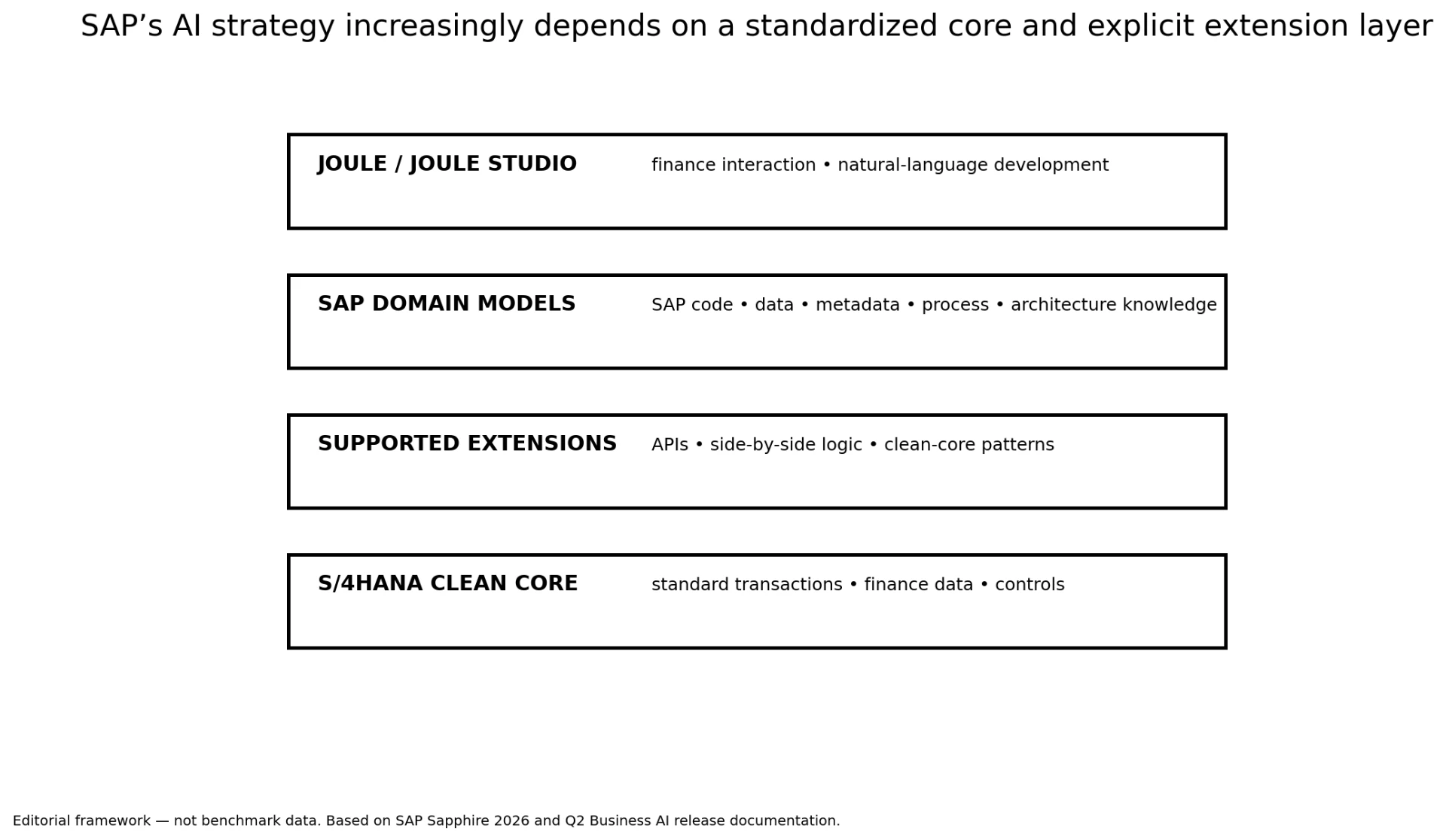
At SAP Sapphire, the company introduced SAP Domain Models—AI models trained on SAP-specific code, data, metadata, business processes, architecture knowledge and documentation. In its Q2 Business AI release update, SAP said those models are being used inside Joule and Joule Studio to ground responses in SAP context and to help developers create clean-core-compliant code for S/4HANA Cloud Public Edition and Ariba.
That connects two technology agendas that finance teams often evaluate separately.
Clean core is no longer only about making ERP upgrades easier. It is becoming part of the foundation for governable enterprise AI.
Why AI cares about ERP architecture
Generic language models are good at language.
Finance systems require context.
A model asked to explain a journal entry needs to understand the company’s chart of accounts, posting logic, business objects, permissions and process state. A model asked to create an extension needs to know which SAP APIs and extension patterns are permitted and which customizations will create future upgrade problems.
SAP Domain Models are designed for that gap.
SAP says the models are trained on domain knowledge including code, data models, metadata, business processes, architecture and documentation. They operate under Joule and Joule Studio rather than being directly exposed as standalone customer products.
The strategic idea is straightforward: instead of asking a general-purpose model to infer how SAP works, give the AI a model of SAP itself.
For finance, that can improve more than answer quality.
It can shape what the AI is allowed to build.
Clean core becomes a machine-readable constraint
“Clean core” can sound like consulting language until a company tries to upgrade a heavily customized ERP.
The principle is to keep the core standardized and move differentiating extensions into supported mechanisms and side-by-side services.
Historically, enforcing that discipline required architecture governance and developer judgment.
SAP’s domain-model approach creates the possibility of embedding some of that knowledge into the development process.
At Sapphire, SAP said developers using Joule Studio could use specialized domain models for S/4HANA and Ariba to understand and generate clean-core-compliant code from natural language. Early Adopter Care access was available, with general availability planned for Q3 2026.
The distinction matters: planned availability is not the same as a capability every customer already has.
But the direction is clear.
AI is being positioned not only to accelerate customization, but to steer customization toward SAP’s preferred architecture.
That is good for upgrades—and good for SAP
Finance leaders should view the strategy from both sides.
A cleaner ERP can reduce the cost and risk of upgrades. Standardized extensions are easier to govern. Technical debt becomes more visible. AI agents can operate against more consistent business objects and APIs.
Those are real buyer benefits.
The same architecture also increases the importance of SAP’s surrounding platform.
If custom logic moves out of the S/4HANA core, it still has to live somewhere. SAP wants Business Technology Platform, Joule Studio, its data layer and its AI governance products to become that surrounding environment.
Clean core can therefore reduce dependency on custom code while increasing dependency on the vendor’s platform architecture.
That is not automatically bad.
It is a trade-off CFOs should understand.
Finance is already seeing transactional Joule capabilities
The AI story is not limited to developer tooling.
SAP’s 2026 Joule documentation shows a steady expansion of transactional finance capabilities.
For S/4HANA Cloud Private Edition, capabilities released in 2026 include finance use cases such as displaying journal-entry information, posting recurring journal entries and navigating AP process flows. June documentation lists preparation-of-payments capabilities that can display process flows spanning purchase orders, goods movements, incoming invoices, journal entries, clearing entries and earmarked funds.
SAP also added conversational integration with Taulia financing in May, allowing navigation and management around receivables and payables financing processes.
These are incremental capabilities, not an autonomous finance department.
But they show why clean data and process context matter.
The more an AI system moves from answering a question to initiating or navigating a transaction, the more dangerous ambiguity becomes.
SAP is building governance around the agent layer
SAP’s Q2 release also describes an AI Agent Hub intended as a control plane for agents, LLMs and MCP servers across the enterprise.
The company says the hub can discover AI assets across platforms including Microsoft, Google, AWS, ServiceNow and SAP AI Core, apply governance assessments and use verification badges that integrate with runtime solutions to control which agents and MCP servers are approved.
SAP says future expansion will include runtime observability, identity and access control, agent-in-process mining and workforce-impact mapping.
Again, buyers should separate shipping capability from roadmap.
But the product direction addresses a problem that is becoming urgent for CFOs and CIOs: once every application has agents, who inventories them, approves them and watches what they do?
A finance organization may soon have SAP agents, Microsoft agents, bank agents, procurement agents and internally built agents touching the same transaction chain.
The governance problem is cross-vendor even when the ERP is not.
The clean-core test is different for finance
IT teams often measure clean core through upgradeability and technical debt.
Finance needs additional tests.
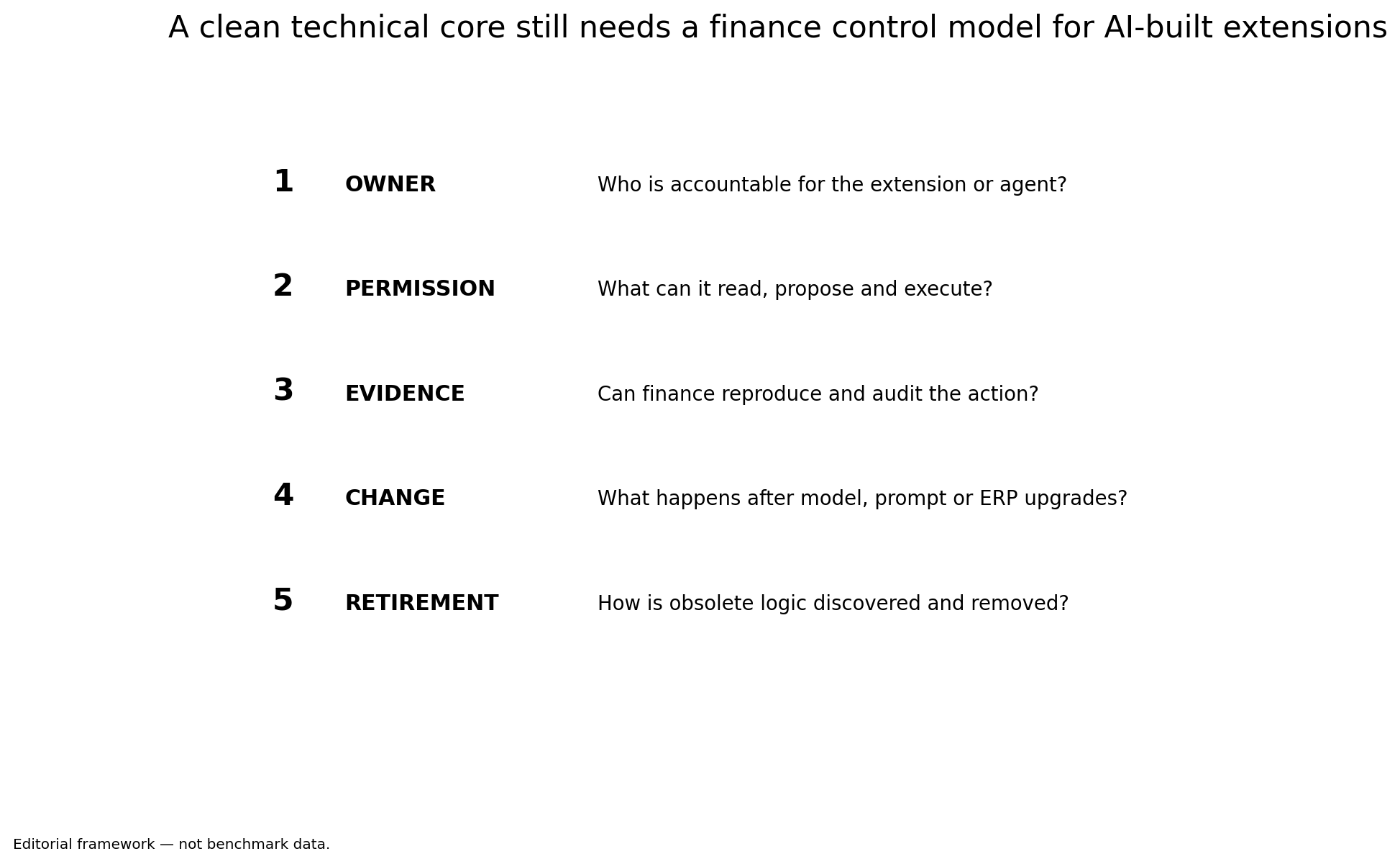
Does moving logic out of the core preserve the audit trail? Can an auditor trace a transaction through an extension? Are approval rules enforced consistently? Does segregation of duties survive when an agent invokes a service rather than a user clicking a screen? Can the company reproduce the output after the model or prompt changes?
Those questions should be part of extension design from the start.
A clean technical architecture can still produce a messy control environment.
AI-generated extensions need stricter review, not lighter review
Natural-language development can make extension creation dramatically easier.
That creates a governance paradox.
The easier it becomes to build, the more important it becomes to control what gets built.
A finance analyst who can describe a workflow to Joule Studio may no longer need the same development resources to prototype an extension. That is useful. It also lowers the friction that once limited the number of custom workflows in the estate.
CFOs and CIOs should therefore resist measuring success by the number of AI-generated extensions.
The better metric is how many manual processes are removed without increasing control complexity or upgrade risk.
Every generated extension should still have an owner, purpose, data classification, permission model, test evidence and retirement path.
AI can write code faster than organizations can govern code.
Buyers should ask where the intelligence actually lives
SAP’s AI portfolio now spans Joule, specialized agents, domain models, Joule Studio and governance tooling.
That breadth can make procurement conversations confusing.
Finance buyers should ask vendors to map a use case end to end.
Which model interprets the request? Which data is retrieved? Where does business context come from? Which application executes the action? Which permissions apply? Where is the audit record? Which component is licensed separately? What happens when the underlying S/4HANA release changes?
Those questions turn an AI demo into an architecture review.
They also reveal whether the product genuinely reduces complexity or simply redistributes it.
Clean core may become more valuable as agents multiply
The strongest case for SAP’s strategy is not that every finance process will become autonomous.
It is that the number of software actors touching finance data is increasing.
Humans, APIs, workflows and AI agents will all read and act on enterprise systems. In that environment, inconsistent custom logic becomes more expensive. Every undocumented exception is another rule an agent may fail to understand.
A standardized core with explicit extensions gives AI a clearer operating environment.
That is the logic behind the convergence of clean core and domain-specific AI.
The CFO implication is architectural, not fashionable
Finance leaders do not need to become experts in SAP Domain Models.
They do need to understand the technology decision underneath them.
An ERP modernization program that simply moves existing customizations into a newer system may preserve the very complexity that makes AI difficult to govern.
A cleaner architecture can create optionality: easier upgrades, more standardized data access, clearer agent permissions and a better-defined place for extensions.
But the migration cost is real, and the surrounding SAP platform can become more strategically important.
That makes clean core a business-case question, not an IT slogan.
SAP spent years telling customers that customization debt makes cloud ERP harder.
In 2026, the message is evolving: customization debt may also make enterprise AI harder.
For the Office of the CFO, that is a more compelling reason to care.
Key takeaways
- For Finance Systems teams
- Treat clean core as an AI prerequisite: standardized business objects, supported APIs and documented extensions make agent behaviour easier to permission and audit.
- For Controllers
- Test extension designs against audit trail, approval enforcement, segregation of duties and reproducibility — not only upgradeability.
- For CFOs
- Weigh the trade-off: less custom-code dependency, more platform dependency. Judge AI success by manual work removed, not by extensions generated.
Sources & further reading
- SAP News CenterSAP Business AI: Release Highlights Q2 2026July 2026 — SAP Domain Models, clean-core-compliant extension generation, AI Agent Hub
- SAPSapphire Innovation News Guide 2026Domain Models, S/4HANA and Ariba use cases, Early Adopter Care and planned Q3 2026 general availability
- SAP News CenterSAP Business AI: Release Highlights Q1 2026April 2026 — agent strategy, Joule Skills
- SAP Help PortalWhat’s New for Joule2026 finance transactional and navigational capabilities, Taulia financing integration, payment preparation
- SAP Help PortalS/4HANA Cloud Public Edition 2608 — Integrating JouleInformational, navigational and transactional capabilities; entitlement note
Product capabilities are attributed to SAP’s own release documentation, and planned Q3 2026 availability is described as planned rather than shipped. Clean-core and control conclusions are editorial analysis, not vendor claims or benchmark data. No information published after September 6, 2026 is used and no quotes are invented.
- Topics
- AI & Automation
- For
- Finance Systems · Controller · Accounting Manager · CFO
- Level
- All Levels

About the author
Sophie GrantFinance Technology Correspondent
Sophie covers finance technology and the systems behind accounting and reporting.
The Finance Observer content is for informational purposes only and is not professional financial, tax, legal or investment advice.
Related reading

Microsoft Is Moving the Finance Interface Out of the ERP
Finance Agent answers AP and AR questions and takes selected ERP actions from inside Copilot, with MCP as the plumbing. The ERP stays the system of record — but may stop being the system of engagement.

PwC Put 100,000 People on One Cloud ERP. The Real Story Is What It Removed.
PwC-reported results from its own SAP Cloud ERP program — 100,000+ professionals, 19 countries, 22 systems retired, 10x faster upgrades — make an architectural point: AI multiplies the value of a simpler core.
Finance AI Is Moving Up the Value Chain. The Best Returns Are No Longer in Automation.
KPMG’s 2026 study of 1,013 finance leaders finds the strongest reported AI gains in decision speed, decision quality and forecast accuracy — not task elimination. Adoption is now broad; exceptional performance is not.
Related across formats
Curated video and audio that share this article's finance topics.
SAP’s Autonomous Finance Vision: What CFOs Should Look For Beyond the AI Demo
SAP
In this SAP Finance Connect keynote, SAP presents how AI assistants and agents could fit into core finance workflows, from accounting and consolidation to planning, billing and payments. As a vendor-hosted keynote, its product capabilities and reported benefits are SAP and participant claims rather than independently verified outcomes.
1Password’s CAO on Where AI Fits in a Well-Run Accounting Team
Senad Mustafic · Chief Accounting Officer, 1Password
Senad Mustafic, Chief Accounting Officer at 1Password, joins Kinter controller Armen Aklian, CPA, for an on-demand fireside chat (The CFO Track) about his path from financial analysis into controllership, how his thinking on AI has changed, and his approach to AI adoption at 1Password.

CFO Weekly
Why Accounting Judgment Still Matters When AI Does the Work
Host Megan Weis and Kerrie Jones, Financial Controller at Peak Living, on why following the correct process doesn’t guarantee a sensible outcome — and how controllers can teach accountants when to question the output, including AI’s. CFO Weekly is produced by Personiv.
CFO Weekly
Editor's PickThe Rise of AI-Driven Finance Teams
A forward-looking discussion on AI agents transforming accounts receivable, the shift from finance operators to finance architects, “headless finance,” and what the CFO function could look like in the next three to five years.