
AI & Automation
PwC Put 100,000 People on One Cloud ERP. The Real Story Is What It Removed.
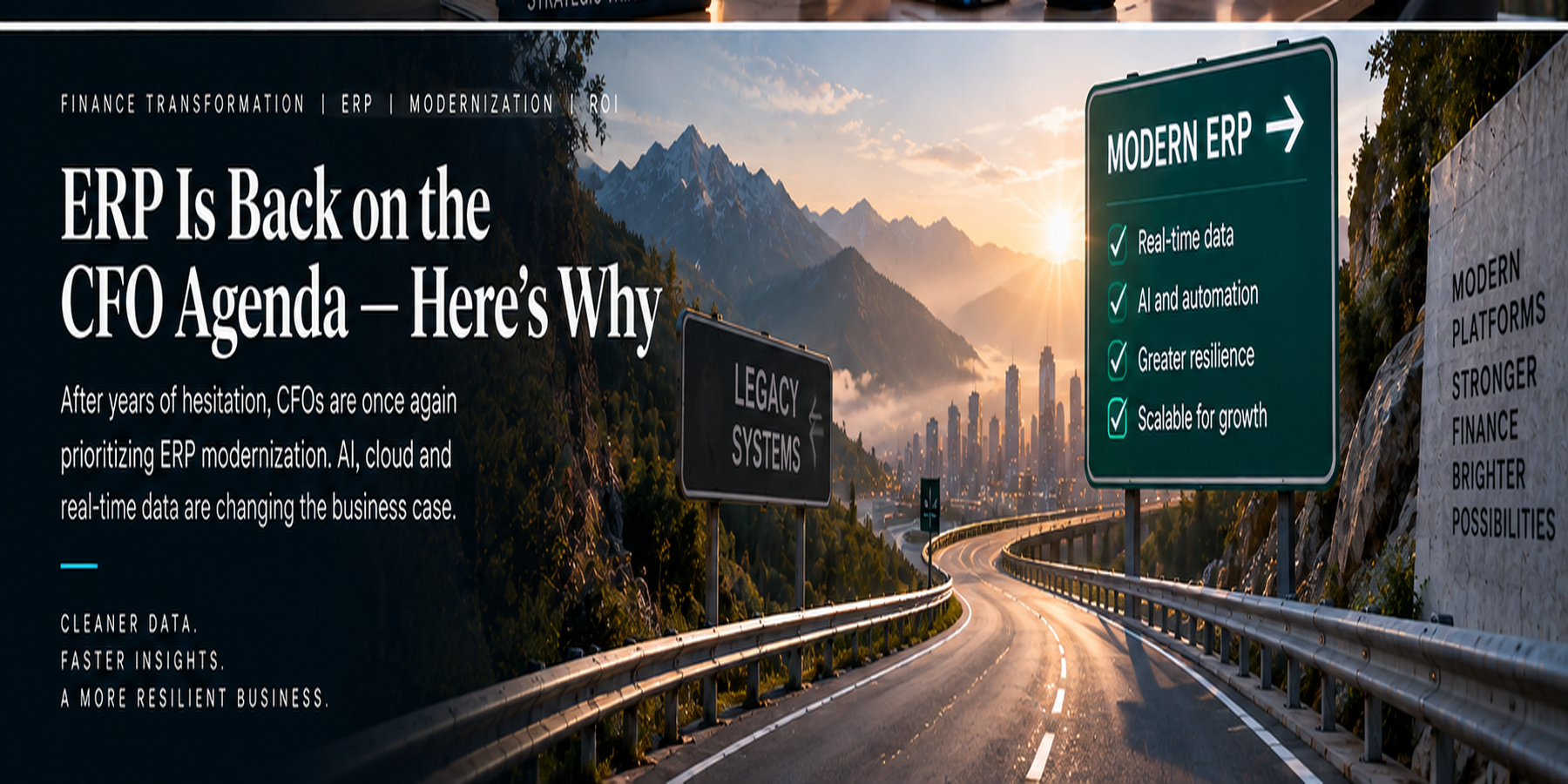
PwC says its internal SAP S/4HANA Cloud transformation connected more than 100,000 professionals across 19 countries, retired 22 legacy applications and databases and made upgrades 10 times faster. The case shows why ERP modernization is returning to the center of finance transformation: simplification is becoming the prerequisite for AI.
For CFO · Finance Systems · Controller · VP Finance
Level All Levels
Finance transformations are usually sold through what they add.
New dashboards. New automation. New AI. New planning tools. New workflows.
PwC’s internal finance transformation is more interesting for what it removed.
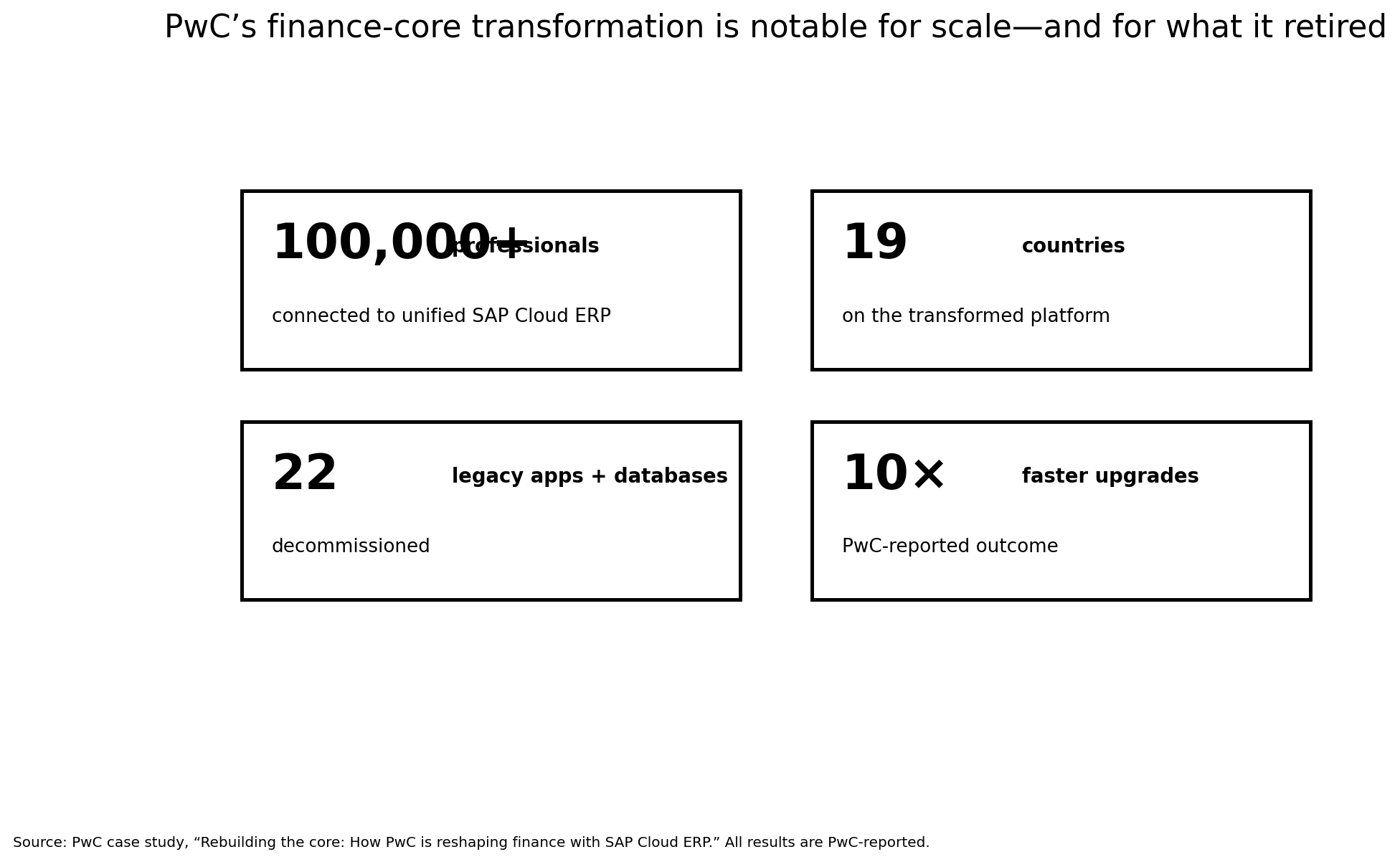
The professional-services firm says it has moved more than 100,000 professionals across 19 countries onto a unified SAP S/4HANA Cloud ERP platform. The program decommissioned 22 legacy applications and databases and, according to PwC, made upgrades 10 times faster.
Those are vendor/client-reported results from PwC’s own case study, not independently audited benchmarks.
Still, the architecture lesson is important.
For years, companies could postpone ERP simplification by building more layers around the core: data warehouses, integration platforms, robotic process automation and spreadsheets.
AI is making that strategy harder to defend.
An agent can only reason reliably across finance if it can reach consistent processes, trusted master data and well-defined system interfaces. Every legacy application, duplicate data store and bespoke integration becomes another place where context can diverge.
ERP modernization is returning to the CFO agenda not because cloud ERP is new.
It is returning because simplification has become an AI dependency.
The transformation began with a fragmentation problem
PwC describes its previous environment as fragmented legacy systems that made it harder to standardize processes and scale innovation.
That is a familiar finance story.
A multinational organization grows through geographies, service lines, acquisitions and local requirements. Over time, the finance stack accumulates applications. One system handles part of order-to-cash. Another supports expenses. Local databases fill gaps. Interfaces multiply.
Each application may have a reason to exist.
The portfolio as a whole becomes the problem.
PwC’s response was to build a single SAP Cloud ERP foundation across a large international footprint.
The headline scale—100,000-plus professionals and 19 countries—is notable.
The more useful transformation metric is 22 systems and databases retired.
Deletion is underrated.
Why system retirement matters more than go-live
A new ERP can make an architecture worse if the old systems stay.
The company ends up paying for the new platform while maintaining legacy applications, duplicate interfaces and reconciliation processes.
That is why “go-live” is a weak transformation milestone.
The stronger metric is complexity retired.
How many applications disappeared? How many integrations were removed? How many duplicate master-data stores were eliminated? How many manual reconciliations became unnecessary? How many local process variants were standardized?
Those measures reveal whether the company transformed the core or simply added another layer.
PwC’s case is useful because it reports system retirement explicitly.
The 10x upgrade claim deserves careful interpretation
PwC says upgrades are now 10 times faster.
That is a striking number.
It should be interpreted as a company-reported outcome from this specific transformation, not as a general expectation for SAP S/4HANA Cloud.
Upgrade speed depends on customization, testing, integrations, organizational process and release strategy.
But the direction of the result is consistent with the logic of a cleaner core.
The fewer bespoke dependencies a company has, the less work is required to assess and remediate change.
This is where technical debt becomes a finance issue.
Slow upgrades delay access to functionality, consume IT and finance resources and increase the cost of every future transformation.
The business case for ERP modernization should therefore include the cost of change, not only the cost of running the current system.
AI changes the value of standardization
Historically, standardization was sometimes viewed as a compromise.
Business units gave up local flexibility so the group could reduce cost and simplify controls.
AI changes that equation.
Standardized processes create a larger reusable surface for automation.
If 19 countries run materially different invoice, journal or reporting processes, an AI solution may need 19 variants. If the underlying process and data model are common, one capability can potentially scale further.
PwC explicitly links the unified ERP foundation to its ability to scale AI and innovation with greater confidence. The company says AI was used during design and build, including pre-developed documentation, and is now helping accelerate code and prototype development after go-live.
These are PwC’s descriptions of its own implementation.
The broader implication is architectural.
AI multiplies the value of reusable process design.
The transformation case should include the next transformation
Traditional ERP business cases often calculate savings from the implementation itself.
A better case asks what the architecture makes cheaper afterward.
How quickly can the company integrate an acquisition? Add a legal entity? Deploy a new finance agent? Change a reporting dimension? Adopt a new SAP capability? Respond to a regulatory requirement?
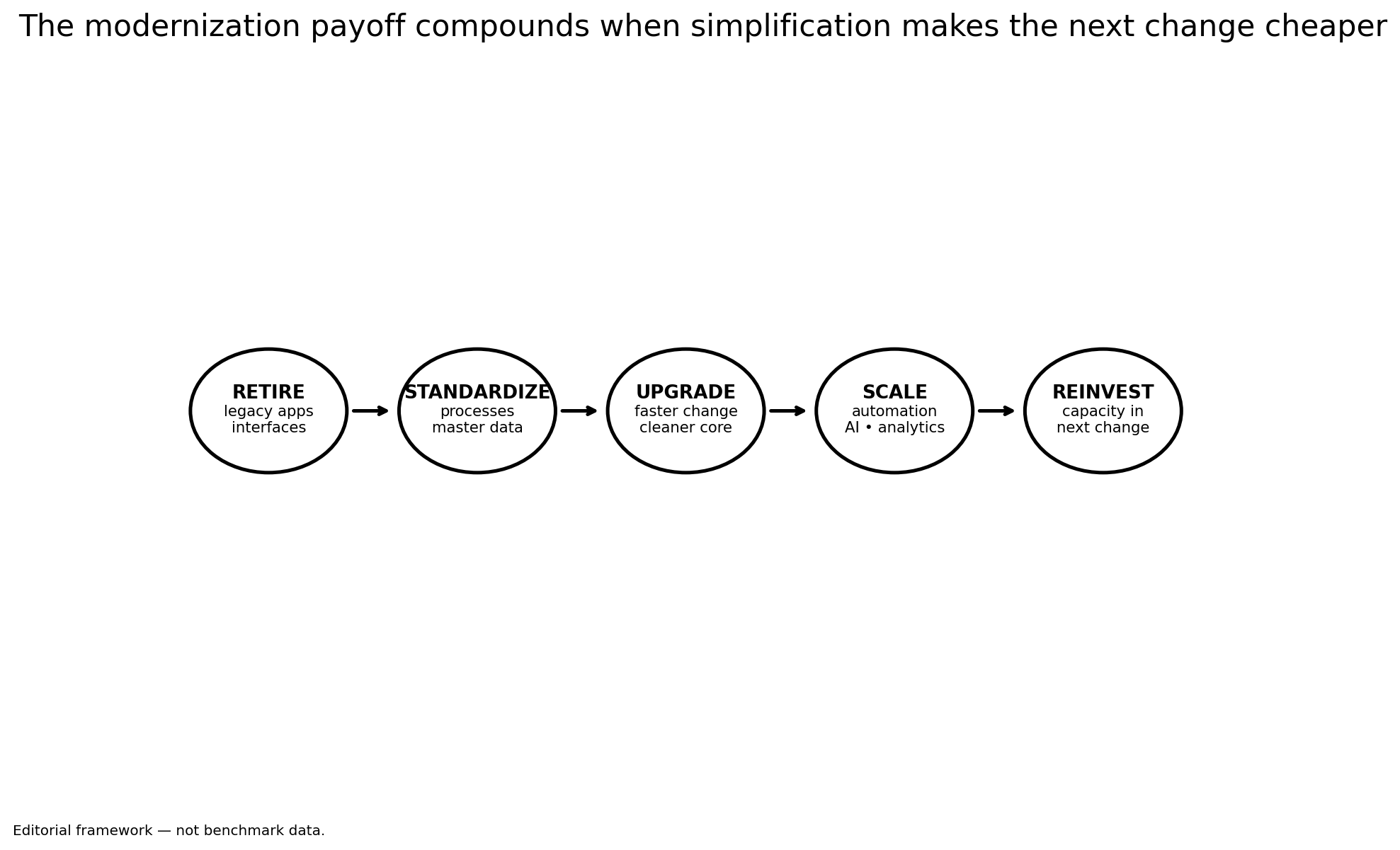
That is the option value of simplification.
PwC’s 10x upgrade-speed claim is one example of this idea.
A modern core is valuable partly because future change should become less expensive.
One ERP does not mean one finance truth automatically
Platform consolidation can be oversold.
Putting countries on the same ERP does not guarantee common master data, identical process discipline or perfect reporting.
Organizations can recreate fragmentation inside a single system through local configuration, custom fields, inconsistent hierarchies and side spreadsheets.
The governance work therefore continues after migration.
Finance needs ownership of chart-of-accounts design, entity structures, customer and supplier masters, reporting dimensions and process variants.
The system provides the container.
The operating model determines whether it stays coherent.
Cloud ERP is not automatically clean ERP
The same caution applies to customization.
Moving heavily customized processes into a cloud platform can preserve technical debt in a newer environment.
Modern ERP programs increasingly emphasize clean-core principles: keeping the transaction core standardized and placing differentiating extensions in supported layers.
The rationale is no longer merely easier upgrades.
A clean architecture makes data and actions easier to expose safely to AI agents.
That links this transformation story to the broader 2026 technology agenda.
Finance organizations want agents, real-time analytics and automation. Those capabilities are easiest to scale when the underlying system is predictable.
Finance should own the simplification decisions
ERP programs are often led technically.
The hardest decisions are business decisions.
Which local process is genuinely required? Which report can disappear? Which custom field is still useful? Which approval step exists because of policy and which exists because the old system was awkward? Which legacy application can actually be switched off?
IT cannot answer those questions alone.
Finance has to choose.
That is why CFO sponsorship matters most during simplification, not during the software selection.
Every exception preserved in the new design becomes future complexity.
Measure transformation with subtraction
CFOs evaluating a core modernization should build a subtraction scorecard.
Applications retired. Interfaces removed. Manual reconciliations eliminated. Local variants standardized. Duplicate data stores closed. Custom code reduced. Reports decommissioned.
Then add the conventional outcome measures: close speed, cost, control quality, user productivity and decision latency.
The subtraction metrics explain why those outcomes may improve.
They also make scope discipline visible.
A program that promises simplification but retires almost nothing should trigger skepticism.
The migration risk is real
None of this makes ERP transformation easy.
Large programs can disrupt operations, exceed budgets and create change fatigue. Data migration can expose years of master-data inconsistency. Standardization can become political when local teams believe their requirements are unique.
The risk is highest when leadership treats the program as a technical replacement.
The finance team has to define which complexity is valuable and which is historical residue.
That requires senior decisions.
It also requires the courage to say no.
The CFO agenda has changed around ERP
For several years, finance technology attention shifted outward from the ERP.
Planning platforms, spend tools, billing systems, data clouds and AI products generated more excitement.
Those categories remain important.
But AI is reminding CFOs that the intelligence layer inherits the quality of the transaction layer beneath it.
If the core is fragmented, agents inherit fragmentation.
If the master data is inconsistent, analytics inherit inconsistency.
If every process is customized, automation inherits exceptions.
That is why ERP modernization is becoming strategic again.
The most valuable new capability may be less legacy
PwC’s transformation is a single company case, and its reported results should not be generalized into benchmarks.
But the program illustrates a principle that applies far beyond PwC or SAP.
Finance transformation is often measured by the number of capabilities introduced.
The better question is whether the organization becomes simpler to operate and easier to change.
One hundred thousand users on a cloud ERP is scale.
Twenty-two retired systems is simplification.
Ten-times-faster upgrades, if sustained, are evidence that simplification can change the economics of future change.
That is the real transformation argument.
The modern finance stack does not need more technology everywhere.
Sometimes it needs fewer things underneath everything else.
Key takeaways
- CFO
- Judge a core modernization by what it retires — applications, interfaces, duplicate data stores, manual reconciliations — not by the go-live date.
- Finance Systems
- Protect the clean core: keep the transaction layer standard and push differentiating logic into supported extension layers so upgrades and agents stay predictable.
- Controller
- Own master data and process-variant decisions after migration; one ERP does not automatically produce one version of finance truth.
Sources & further reading
- PwC USRebuilding the core: How PwC is reshaping finance with SAP Cloud ERPPrimary case study — PwC-reported: 100,000+ professionals across 19 countries, 22 legacy applications and databases decommissioned, 10x faster upgrades
- PwC GermanyThe Digital CFO 2026May 26, 2026 — 71% of surveyed CFOs assign high priority to finance digitalization; 20% describe finance as highly digitalized; 76% expect rising digitalization budgets
- PwC SEECFO Compass 2026March 2026 — 230+ finance leaders; continued spreadsheet reconciliation and gaps between modernization and trust in data and processes
- DeloitteQ4 2025 CFO SignalsJanuary 13, 2026 — 50% of surveyed North American CFOs cite digital transformation of finance as a top 2026 priority
The central evidence is a case study, not a market benchmark: PwC is both the transformed organization and the publisher, so the 100,000+, 19-country, 22-system and 10x-upgrade figures are PwC-reported outcomes rather than independently audited results. Supporting surveys come from separate samples and methodologies and are not combined. The modernization flywheel is a The Finance Observer editorial framework, not benchmark data. No information published after September 6, 2026 is included and no quotes are invented.
- Topics
- AI & Automation
- For
- CFO · Finance Systems · Controller · VP Finance
- Level
- All Levels

About the author
Sophie GrantFinance Technology Correspondent
Sophie covers finance technology and the systems behind accounting and reporting.
The Finance Observer content is for informational purposes only and is not professional financial, tax, legal or investment advice.
Related reading
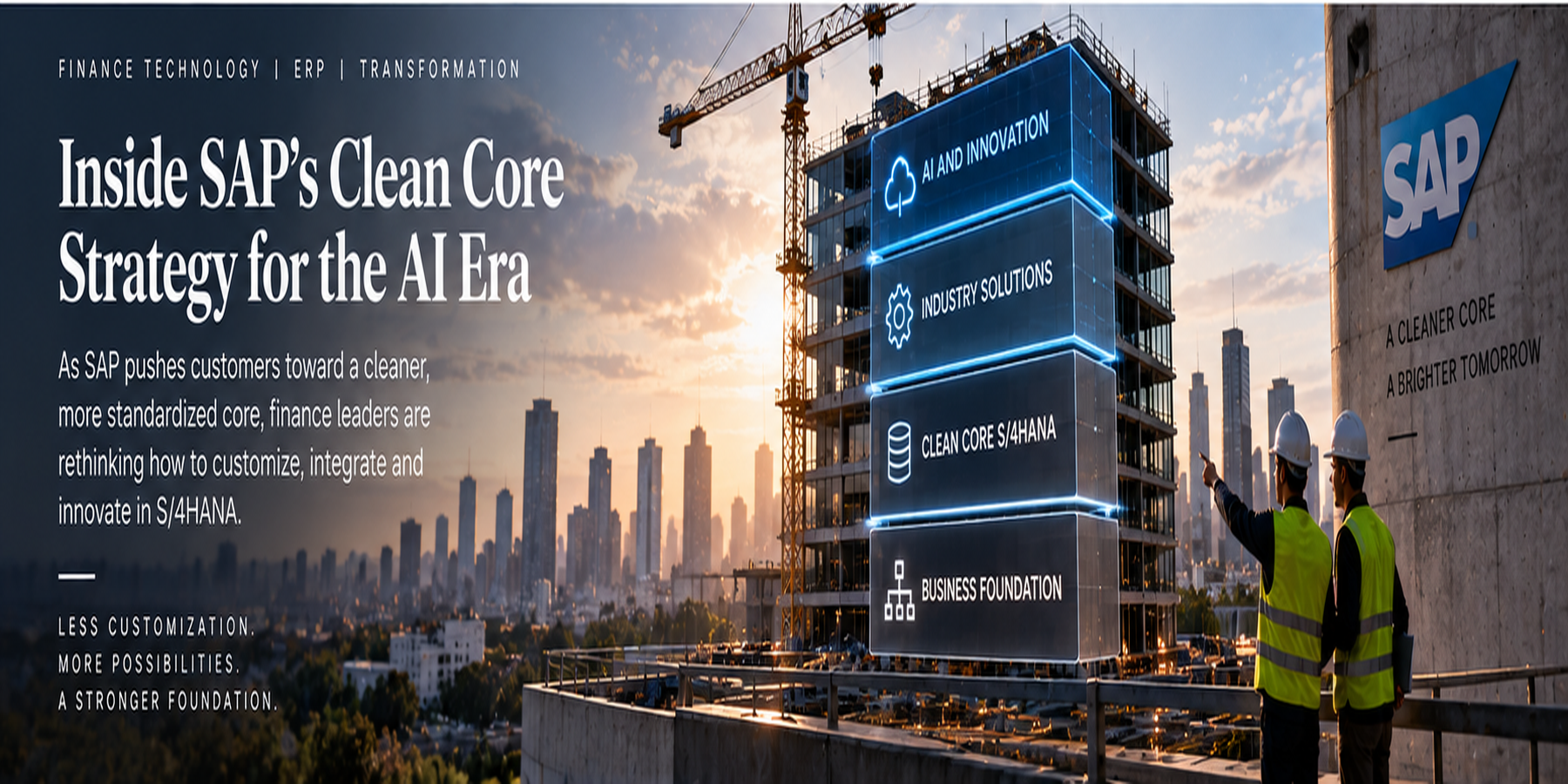
SAP’s Clean-Core Strategy Is Becoming an AI Strategy
SAP Domain Models are trained on SAP code, data, metadata and process knowledge — and are being used to generate clean-core-compliant extensions. Clean core is no longer only about easier upgrades; it is becoming the foundation for governable enterprise AI.
Microsoft Is Moving the Finance Interface Out of the ERP
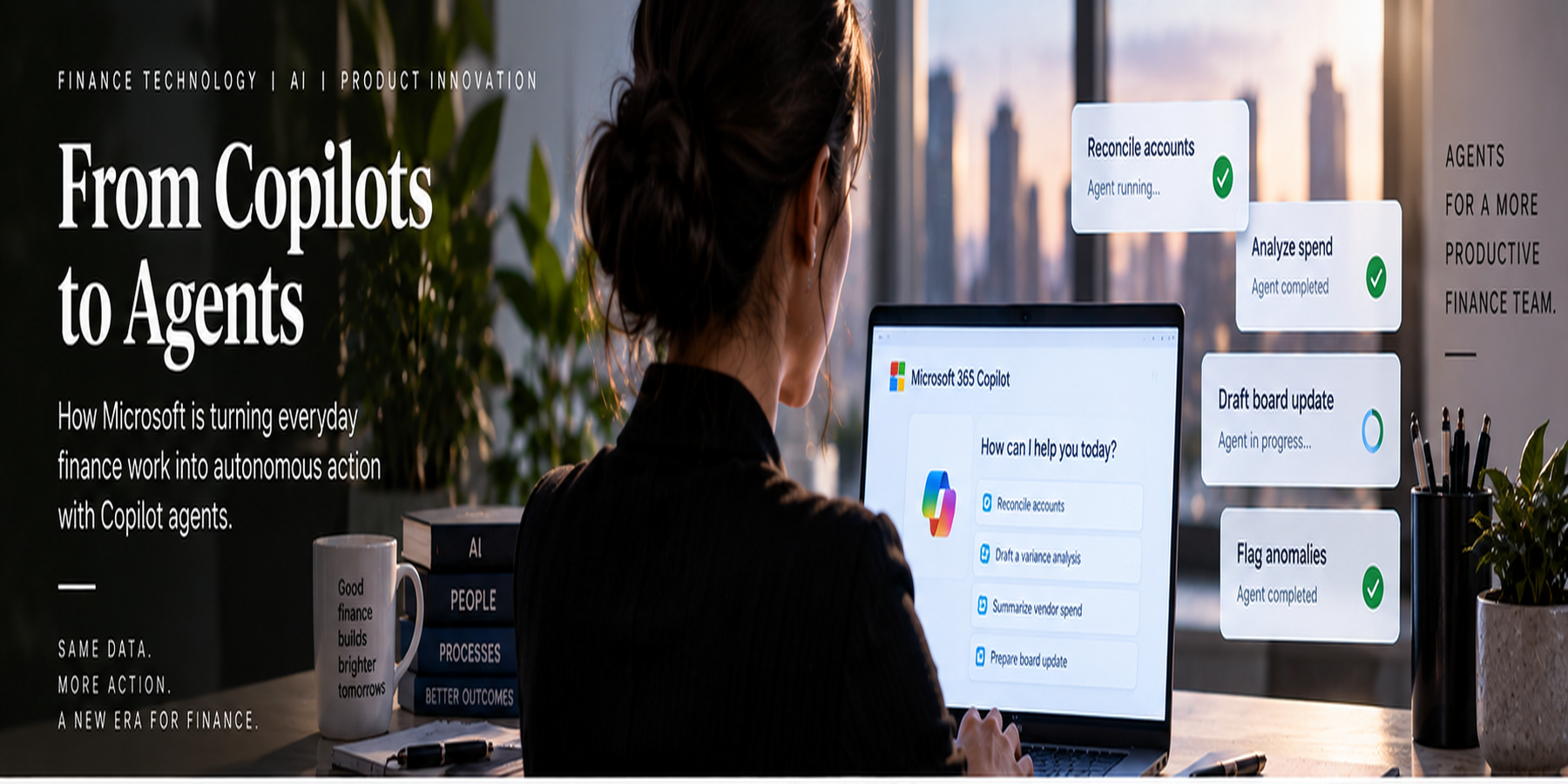
Finance Agent answers AP and AR questions and takes selected ERP actions from inside Copilot, with MCP as the plumbing. The ERP stays the system of record — but may stop being the system of engagement.
The ERP Challenger Is No Longer a Thought Experiment
Replacing a general ledger is never casual. Rillet's 2026 funding and customer growth make AI-native accounting infrastructure a serious product question for finance leaders.
Related across formats
Curated video and audio that share this article's finance topics.
SAP’s Autonomous Finance Vision: What CFOs Should Look For Beyond the AI Demo
SAP
In this SAP Finance Connect keynote, SAP presents how AI assistants and agents could fit into core finance workflows, from accounting and consolidation to planning, billing and payments. As a vendor-hosted keynote, its product capabilities and reported benefits are SAP and participant claims rather than independently verified outcomes.
1Password’s CAO on Where AI Fits in a Well-Run Accounting Team
Senad Mustafic · Chief Accounting Officer, 1Password
Senad Mustafic, Chief Accounting Officer at 1Password, joins Kinter controller Armen Aklian, CPA, for an on-demand fireside chat (The CFO Track) about his path from financial analysis into controllership, how his thinking on AI has changed, and his approach to AI adoption at 1Password.

CFO Weekly
Why Accounting Judgment Still Matters When AI Does the Work
Host Megan Weis and Kerrie Jones, Financial Controller at Peak Living, on why following the correct process doesn’t guarantee a sensible outcome — and how controllers can teach accountants when to question the output, including AI’s. CFO Weekly is produced by Personiv.
CFO Weekly
Editor's PickThe Rise of AI-Driven Finance Teams
A forward-looking discussion on AI agents transforming accounts receivable, the shift from finance operators to finance architects, “headless finance,” and what the CFO function could look like in the next three to five years.