
Treasury, Cash & Banking
The Fed Is on Hold, but Treasury’s Rate Problem Is Getting Harder
The policy rate remains 3.5%–3.75%, yet the 10-year Treasury yield reached 4.78% on September 4 and the 30-year 5.24%. For corporate treasurers, the 2026 problem is no longer simply guessing the next Fed move—it is managing a steeper, more fragmented rate environment across cash, debt and hedging.
For Treasury Analyst · Treasurer · Controller · CFO
Level All Levels
The Federal Reserve did nothing in July.
For corporate treasury, that does not mean rates did nothing.
On July 29, the Federal Open Market Committee kept the federal funds target range at 3.5% to 3.75%. The decision was unusual enough to produce three dissents—all preferring a quarter-point increase. The statement said economic activity was expanding at a solid pace while inflation remained elevated relative to the Fed’s 2% goal.
By September 4, the Treasury curve was sending its own message.
The three-month Treasury yield was 3.91%. The two-year was 4.37%. The 10-year was 4.78%. The 30-year was 5.24%.
For treasurers, the important story is not “higher for longer” as a slogan. It is that short-term policy rates, long-term funding costs and investment yields are no longer moving as one simple trade.
That complicates almost every treasury decision.
The curve is a balance-sheet problem
A corporate treasurer interacts with different parts of the curve at the same time.
Operating cash may sit in overnight deposits, money-market funds or short Treasury instruments. Revolvers and floating-rate debt may price off short-term benchmarks. New bonds price off longer maturities and credit spreads. Pension liabilities, leases and valuation models react elsewhere.
When the curve changes shape, the company can be simultaneously earning more on cash and paying more to refinance debt.
That is exactly why a single “interest rate” assumption is dangerous.
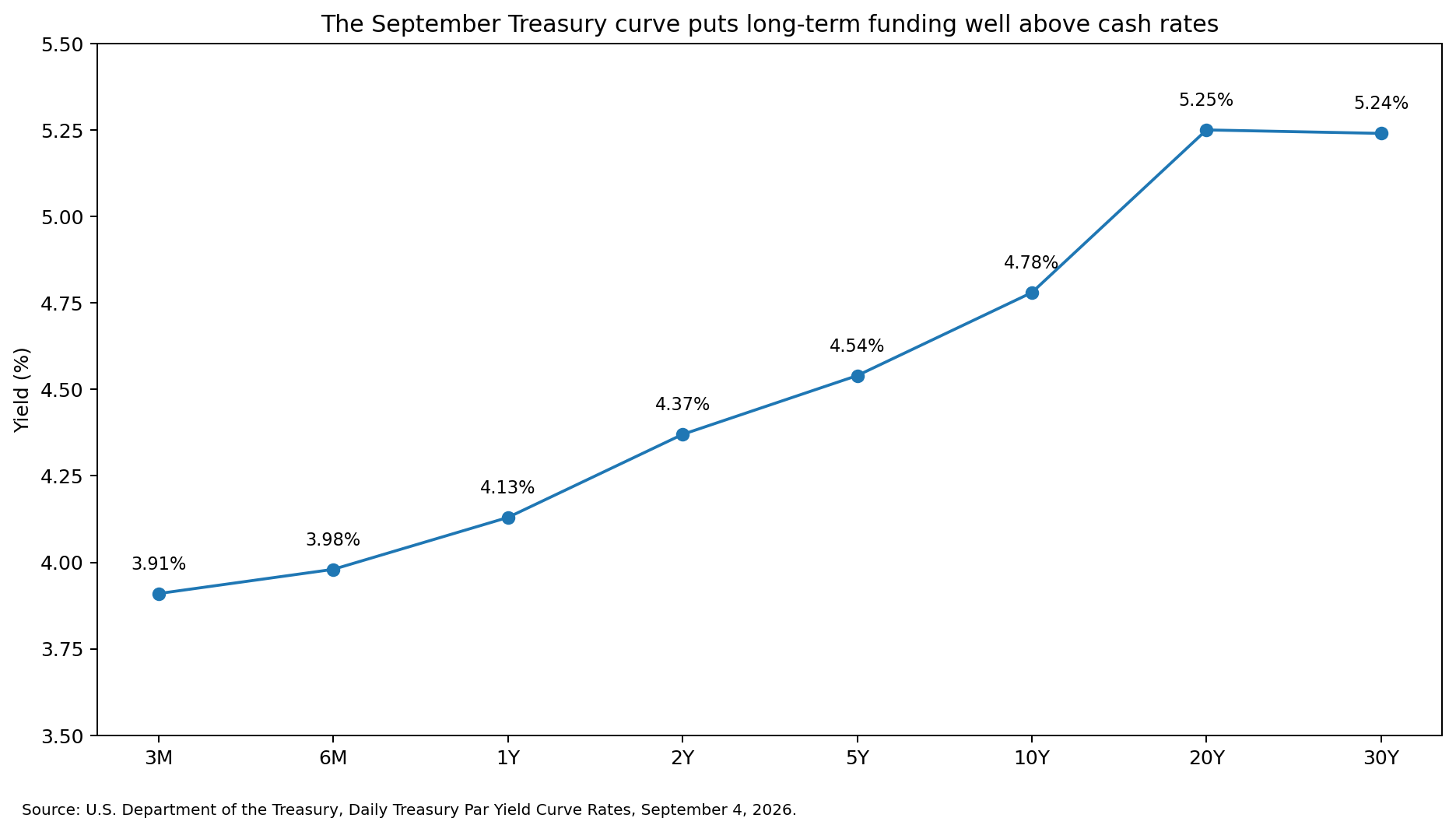
That spread matters even before corporate credit spreads are added.
A CFO looking only at the Fed’s target rate can therefore underestimate the economics of term financing.
The Fed’s own forecast is not a promise
The June Summary of Economic Projections showed a median participant projection of 3.8% for the federal funds rate at the end of 2026, up from 3.4% in the March projection.
The same June projections put median 2026 PCE inflation at 3.6% and core PCE at 3.3%.
Those projections help explain the Fed’s caution. They do not provide treasury with a guaranteed path.
The July vote demonstrated that uncertainty clearly: three policymakers wanted to raise rates rather than hold.
Treasury should treat the dot plot as a scenario input, not a budget rate.
That sounds obvious, but planning processes often collapse a range of possible rate outcomes into one line because the model needs a number.
The better approach is to preserve the range.
Cash is still earning—but duration has value again
High rates created an unusual benefit for cash-rich companies: liquidity became a meaningful earnings contributor.
That remains true.
But the September curve changes the question from “how much can we earn on cash?” to “how much duration should we own?”
Very short instruments preserve flexibility. Longer Treasury maturities offer higher yields but create mark-to-market sensitivity and opportunity cost if rates rise further.
Treasury therefore needs a segmentation model.
Operating cash should prioritize availability and principal protection. Reserve cash can tolerate more duration. Strategic cash may support a longer investment horizon if policy permits.
Blending those pools into one portfolio can create false liquidity.
A company may technically have $1 billion of cash while only a fraction is genuinely available for next week’s payroll, tax or acquisition payment without selling an instrument.
Refinancing is where the curve becomes painful
The other side of the balance sheet is less comfortable.
A company that issued cheap long-term debt several years ago may face a substantial reset when maturities arrive. Even if the Fed eventually cuts short-term rates, long-term yields can remain elevated because they reflect inflation expectations, growth, term premium, fiscal supply and investor demand.
That means “wait for the Fed to cut” is not a complete refinancing strategy.
Treasurers should map debt maturities against multiple curves, not one forecast.
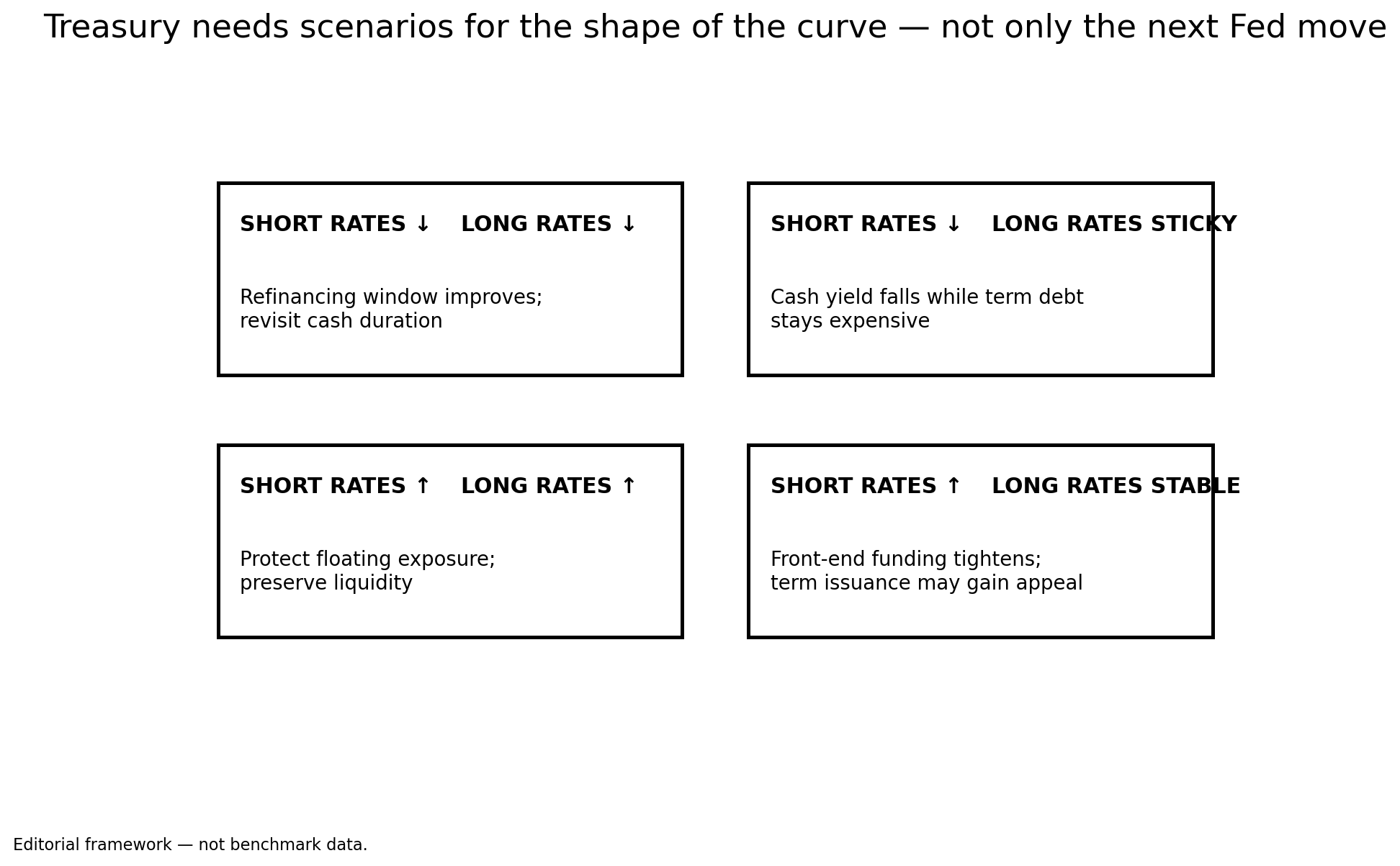
What happens if the policy rate falls 50 basis points but the 10-year stays near current levels? What if both rise? What if recession pulls the curve lower but credit spreads widen?
The company’s refinancing cost depends on the combination.
Floating versus fixed is no longer an ideological choice
Rate environments often produce simplistic advice.
When rates are expected to fall, stay floating. When rates are expected to rise, fix.
Corporate treasury cannot operate that cleanly.
The decision depends on leverage, covenant headroom, cash-flow volatility, debt maturity, hedge accounting, acquisition plans and the company’s ability to absorb an adverse move.
A floating-rate borrower may benefit if short rates decline, but it also exposes interest expense directly to policy surprises. A fixed-rate borrower gains certainty but can lock in a high coupon.
The right hedge ratio is therefore a risk-budget decision.
Finance should ask how much earnings and free cash flow can move before the company’s strategic choices become constrained.
Then hedge to protect that capacity.
The three dissenters matter for scenario design
The July FOMC decision passed 9–3, with Beth Hammack, Neel Kashkari and Lorie Logan preferring a 25-basis-point increase.
For treasury teams, the point is not to predict which camp will win.
It is to recognize that an upside-rate scenario is not theoretical.
The June median policy projection had already moved higher from March. July produced multiple votes for a hike. Long yields were above short yields by early September.
A treasury plan containing only “base” and “cuts” scenarios is therefore incomplete.
At minimum, finance should model a renewed tightening case.
Treasury and FP&A need the same rate architecture
Interest rates often enter planning in several disconnected places.
FP&A models interest expense. Treasury forecasts cash and debt. Tax models deductibility. Accounting handles hedge treatment. Business units may model customer financing or lease economics separately.
That fragmentation becomes expensive when the curve is volatile.
The organization should use a common rate architecture: the same market curve date, the same base scenarios and clearly documented adjustments for credit spreads, deposit betas and hedge positions.
Otherwise the company can produce a budget in which cash earns one assumed rate while debt costs are derived from an inconsistent market view.
The numbers may each look reasonable.
Together they are not.
Deposit beta deserves CFO attention
Not every dollar of short-term rate movement reaches corporate deposits.
Banks price deposits according to relationship economics, balance-sheet needs and product structure. The rate a company earns may move differently from Treasury bills or the federal funds rate.
That creates another scenario variable: deposit beta.
A treasury team forecasting interest income should not automatically apply the Fed path one-for-one to bank deposits.
The same principle applies to borrowing. Corporate spreads can move independently of Treasury yields.
The company’s actual rate exposure is therefore a set of basis relationships, not just a benchmark.
The KPI is resilience to the wrong forecast
Treasurers are paid to have views on markets.
They are not paid to bet the company on being right.
The quality of a 2026 rate strategy should be judged by how the balance sheet behaves when the forecast is wrong.
Can the company refinance if long rates remain above 5%? Does a 50-basis-point increase materially change earnings? Is enough cash liquid if attractive yields encourage the portfolio to extend duration? Can hedges be unwound without creating a liquidity problem? Does the company have maturity concentration in a single year?
Those are controllable questions.
The next Fed decision is not.
“On hold” is not a stable environment
The Fed’s July decision can look like a pause.
For treasury, the environment is anything but static.
Short-term rates remain restrictive. The June projections moved the expected policy path higher. The July committee contained three votes for a hike. Long Treasury yields entered September materially above short yields.
That combination makes cash valuable, refinancing expensive and rate forecasting unusually consequential.
The correct response is not to make a more confident prediction.
It is to build a balance sheet that needs less confidence.
Treasury’s advantage comes from optionality: diversified maturities, explicit liquidity buckets, measured duration, disciplined hedging and scenarios that acknowledge both cuts and renewed tightening.
The Fed can stay on hold.
Treasury cannot.
Key takeaways
- For Treasury teams
- Replace the single rate assumption with a curve: segment cash into operating, reserve and strategic pools, and map debt maturities against multiple curve shapes rather than one forecast.
- For FP&A
- Use one rate architecture across interest expense, cash, tax and hedge models — same curve date, same scenarios, documented adjustments for spreads and deposit betas.
- For CFOs
- Judge rate strategy by resilience to being wrong: refinancing capacity above 5% long yields, earnings sensitivity to +50bp, genuine liquidity and no single-year maturity concentration.
Sources & further reading
- Federal ReserveFOMC statement, July 29, 2026Target range held at 3.5%–3.75%; 9–3 vote with three dissents preferring a 25bp increase
- Federal ReserveSummary of Economic Projections, June 17, 2026Median end-2026 federal funds rate 3.8% vs 3.4% in March; 2026 PCE 3.6%, core PCE 3.3%
- U.S. Department of the TreasuryDaily Treasury Par Yield Curve RatesSeptember 4, 2026 — 3M 3.91%, 2Y 4.37%, 10Y 4.78%, 20Y 5.25%, 30Y 5.24%
Policy and market figures are taken from Federal Reserve and U.S. Treasury primary sources. Fed projections are identified as projections, not commitments. Scenario and hedging guidance is editorial analysis, not benchmark data. No information published after September 6, 2026 is used and no quotes are invented.
- Topics
- Treasury, Cash & Banking
- For
- Treasury Analyst · Treasurer · Controller · CFO
- Level
- All Levels

About the author
Ethan ColeTreasury & Payments Correspondent
Ethan covers corporate treasury, cash management and banking, with a focus on the technologies and practices changing how finance teams manage liquidity, payments and financial risk.
The Finance Observer content is for informational purposes only and is not professional financial, tax, legal or investment advice.
Related reading

The Always-On Treasury Is Arriving. Cash Management Was Not Designed for It.
FedNow settled almost five million payments in Q2 2026, up 83%, and the network limit is now $10 million. The real prize is not faster vendor payments — it is rethinking prefunding, liquidity buffers and controls.

Treasury Is Becoming a Real-Time Control System
Corporate treasury is moving toward connected bank data, continuous cash visibility and AI-assisted forecasting — but faster information makes controls more important, not less.

Payments Fraud Is High. Recovery Is Getting Harder.
Fraud attempts stayed near record levels in AFP’s 2025 benchmark, but strong recovery became far less common — shifting treasury’s control case toward verification, response speed and recoverability.
Related across formats
Curated video and audio that share this article's finance topics.

TreasuryCast
Bank Guarantees Are Still Stuck in Spreadsheets. Treasury Has a Visibility Problem.
Recorded at Treasury 360° Europe, host Eleanor Hill and Surecomp’s Head of Product Achraf Abourida on how fragmented bank portals and spreadsheets obscure guarantee obligations across entities. The guest represents Surecomp, a trade finance technology provider. TreasuryCast is published by TMI.
TreasuryCast
Tokenised Deposits Move From Banking Experiment to Treasury Operations
Host Eleanor Hill with Ant International’s Kelvin Li and HSBC’s Selene Chong and Lewis Sun on using HSBC’s Tokenised Deposit Service to move liquidity between group entities. The speakers represent the provider and its customer; operational benefits are their claims. TreasuryCast is published by TMI.