
AI & Automation
A Finance Team’s First 90 Days With AI
A practical operating playbook for moving from scattered experiments to governed, repeatable finance workflows.
For Financial Analyst · Accounting Manager · Controller · Finance Operations · CFO
Level All Levels

The Problem Is No Longer Finding an AI Use Case
By late 2025, finance leaders did not need another list of things generative AI might someday do. They needed an operating method for deciding what should move from experiment to repeatable workflow.
McKinsey reported in November 2025 that 44% of CFO respondents were using generative AI for more than five use cases, up from 7% in the prior-year survey. Sixty-five percent said their organizations would increase generative-AI investment in 2025.
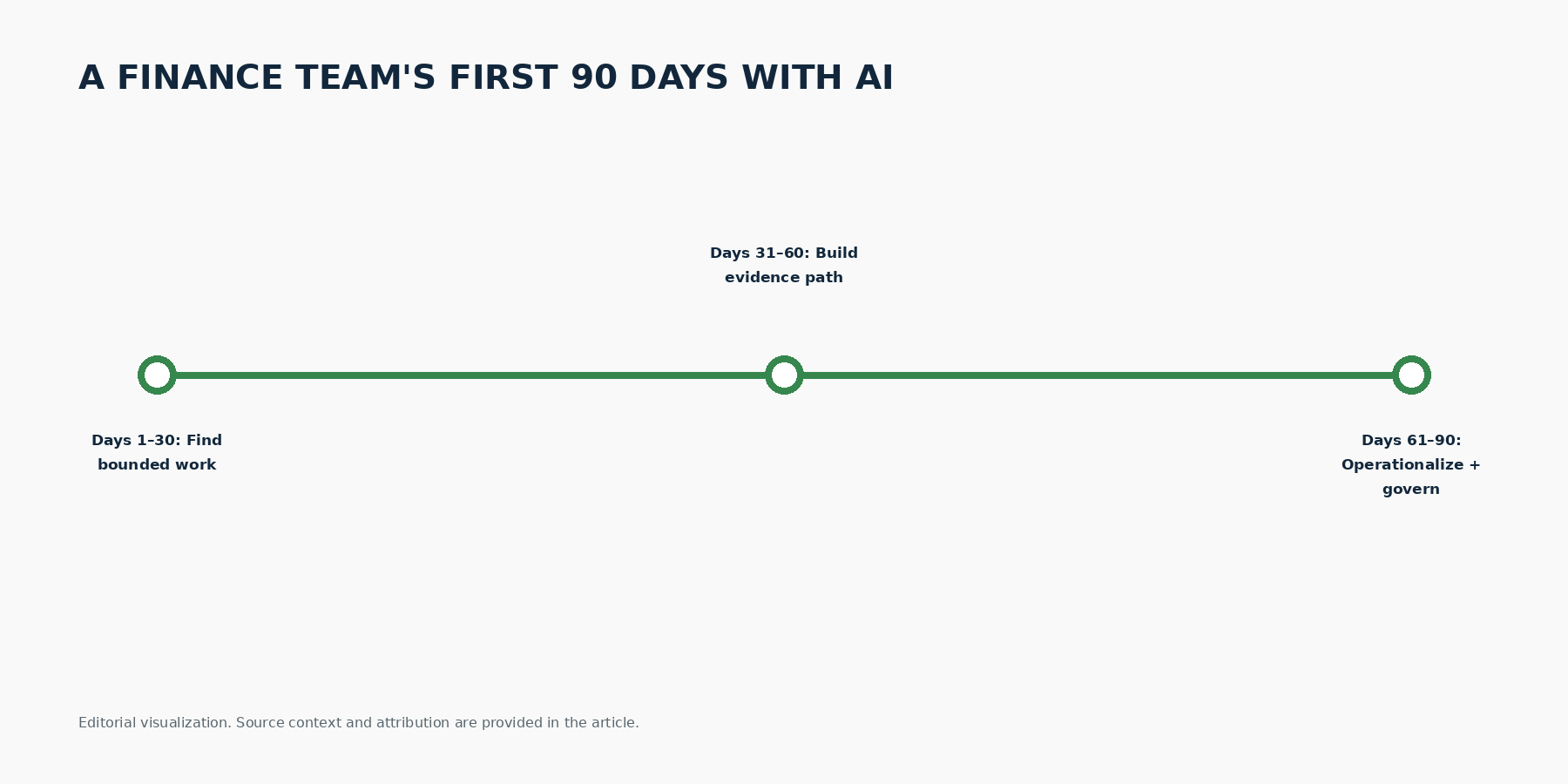
Days 1–30: Find Work, Not Technology
Start with a workflow inventory. Ask analysts and managers where they repeatedly copy information, reconcile versions, search for context, draft recurring commentary or answer the same questions.
Score each workflow on frequency, time consumed, financial materiality, data sensitivity, error cost and ease of human review. The best first use cases are frequent enough to matter, bounded enough to test and easy enough to verify.
Days 31–60: Build the Evidence Path
For each selected workflow, define the source data and what counts as an acceptable answer. If AI drafts variance commentary, the reviewer should be able to trace every material statement to financial data. If AI prepares a reconciliation, define tolerances. If AI summarizes a contract, identify clauses requiring human confirmation.
Create a small evaluation set from real historical work. Run the workflow repeatedly and record where it fails.
Days 61–90: Move From Prompt to Process
A useful finance AI workflow needs more than a good prompt. It needs an owner, approved data access, versioned instructions, review rules, an escalation path and a measurable outcome.
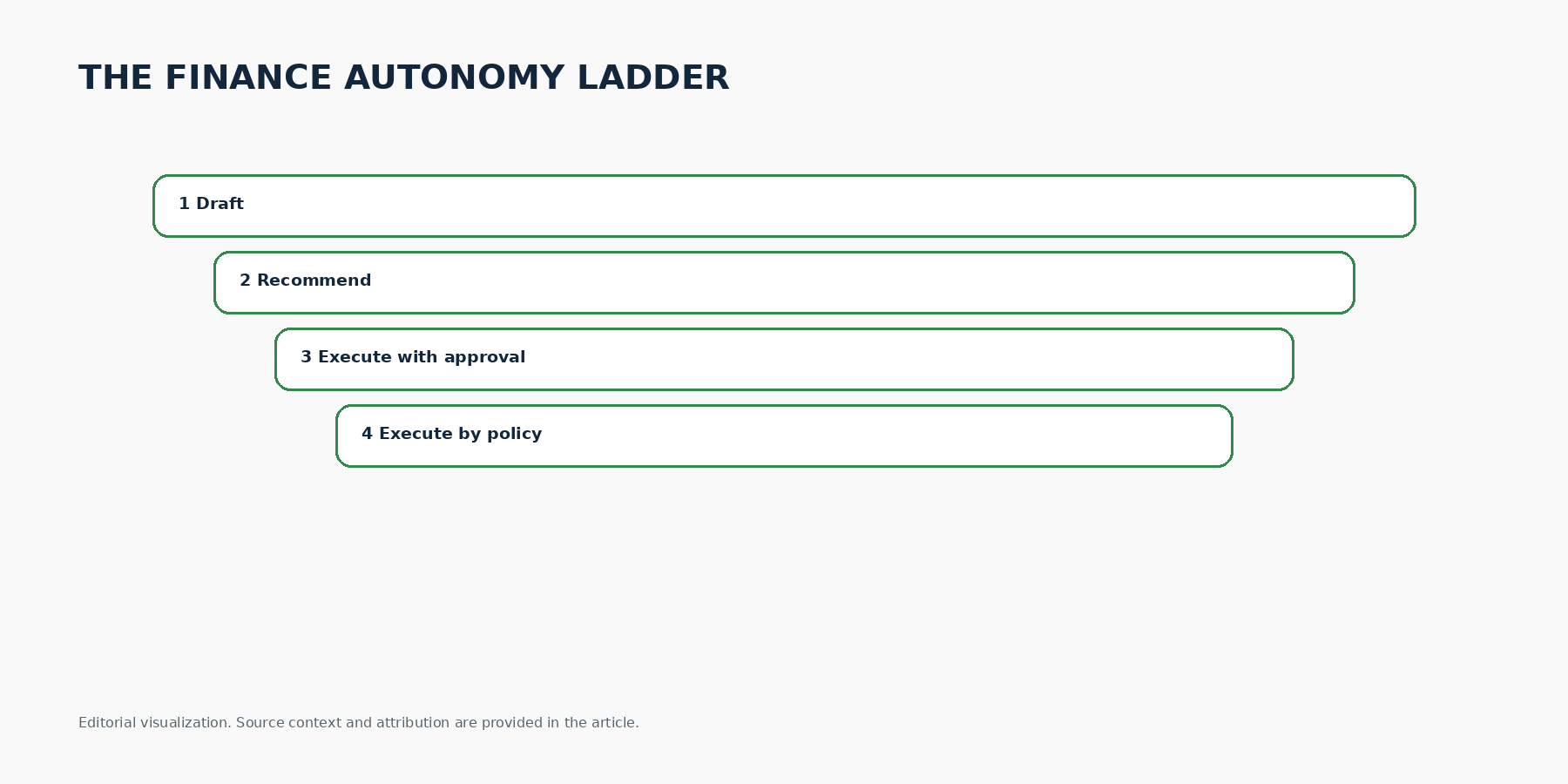
- 01Level 1 — Draft — AI produces content; a person does the work.
- 02Level 2 — Recommend — AI proposes an action; a person approves.
- 03Level 3 — Execute with approval — AI prepares the action; a person releases it.
- 04Level 4 — Execute by policy — AI acts inside predefined thresholds and escalates exceptions.
Not every workflow should reach Level 4.
Measure the Right Thing
Do not measure success by prompts sent or licenses activated. Measure cycle time, manual touches, rework, exception rate, reviewer time, accuracy against an agreed standard and the percentage of outputs traceable to source evidence.
The Human Review Trap
Human-in-the-loop is not automatically safe. If reviewers rubber-stamp hundreds of AI outputs, the control exists on paper but not in practice. Review should be risk-based.
What Every Finance Team Should Document
Who owns the workflow. Which data sources are approved. Which model or tool is used. What the AI may and may not do. How outputs are checked. Where actions are logged. What triggers escalation. How performance is reviewed over time.
The 90-Day Outcome
The goal is not an “AI strategy deck.” It is two or three workflows that the team can run repeatedly, measure, audit and improve. Once that foundation exists, scaling becomes an operating problem rather than a series of experiments.
Verified Facts Used
- McKinsey reported in November 2025 that 44% of surveyed CFOs used generative AI for more than five use cases, up from 7% in its prior-year survey.
- 65% said their organizations would increase generative-AI investment in 2025.
- The 90-day framework in this article is editorial guidance, not benchmark research.
Key takeaways
- For analysts
- Focus on traceability, exception handling and understanding the business process behind the automation.
- For managers
- Measure workflow outcomes, not AI activity. Establish a baseline before rollout.
- For controllers / process owners
- Treat permissions, evidence, change management and audit trails as product requirements.
- For CFOs
- Buy technology for a measurable operating problem. AI capability without reliable data and controls is not transformation.
Sources & further reading
- McKinsey & CompanyHow finance teams are putting AI to work todayNovember 2025
Factual product claims and statistics are limited to information available by the publication date. Vendor-reported metrics are identified as vendor/company-reported rather than independent benchmarks.
- Topics
- AI & Automation
- For
- Financial Analyst · Accounting Manager · Controller · Finance Operations · CFO
- Level
- All Levels

About the author
Daniel BrooksFP&A & Analytics Editor
Daniel covers planning, forecasting and financial analytics, focusing on how finance teams are using better data, technology and new planning methods to improve business decisions.
The Finance Observer content is for informational purposes only and is not professional financial, tax, legal or investment advice.
Related reading

SAP’s Clean-Core Strategy Is Becoming an AI Strategy
SAP Domain Models are trained on SAP code, data, metadata and process knowledge — and are being used to generate clean-core-compliant extensions. Clean core is no longer only about easier upgrades; it is becoming the foundation for governable enterprise AI.
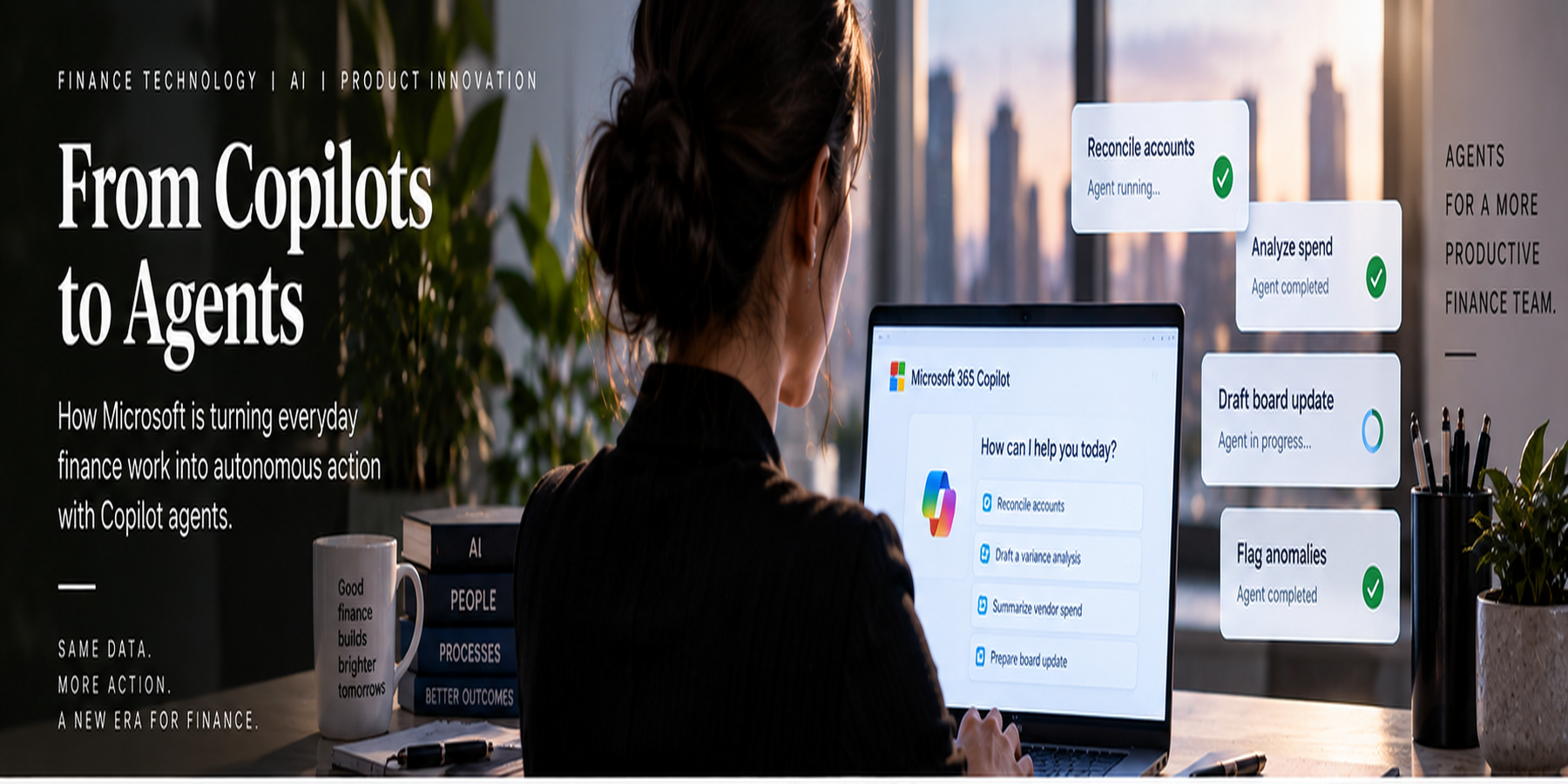
Microsoft Is Moving the Finance Interface Out of the ERP
Finance Agent answers AP and AR questions and takes selected ERP actions from inside Copilot, with MCP as the plumbing. The ERP stays the system of record — but may stop being the system of engagement.
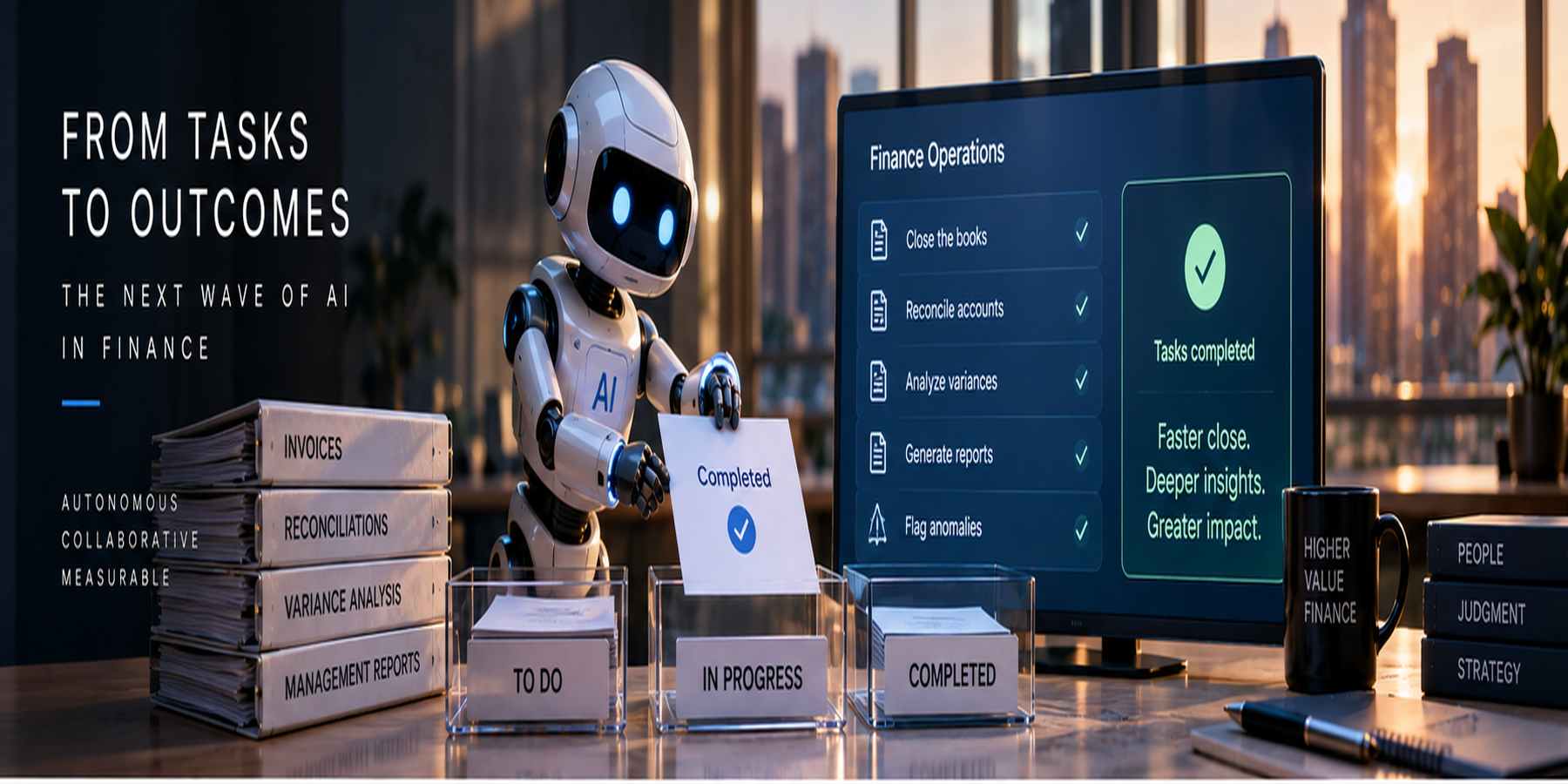
Finance AI Is Moving Up the Value Chain. The Best Returns Are No Longer in Automation.
KPMG’s 2026 study of 1,013 finance leaders finds the strongest reported AI gains in decision speed, decision quality and forecast accuracy — not task elimination. Adoption is now broad; exceptional performance is not.
Related across formats
Curated video and audio that share this article's finance topics.
SAP’s Autonomous Finance Vision: What CFOs Should Look For Beyond the AI Demo
SAP
In this SAP Finance Connect keynote, SAP presents how AI assistants and agents could fit into core finance workflows, from accounting and consolidation to planning, billing and payments. As a vendor-hosted keynote, its product capabilities and reported benefits are SAP and participant claims rather than independently verified outcomes.
1Password’s CAO on Where AI Fits in a Well-Run Accounting Team
Senad Mustafic · Chief Accounting Officer, 1Password
Senad Mustafic, Chief Accounting Officer at 1Password, joins Kinter controller Armen Aklian, CPA, for an on-demand fireside chat (The CFO Track) about his path from financial analysis into controllership, how his thinking on AI has changed, and his approach to AI adoption at 1Password.

CFO Weekly
Why Accounting Judgment Still Matters When AI Does the Work
Host Megan Weis and Kerrie Jones, Financial Controller at Peak Living, on why following the correct process doesn’t guarantee a sensible outcome — and how controllers can teach accountants when to question the output, including AI’s. CFO Weekly is produced by Personiv.
CFO Weekly
Editor's PickThe Rise of AI-Driven Finance Teams
A forward-looking discussion on AI agents transforming accounts receivable, the shift from finance operators to finance architects, “headless finance,” and what the CFO function could look like in the next three to five years.