
FP&A, Planning & Analytics
Most Finance Teams Still Don’t Do Structured Scenario Planning. That Is Becoming Expensive.
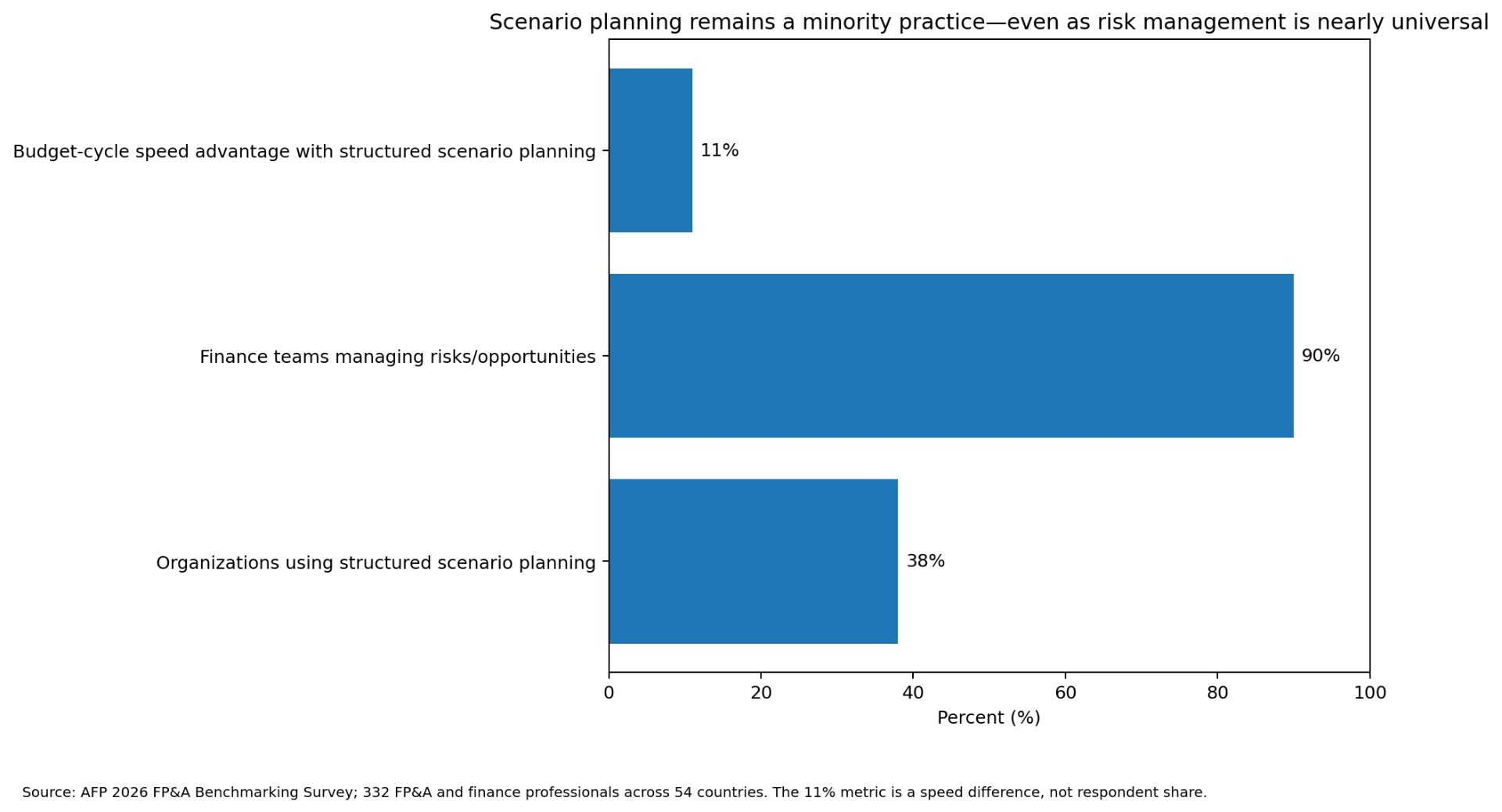
AFP’s 2026 global FP&A benchmark finds only 38% of organizations use structured scenario planning. Those that do finish budgets 11% faster, while the average budgeting cycle across the survey still sits near nine weeks. The planning gap is no longer about whether companies own an EPM tool—it is whether finance has built a repeatable decision system.
For FP&A Analyst · FP&A Leader · VP Finance · CFO · Financial Analyst
Level All Levels

Finance has spent years buying planning technology.
The planning process has not become proportionately faster.
The Association for Financial Professionals’ 2026 FP&A Benchmarking Survey, based on 332 FP&A and finance professionals across 54 countries, found that the average budgeting cycle still takes nearly nine weeks—essentially unchanged over three years.
That is striking because planning software is now widespread, data platforms are faster and AI can generate scenarios in seconds.
The constraint increasingly sits elsewhere.
Only 38% of organizations in AFP’s survey use structured scenario planning. Yet organizations that do use it complete budgets 11% faster on average and report stronger effectiveness across planning dimensions.
The important finding is not that scenario planning is useful. Finance leaders already know that.
It is that structured scenario planning remains a minority practice even after several years in which volatility repeatedly invalidated annual assumptions.
The planning problem in 2026 is not a lack of scenarios.
It is a lack of operating discipline around them.
Nine weeks is a process signal
A budget taking nearly nine weeks does not necessarily mean the finance team is inefficient.
Large companies have real complexity: entities, currencies, business units, allocations, workforce plans, capital requests and management review.
But a cycle that has not materially shortened despite new tools should force a harder question.
Where is the time actually going?
Often it is not calculation.
It is waiting.
Waiting for business inputs. Waiting for assumptions to be agreed. Waiting for managers to reconcile different versions. Waiting for leadership to decide which trade-off it prefers. Waiting for finance to repair data.
Technology can accelerate computation while leaving those queues untouched.
That is why integrated planning is an operating-model topic, not merely an EPM topic.
Scenario planning works when it is structured
Many organizations can produce an upside and downside case.
That is not the same as structured scenario planning.
A structured process defines the variables that matter, the relationships among them, the cadence for refreshing them and the decisions attached to changes.
A retailer might define scenarios around traffic, conversion, wage inflation and inventory availability. A manufacturer may focus on volume, energy, FX and input costs. A subscription company may use bookings, churn, pricing and headcount.
The value comes from consistency.
Management knows what changed, why it changed and which action is implied.
AFP’s data suggest that organizations with this discipline move through budgeting faster.
That does not prove scenario planning alone causes the speed advantage. More mature finance functions may be better at several planning practices simultaneously.
But the association is directionally important.
Risk is being discussed more than it is integrated
AFP reports that 90% of finance teams manage risks and opportunities, but fewer formalize those insights into integrated planning processes.
That gap explains a common planning failure.
Risk management produces a list.
Planning produces a forecast.
The two meet in a presentation rather than in the model.
A supply disruption may be marked “high risk” without changing inventory assumptions. A tariff risk may appear in the enterprise-risk register without changing sourcing scenarios. A hiring constraint may be discussed by HR without changing the capacity plan.
Integrated planning requires risks to have financial mechanics.
What variable changes? By how much? When? What second-order effects follow? What action becomes available?
Without that translation, risk management remains adjacent to planning.
Executive alignment is not enough
AFP says budget alignment is strongest at the executive level, while horizontal and operational alignment lag.
This is a subtle but important finding.
Leadership can agree on strategy while functions still plan against incompatible assumptions.
Sales assumes a launch in April. Operations assumes June. HR plans hiring against a third volume curve. Procurement uses last year’s demand profile. Finance reconciles the contradictions late in the cycle.
The budget can eventually balance.
The organization is not integrated.
That is why the best integrated-planning work often happens below the executive layer.
Finance has to create common drivers that sales, operations, HR and procurement can actually use.
Planning technology has not eliminated planning friction
AFP explicitly notes that investments in planning technology have not yet delivered the expected efficiency gains for many organizations.
That should not be read as an indictment of EPM software.
Tools can centralize data, control versions, automate calculations and improve workflow.
They cannot decide the business’s assumptions.
They cannot resolve unclear accountability.
They cannot force one function to use another function’s driver.
A company can reproduce a dysfunctional spreadsheet process inside a sophisticated platform.
The screens improve.
The planning logic does not.
Finance should measure planning latency
Budget duration is useful but blunt.
A better transformation program decomposes planning latency.
How long from actuals becoming available to the first forecast?
How long does a business unit take to submit assumptions?
How long between a material market change and an updated scenario?
How many days are spent in executive review?
How many forecast versions are created because assumptions change asynchronously?
Those measures identify where the cycle is slow.
They also distinguish useful deliberation from administrative delay.
The most important artifact may be the assumption registry
Finance teams often maintain detailed models but weak records of assumptions.
A practical integrated-planning system should make assumptions first-class objects.
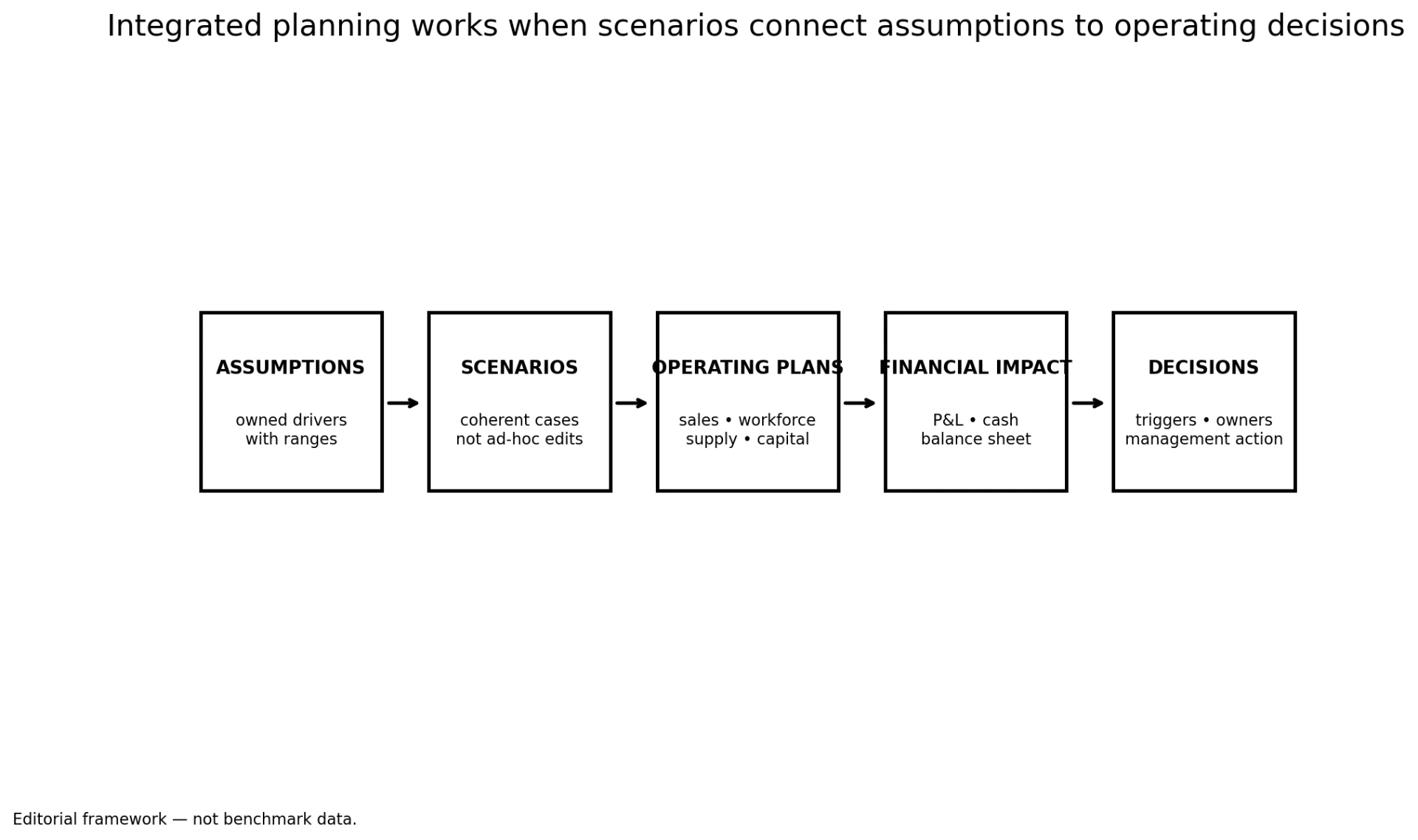
For each material driver, record the current value, owner, source, refresh cadence, scenario range and downstream models affected.
That creates a common language.
If FX changes, finance knows which forecasts update.
If headcount timing moves, operating plans can react.
If demand weakens, inventory and cash scenarios change with it.
The assumption registry is less glamorous than an AI forecasting engine.
It may be more useful.
AI makes process discipline more valuable, not less
Generative AI can make scenario creation dramatically easier.
That creates a new risk: scenario abundance.
Finance can generate dozens of cases without improving a single decision.
The bottleneck shifts from modeling to governance.
Which scenarios matter? Which assumptions are authoritative? Who can change them? What threshold triggers management action?
AI lowers the cost of analysis.
It does not lower the cost of organizational disagreement.
Structured planning becomes more important precisely because scenario generation becomes easier.
High-performing FP&A is becoming cross-functional infrastructure
The AFP report describes FP&A roles expanding beyond finance into strategy, technology, operations and leadership.
That makes sense.
Integrated planning is fundamentally a coordination problem.
Finance sits at the intersection because it can translate operational drivers into revenue, cost, cash and capital.
The function’s value is not owning every plan.
It is making the plans connect.
That requires different skills from traditional budgeting: facilitation, data architecture, business modeling and the ability to challenge assumptions without turning planning into a finance-controlled exercise.
A practical maturity path
Organizations do not need to build a fully integrated planning architecture at once.
Start with one decision where disconnected planning creates real cost.
For example: workforce capacity, inventory, pricing or capital deployment.
Define the shared drivers.
Create three structured scenarios.
Connect each scenario to the relevant financial statements and operating metrics.
Assign owners to assumptions.
Set a refresh cadence.
Then define the decisions management will take if the scenario moves.
Once that works, extend the model.
This is more likely to create value than launching a company-wide planning transformation with hundreds of metrics and no clear decision use case.
The benchmark is telling finance where the problem moved
The 2026 AFP findings capture an uncomfortable stage in planning modernization.
The tools are better.
The process is still slow.
Risk is widely discussed.
It is not consistently integrated.
Executives can align on strategy.
Operational plans still diverge.
And structured scenario planning—the discipline most suited to a volatile environment—is used by only 38% of organizations in the survey.
The next improvement in FP&A will not come from producing more forecasts.
It will come from making assumptions, risks, operational plans and management actions part of one repeatable system.
That is what integrated planning is supposed to mean.
Key takeaways
- CFO
- Ask for planning latency, not just budget duration: time from actuals to first forecast, time from a material market change to an updated scenario, and days spent in review.
- FP&A Leader
- Stand up an assumption registry before buying more planning capability — owner, current value, source, refresh cadence, scenario range and downstream models for every material driver.
- Finance Operations
- Attach decisions and triggers to each scenario so structured planning ends in management action rather than another version of the model.
Sources & further reading
- Association for Financial Professionals2026 FP&A Benchmarking Survey Report: Integrated PlanningPrimary research — 332 FP&A and finance professionals across 54 countries
- DeloitteFinance Trends 2026Supporting context — 1,300+ global finance leaders; advanced scenario planning and agile governance as leading trends
Associations reported in the AFP survey between structured scenario planning and faster budget cycles are not evidence of causation; more mature finance functions may perform several planning practices well at once. The 11% measure is an average difference in budget completion speed, not a share of respondents. The integrated planning loop is a The Finance Observer editorial framework, not benchmark data. No information published after September 6, 2026 is included.
- For
- FP&A Analyst · FP&A Leader · VP Finance · CFO · Financial Analyst
- Level
- All Levels

About the author
Daniel BrooksFP&A & Analytics Editor
Daniel covers planning, forecasting and financial analytics, focusing on how finance teams are using better data, technology and new planning methods to improve business decisions.
The Finance Observer content is for informational purposes only and is not professional financial, tax, legal or investment advice.
Related reading

FP&A Bought Better Planning Tools. The Budget Still Takes 8.7 Weeks.
AFP’s 2026 benchmark finds the average budget still takes 8.7 weeks despite years of planning-technology investment. The teams reporting faster cycles are the minority that run structured scenario planning.

FP&A Bought More Tools. The Data Problem Got Worse.
AFP’s 2025 benchmark found unreliable and inaccessible data are still FP&A’s biggest technology obstacles, with spreadsheets nearly universal — the next upgrade is the information supply chain, not another application.
The Forecast Is Becoming a Living System
FP&A is moving from periodic forecasting toward a continuously updated view of the business — but spreadsheets, fragmented data and process design still stand in the way.
Related across formats
Curated video and audio that share this article's finance topics.
The CFO Playbook
Editor's PickThe Operator CFO: Turning Growth Ambition Into Margin, Cash and Accountability
Benzinga CFO Robert Checchia, with host David McClelland, explains why finance leaders need to get closer to operations, give P&L owners clearer numbers and connect growth decisions to margin and cash generation — plus prioritization under private-equity ownership and AI experimentation with guardrails.
CFO Thought Leader / Planning Aces
Editor's PickFinance Leaders Decode AI's Promise
Finance leaders explore AI agents for analytics, experimentation and order-to-cash checks, along with reconciliations, data readiness and opportunities to dramatically shorten finance cycle times.